
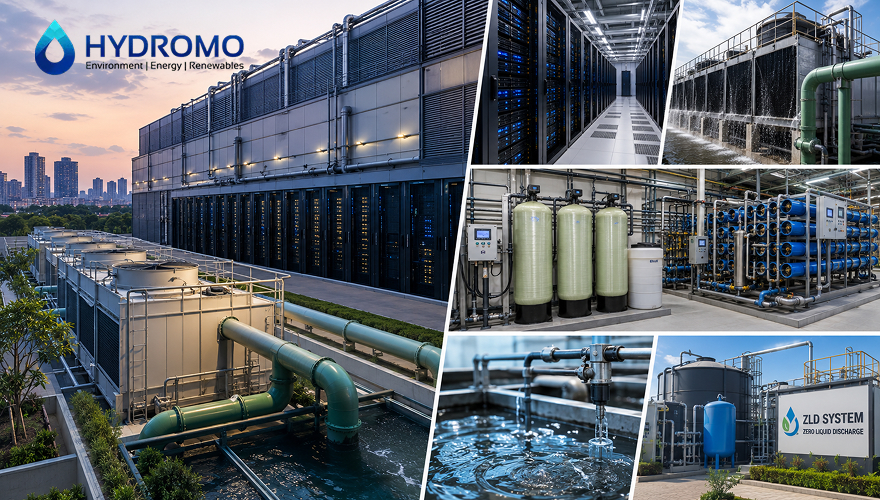
Hyderabad is becoming one of India’s biggest data center hubs. Global cloud providers, hyperscalers, and AI infrastructure companies are setting up shop across the city, drawn by reliable power and a strong tech ecosystem. But behind every rack of servers is a resource that rarely gets discussed: water, specifically water that keeps these facilities from overheating.
As data centers scale up, so does their appetite for cooling, and cooling almost always means water. That’s why industrial water treatment has moved from a back-office concern to a core part of reliability planning.
Why Do Data Centers Need Water Treatment?
Cooling towers and chilled water systems are the backbone of managing server heat, but the water circulating through them isn’t just tap water put straight to work. Untreated water carries dissolved minerals, organic matter, and microorganisms that cause scale formation, corrosion, and biofouling.
Scale insulates heat exchanger surfaces, cutting heat transfer efficiency. Corrosion weakens pipework until it fails. Biofouling, driven by bacteria like Legionella and algae, clogs systems and creates health risks. Treated water that is filtered, softened, and chemically balanced prevents all three and keeps cooling systems running as designed.
How Much Water Do Data Centers Use?
Evaporative cooling towers consume water continuously through evaporation and blowdown, the periodic discharge of concentrated water to prevent mineral buildup. As facilities add higher-density racks and AI training clusters that run hotter than traditional servers, cooling demand and water consumption rise with it.
This growing footprint has put data center cooling systems under scrutiny from local planners in cities like Hyderabad, pushing operators toward smarter water treatment for data centers rather than simply drawing more from local supply.
How Data Center Cooling Works
Most facilities use cooling towers, which reject heat by evaporating a portion of circulating water; chilled water systems, which use a closed loop with chillers; or, increasingly, direct liquid cooling for high-density racks. Whichever method is used, water quality directly affects performance; poor quality means more cleaning, more downtime, and higher costs.
Best Water Treatment System for Data Centers
There’s no single silver bullet; most facilities use a layered approach. Multimedia filters remove suspended solids before water enters the cooling loop. Water softeners strip out hardness-causing calcium and magnesium. Activated carbon filters remove chlorine and organics that could damage membranes downstream.
Where source water has high TDS, an industrial RO plant is often added to produce low-mineral makeup water and cut scaling risk. Chemical dosing then maintains corrosion inhibitors and biocides, while automated monitoring tracks conductivity and pH in real time.
Cooling Tower Water Treatment Process
A typical cooling water treatment system follows filtration, then softening, then, where needed, reverse osmosis. Treated water enters the cooling tower circuit, where chemical dosing handles scale, corrosion, and biocide control. Blowdown removes a controlled portion of concentrated water, replaced with fresh make-up water, while monitoring helps operators fine-tune cycles of concentration to balance water savings against scale risk.
Industrial Water Treatment for AI Data Centers
AI workloads behave differently from traditional computing. GPU clusters training large models generate sustained, high-density heat with little of the idle time typical of conventional servers, so cooling systems work harder and more continuously.
That leaves less margin for error in water chemistry. In Hyderabad, where AI data centers are rising alongside traditional cloud infrastructure, water treatment specialists are increasingly brought into the design phase early, rather than called in to fix problems later.
Water Quality for Data Center Cooling
A few parameters matter most: hardness (calcium and magnesium content), which drives scale; TDS, the overall mineral load; pH, which must stay in a narrow band to avoid scaling and corrosion; and conductivity, a quick proxy for dissolved solids used to track cycles of concentration. Silica deserves special mention, since it forms a hard, difficult-to-remove scale at high concentrations. Microbial counts round out the picture; regular testing and monitoring let teams act before small deviations become expensive failures.
Industrial RO Plant for Cooling Towers
An industrial RO plant removes much of the dissolved mineral content before water enters the cooling loop, reducing scale-forming potential. That allows the system to run at higher cycles of concentration, meaning less blowdown and lower makeup water consumption. It also reduces the load on chemical dosing and extends the gap between descaling cycles for facilities running around the clock; this often pays for itself quickly.
Reducing Water Consumption in Data Centers
The importance of sustainable data centers for water efficiency is gaining momentum as well as energy efficiency. Water recycling, reusing treated wastewater or condensate for cooling makeup, is one of the most direct levers. Optimizing blowdown on a real-time conductivity monitoring schedule instead of a fixed schedule helps to prevent unnecessary waste. It is possible to use condensate from the air handling units as makeup water at relatively low additional costs, and preventive maintenance will ensure that systems will not slowly move toward greater water usage due to fouling up. In larger facilities, the treatment and recycling of virtually all wastewater (nearly 100 percent) can be accomplished by the use of a zero liquid discharge (ZLD) system, but at a higher initial cost.
The facilities that approach data center cooling water treatment intelligently through appropriate filtration, softening, RO, and smart monitoring will be the ones that will keep on operating effectively while also keeping their water footprint under control. Hydromo Engineering provides cooling tower water treatment solutions, customized water-softening systems, and industrial RO plants to industrial and infrastructure clients based on their water quality and load conditions in the city of Hyderabad. When considering or upgrading a data center cooling water system, it’s good to discuss the issue with a water treatment expert early on.
Frequently Asked Questions
1. Why do data centers need water treatment for cooling systems?
Untreated water causes scale, corrosion, and biofouling in cooling towers and heat exchangers, reducing efficiency and raising maintenance costs. Treatment removes minerals, contaminants, and microorganisms, protecting equipment and helping avoid downtime caused by fouled cooling infrastructure.
2. What is the best water treatment system for a data center cooling tower?
Most of the facilities use a multimedia filter along with softening along with chemical dosing and also add an industrial RO plant if the source water has high TDS or hardness. Automated conductivity and pH monitoring maintains consistent water quality throughout the year.
3. How does an industrial RO plant help cooling towers?
Dissolved minerals are filtered out of makeup water by an RO plant, which decreases the potential for scale formation. This allows cooling towers to operate at a higher cycle of concentration, thereby reducing the volume of blowdown, water usage, and the burden on chemical dosing systems.