
If you’ve ever wondered why your tap water sometimes tastes a bit off or leaves white spots on your utensils, the culprit is often TDS—Total Dissolved Solids. In India, especially in places like Hyderabad, where groundwater and municipal supplies vary a lot, checking the water TDS level has become super important for families.
I started looking into this after noticing scale buildup in my kettle. What I found changed how I think about the water we drink every day.
What are Total Dissolved Solids in Water?
Total Dissolved Solids (TDS) is simply the summation of inorganic as well as organic matter that has been dissolved in water. Consider minerals such as calcium, magnesium, sodium, potassium, and salts, chlorides, sulfates, and perhaps traces of metals or other substances.
These solids are natural (weathering of rocks and soils) and man-made (agricultural runoff, sewage, and industrial garbage). TDS is given in parts per million (ppm) or milligrams per liter (mg/L). No more than a little is bad or even evil, and minerals make water taste good and can be good medicine. However, excessive amounts may render water salty or bitter, scale pipes and appliances, and, in the worst-case scenario, may cause concern about whether any dangerous substances are involved.
TDS is not directly a health hazard as per the WHO, but it is a measure of the overall water quality. High TDS is usually an indicator of other problems that should be addressed.
Optimal TDS of Drinking Water
The majority of experts and health organizations concur that the optimal TDS content of drinking water is 50-150 ppm for excellent taste and balanced minerals. In this temperature, water will be chilled, not salty, and it supplies your body with the necessary minerals without flooding your system.
Under 50 ppm: Can be considered flat or empty (as with distilled or over-purified RO water). Others insert mineral cartridges to remineralize it.
150-300 ppm: This is also very good and is generally recommended as ideal to drink on a daily basis.
300-500 ppm: Acceptable and good based on WHO palatability ratings. This is typical of most Indian cities.
The palatability according to the World Health Organization (WHO) is rated as follows:
Under 300 mg/L: Very good.
300-600 mg/L: Good
Above 900 mg/L: Poor to unacceptable (can be bad to scale and cause scaling)
In India, the acceptable limit as laid down by the Bureau of Indian Standards (BIS) IS 10500:2012 is 500 mg/L, and the permissible limit is no more than 2000 mg/L and only when there is no other source. To be healthy and taste good in the long term, it is wiser to remain below 500 ppm.
When your TDS is regularly more than 500-600 ppm, it is time to consider a good RO + UV purifier with a remineralization stage.
what is the range of TDS for drinking water?
A rough practical analysis is
0-50 ppm: Extremely pure, but may not contain minerals—usually using advanced RO.
50-150 ppm: Excellent / Ideal to drink.
150-300 ppm: Ideal ratio of taste and minerals.
300-500 ppm: Good and safe to the majority of people.
500-1000 ppm: Fair—drinkable, but can influence taste and appliances.
Over 1000-1200 ppm: Nice-not very nice—do not use frequently without treatment.
And keep in mind, TDS does not inform you of what is dissolved. High reading may indicate healthy minerals or undesirable salts. TDS checks should be used in combination with other tests whenever possible.
How to check water tds at home?
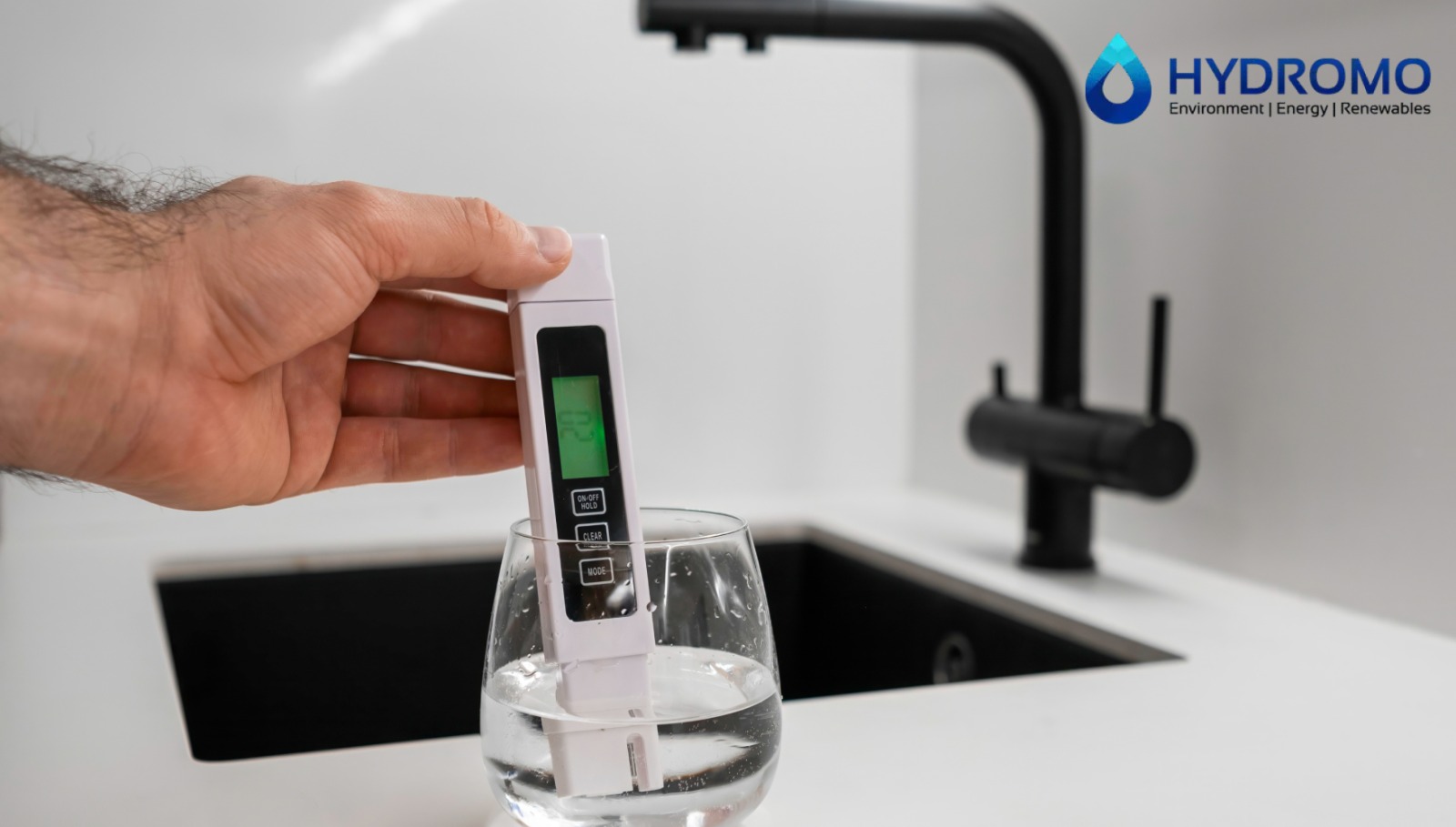
The simplest and most common method is by a digital TDS meter—those inexpensive handheld pens found online at ₹300-800.
Here are the basic step-by-step instructions that you can use:
Purchase a good TDS meter (find one with temperature compensation).
Take the protective cap off and switch ON.
Wet the probe using clean water, and then put it in a glass of your test water (approximately 1-2 inches deep).
Wait 5-10 seconds until the reading is through.
Note the ppm value. Press HOLD if you want to freeze the number.
Rinse the meter again and turn it off.
Test your tap water, RO output, and bottled water for comparison. Do it at room temperature for better accuracy. TDS meters measure electrical conductivity and convert it to ppm—they’re not lab-perfect but great for home monitoring.
If you don’t have a meter, you can send a sample to a local water testing lab, but the meter is perfect for regular checks.
What to do if you have High or low TDS water?
High TDS? Consider Hydromo RO purification followed by remineralization.
When TDS is low, mineral drops might be added to your water. However, before making any changes, it’s always wise to consult an expert on matters concerning water.
Therefore, a premium water treatment plant is necessary, such as Hydromo.
However, remember that TDS is just one indicator of water quality. Other things such as pH values and hardness, must also be considered. Simply contact your local Water Authority if you have any concerns about your drinking water.
Your health matters, so drink clean water!
FAQs
Q1: What are the total dissolved solids in soil and water?
Total dissolved solids (TDS) are all the inorganic minerals and salts as well as the traces of organic matter dissolved in water. Examples of common ones are calcium, magnesium, sodium, and chlorides. It is expressed in ppm and reflects the mineral content of water and the quality of water in general.
Q2: What is optimal TDS in drinking water?
The optimal TDS content of drinking water is typically 50-150 ppm. This variety is very tasty, has necessary minerals, and does not have the problem of flatness or scaling. Most specialists believe that 150-300ppm is ideal as well.
Q3: What is the method of checking the water TDS at home?
Measure with a digital TDS meter. Switch it on, insert the probe in a glass of water, allow the reading to stabilize (a few seconds), and record the value of the ppm. It is fast, cheap, and can be used in the home frequently.
Q4: What is the drinking water range TDS?
The recommended and safe range of drinking water TDS is 50-500 ppm. BIS tolerates up to 500 mg/L, and WHO believes that less than 600 mg/L is good to taste. A concentration of above 1000 ppm is not generally desirable in the absence of treatment.
Q5: Is high TDS water dangerous to drink?
It is not necessarily detrimental, but high TDS (more than 500-1000 ppm) will produce a bad taste and scaling in the appliances and can indicate the presence of potentially unpleasant salts or contaminants. A flat taste and the lack of beneficial minerals can also be experienced in very low TDS.