
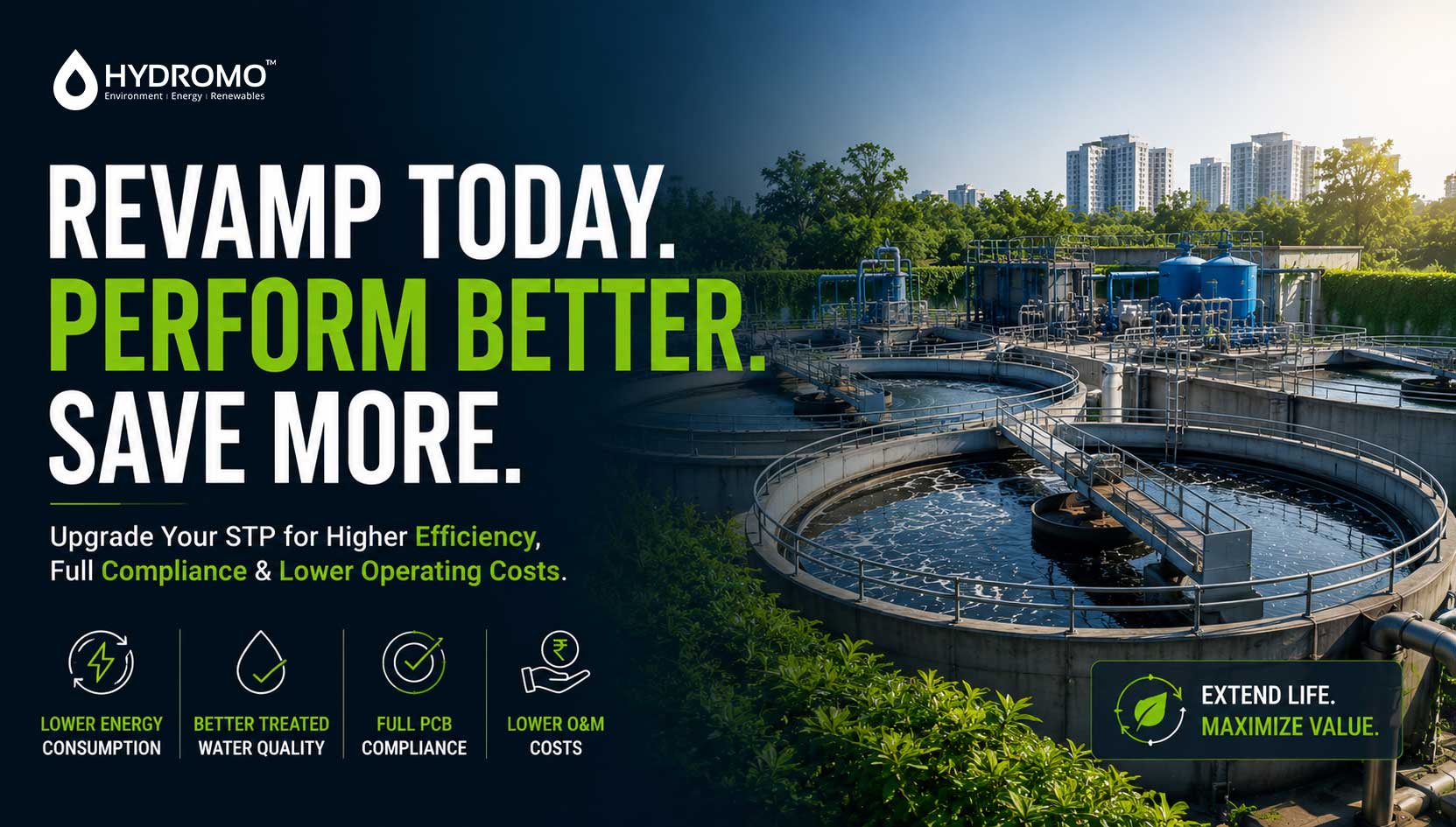
A high-rise apartment complex spends close to ₹15 lakh a year running its sewage treatment plant. Residents still complain about foul odors near the clubhouse. The treated water fails quality checks every few months. Electricity bills keep climbing. Now there’s a notice on the facility manager’s desk from the Pollution Control Board. The instinctive reaction is to tear the plant out and build a new one. But in most cases we’ve seen, across apartments and high-rise residential complexes, hotels, hospitals, commercial buildings, and industrial units, a well-planned STP revamp fixes the same problems for a fraction of the cost.
An STP revamp upgrades the aeration, automation, and treatment parts of an existing sewage treatment plant. The civil structure stays as it is. This restores treated water quality, cuts power and chemical costs, and brings the plant back into compliance. It usually costs 40–60% less than a new STP. In many cases, the plant can keep running while the work happens.
This is the reality for more and more residential and commercial properties across India. Occupancy and wastewater loads have grown well past what many STPs were originally designed for a decade or more ago.
Why So Many STPs Are Struggling Right Now
It isn’t just one property having a bad year. A few things are happening at once, across apartment communities, commercial buildings, and industrial facilities alike:
- Freshwater is getting expensive. Properties that once ignored treated water reuse now need it to work reliably for flushing and landscaping.
- Occupancy has grown. Apartment towers have added residents, and commercial and industrial facilities have scaled up operations since their STPs were first built. Many plants are now well past their designed capacity.
- Good O&M staff are hard to keep. Plants that need constant manual tuning struggle when operators change.
- Old equipment is quietly costing money. Aging blowers, diffusers, and pumps eat into electricity budgets long before they actually break down.
- PCB checks have gotten stricter. Treated water that would have passed inspection five years ago may not meet today’s standard.
None of these problems announce themselves loudly. A slightly higher BOD reading here, a slightly louder blower there. Slowly, the plant reaches a state everyone assumes is unfixable without a full rebuild. Often, it isn’t.
Why Existing STPs Actually Fail
Every plant is different. But the root causes we see on site visits repeat themselves:
- Capacity overload. The plant was sized for 300 flats. It’s now serving 500.
- Outdated blowers and worn diffusers. Aeration efficiency drops. The biological process struggles, even though the tanks look fine.
- Wrong technology at the time of installation. Some early SBR or MBBR designs simply weren’t matched to the actual wastewater load.
- Poor operation and maintenance. Inconsistent dosing, irregular sludge removal, no one tracking oxygen levels.
- No online monitoring. Problems are only caught after a PCB inspection flags them, not in real time.
- Sludge handling bottlenecks. Drying beds or filter presses that can’t keep pace with the sludge being generated.
- Inefficient pumps. Older pumps draw far more power than a modern one for the same flow.
Each of these seems minor on its own. Together, they explain almost every “STP not performing” complaint we investigate.
What an STP Revamp Actually Involves
A revamp isn’t one single fix. It’s a targeted set of upgrades, chosen based on what your specific plant needs. Depending on the assessment, this can include:
- Upgrading the aeration system with energy-efficient blowers and fine-bubble diffusers
- Adding PLC and SCADA-based automation so the plant runs on real data, not guesswork
- Installing online monitoring for parameters like DO, pH, and flow
- Improving sludge management, including dewatering upgrades
- Adding odour control measures at tanks and sludge handling points
- Introducing tertiary treatment or UF/RO for higher-quality reuse water
- Replacing pumps with energy-efficient models
- Targeted civil modifications to correct hydraulic short-circuiting or add capacity
- Smart sensors for early warning before a parameter drifts out of range
The goal is always the same: get the existing civil structure, usually the most expensive part of the plant, working at its full potential again.
Existing STP vs. STP Revamp vs. New STP
| Factor | Existing (Untouched) STP | STP Revamp | New STP |
| Upfront Cost | None, but rising hidden costs | Moderate (40–60% of new build) | High |
| Downtime | N/A (but frequent breakdowns) | Low to moderate; often phased | High (full shutdown likely) |
| PCB Compliance | Often at risk | Restored, with monitoring | Fully compliant from day one |
| Treated Water Quality | Inconsistent | Significantly improved | Best, but at a premium |
| Operating Cost | High and rising | Reduced (energy, chemicals) | Optimized, but higher capex to recover |
| Electricity Consumption | High (old blowers/pumps) | Reduced with efficient equipment | Lowest, if designed well |
| Civil Structure Reuse | N/A | Yes, largely retained | No, rebuilt |
| Typical Lifespan Extension | Declining performance | 8–12 years with proper O&M | 15–20 years |
| ROI Timeline | N/A | Faster, lower investment | Slower, higher investment |
The Business Case: What You Actually Get
Set the technical details aside for a moment. Here’s what a well-executed revamp tends to deliver:
- Lower electricity bills, from efficient blowers, pumps, and motors
- Less chemical use, through better process control
- Treated water that consistently meets reuse standards
- Less dependence on tanker or municipal freshwater
- Stronger standing with the Pollution Control Board
- Fewer emergency maintenance calls and lower upkeep over time
- A stronger ESG and sustainability story for the property
- Better resale or leasing value
One honest note: results vary by plant condition. A revamp isn’t a guarantee of zero future issues. What it reliably does is fix the specific root causes a proper assessment identifies.
Compliance: What You Need to Keep in Mind
Sewage treatment in India is governed by CPCB (Central Pollution Control Board) guidelines, with enforcement handled by the respective state pollution control board. Treated water, whether discharged or reused, is expected to meet set quality standards. Properties are generally expected to keep regular monitoring records for inspection.
Requirements can vary by property type, discharge point, reuse application, and state. They also get updated over time. This article is meant to give you context, not compliance advice. Always check current, project-specific requirements with your state pollution control board or a qualified consultant before finalizing any upgrade plan.
Common Mistakes Property Owners Make
- Ignoring early warning signs. A slight odor or a minor PCB remark gets dismissed until it’s a bigger problem.
- Delaying the upgrade for years. Inefficiency just keeps compounding.
- Only replacing pumps. Aeration and automation get left untouched.
- Skipping preventive maintenance, even right after an upgrade.
- Choosing the wrong technology for the actual wastewater load.
- Treating automation as optional when it’s often what keeps a plant consistent.
- Continuing poor O&M habits, even with brand-new equipment.
- Using low-quality components to save on upfront cost.
- Skipping the performance assessment and guessing at what to fix.
Expert Insight from Hydromo
A revamp makes more sense than a full replacement when the civil structure is sound, and the real issue is aeration, automation, or equipment efficiency, not the basic design capacity. If a plant is undersized by more than roughly 40–50% for current occupancy, or the civil work itself has deteriorated, a new build may genuinely be the better long-term investment. The only way to know for sure is a proper plant performance assessment. Not a guess based on how the plant looks or sounds.
Where to Start
If your STP is causing odor complaints, failing water tests, or driving up costs, don’t assume a rebuild is the only option. Start with a proper performance assessment. It will tell you exactly what’s underperforming and why.
Hydromo works with apartments and high-rise residential complexes, hotels, hospitals, commercial buildings, and industries across India to assess existing STPs. We design revamp solutions matched to the real condition of each plant, not a one-size-fits-all package. If you’d like a professional assessment of your STP, our team is happy to take a look.
FAQs
1. How do I know if my STP needs a revamp instead of just maintenance?
A few signs give it away pretty quickly: frequent breakdowns, electricity bills that keep creeping up, odor complaints from residents or staff, treated water that fails quality tests, or a plant that simply can’t keep up anymore now that occupancy has grown. If you’re seeing two or more of these together, routine maintenance usually isn’t going to fix it. A proper performance assessment is the only reliable way to tell whether specific components need upgrading or the whole system needs a rethink.
2. Is it cheaper to revamp an existing STP, or just build a new one?
Nine times out of ten, revamping works out cheaper. The civil structure, tanks, chambers, and foundations are usually the most expensive part of the plant, and they can typically be reused as-is. You’re only paying to upgrade the mechanical, electrical, and treatment components that have actually worn out or fallen behind. The exception is a plant that’s badly undersized or has structural damage; at that point, a new build often makes more sense.
3. What actually gets upgraded during an STP revamp?
It depends on what the assessment turns up, but common items include blowers, pumps, diffusers, the aeration system, control panels, sensors, sludge handling equipment, filtration units, automation, and odor control. Some plants need almost everything touched. Others just need one or two weak links fixed.
4. Does a revamp actually improve treated water quality?
Yes, and this is often the whole point. Better aeration efficiency alone makes a noticeable difference, and adding tertiary treatment (pressure filters, activated carbon, UV disinfection, or ultrafiltration) can bring water up to a standard fit for flushing, landscaping, or cooling towers. That said, the exact quality you can achieve depends on your source water and the standards you’re targeting.
5. How long does a revamp take?
Smaller apartment STPs can often be sorted in a few weeks. Larger industrial or commercial plants take longer, and the work is usually done in phases to avoid catching everyone off guard. Good planning up front is what keeps a revamp from dragging on longer than it needs to.
6. Can the STP keep running while it’s being upgraded?
Usually, yes. An experienced team will plan the work in stages, or set up temporary arrangements, so wastewater treatment doesn’t just stop for weeks on end. How much downtime you’ll actually see comes down to the plant’s layout and how complex the upgrade is.
7. Will this bring my electricity bill down?
Almost always, at least to some degree. Old blowers and pumps are notorious energy hogs, and swapping them for efficient models plus adding automation tends to show up directly on the power bill. How much you save depends on how outdated your current equipment is and how far the revamp goes.
8. Why do STPs usually fail compliance inspections?
It’s rarely one big thing; it’s a handful of small problems compounding. Overloaded systems, equipment that’s aged past its useful life, aeration that isn’t doing its job, sludge piling up faster than it’s handled, pumps or blowers acting up, and nobody keeping a close eye on water quality day to day. Catch these early with regular assessments, and compliance stops being a scramble.
9. Which kinds of properties tend to need this the most?
Apartment complexes and gated communities are the biggest group, simply because there are so many of them and occupancy tends to grow past the original design. Hotels, hospitals, IT parks, schools and colleges, shopping malls, manufacturing plants, pharma facilities, and commercial office buildings all show up regularly too, especially once wastewater volumes climb beyond what the plant was built for.
10. Can a revamp actually increase how much wastewater the plant can handle?
Often, yes. It’s not always about pouring concrete for a bigger tank; engineers can frequently squeeze more capacity out of the existing footprint by optimizing the treatment process and upgrading key equipment. It won’t work for every plant, but it’s worth checking before assuming you need to build from scratch.
11. How does this help with pollution control board compliance?
A well-executed revamp tightens up treatment performance and gives you better monitoring, which makes hitting your discharge or reuse standards a lot more consistent. Exact requirements differ by state and by project, so it’s worth confirming the specifics with your local pollution control board rather than assuming.
12. When should I actually start thinking about a revamp?
Don’t wait for a crisis. Rising maintenance costs, equipment that keeps failing, odor complaints that won’t go away, treated water quality that’s slipping, or occupancy that’s outgrown the plant-any of these is a reasonable trigger to start looking into it, even before things get bad enough to draw a PCB notice.
13. Can an old STP be automated, or is that only for new plants?
Older plants can absolutely be retrofitted with PLC controls, SCADA systems, remote monitoring, sensors, and automated dosing. It’s one of the more common upgrades we see, mostly because it cuts down on manual guesswork and gives facility teams real visibility into what’s actually happening in the plant.
14. What should I look at before planning a revamp?
Start with the basics, the plant’s age, whether the structure is still sound, how efficiently it’s treating water right now, what your wastewater actually looks like, energy use, equipment condition, running costs, and where your capacity needs are headed. A proper technical audit pulls all of this together and tells you which upgrade path actually makes sense for your plant.