
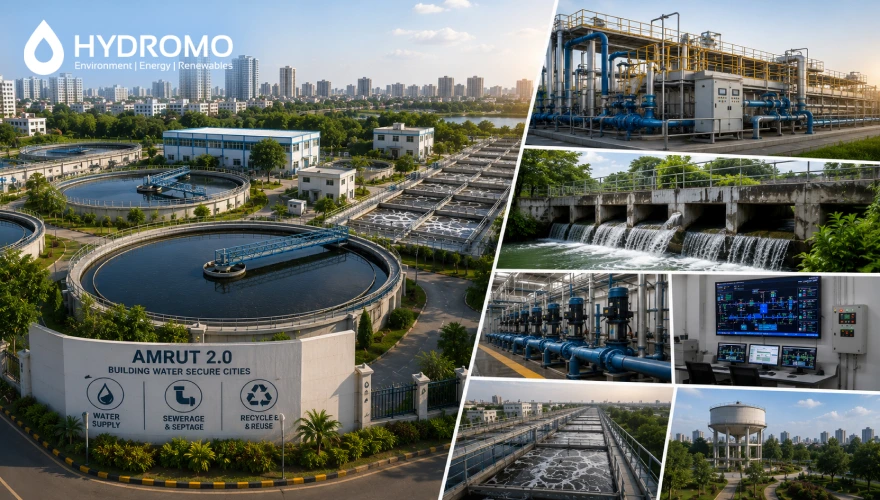
Walk through any municipal corporation office in India today and sewage treatment will come up in nearly every infrastructure conversation. That’s not a coincidence. AMRUT 2.0, the Union Government’s flagship urban water mission, has made sewage treatment plant upgrades a funding priority, and cities that were running on decades-old infrastructure are now rebuilding from the ground up.
What Is AMRUT 2.0?
AMRUT 2.0, short for Atal Mission for Rejuvenation and Urban Transformation 2.0, is a five-year central government scheme running from FY 2021-22 to FY 2025-26, with a total indicative outlay of ₹2,99,000 crore, including a central share of ₹76,760 crore. It builds on the original AMRUT scheme launched in June 2015 and extends coverage to nearly 4,800 statutory towns for water supply, while targeting 100% coverage of sewerage and septage management in the 500 cities already covered under AMRUT 1.0.
The mission’s core goal is to make Indian cities “water secure” and “self-sustainable” through what the Ministry of Housing and Urban Affairs calls a circular economy of water, meaning treated wastewater is reused rather than discharged and forgotten.
Why Is AMRUT 2.0 Investing in Sewage Treatment?
Municipal sewage treatment has historically lagged far behind water supply investment in India. Most Tier 2 and Tier 3 cities were treating a fraction of the sewage they generated, and a large share of that treatment relied on plants built 15 to 20 years ago with outdated process technology.
Under AMRUT 2.0, the Centre has approved close to ₹62,935.90 crore for sewerage and septage projects, which will add a 29,105 km sewerage network and roughly 5,791.94 MLD of additional treatment capacity nationwide. So far, 313 STPs with a combined capacity of 6,232 MLD have been approved across the country, of which 214 plants totalling 4,174 MLD are already complete. That is a meaningful jump from the 32,456 crore sanctioned for sewerage under the original AMRUT scheme, and it signals where national priorities are headed.
How Does AMRUT 2.0 Improve Wastewater Management?
The mission doesn’t just fund new pipes and tanks. It pushes cities toward structured, data-backed planning through a few specific mechanisms:
- City Water Balance Plans (CWBP): Every AMRUT city prepares a plan mapping how much water it consumes, how much wastewater it generates, and how much of that can realistically be recycled.
- Reuse targets: Cities are expected to meet at least 20% of their water demand through recycled water, which makes STP output a usable resource rather than a compliance box to tick.
- Non-Revenue Water Reduction: A parallel reform target of keeping non-revenue water under 20% pushes ULBs to fix the entire water-to-wastewater loop, not just the treatment stage.
- Technology Sub-Mission: This component is meant to bring newer global treatment technologies and start-up innovation into Indian STP projects instead of relying purely on legacy design norms.
- Private participation: Cities with a population above 10 lakh must route at least 10% of project value through a public-private partnership, opening the door for private EPC and O&M players.
What Are the Objectives of AMRUT 2.0?
In simple terms, the mission is built around a small number of measurable goals:
- Universal household tap water coverage in all statutory towns
- 100% sewerage and septage coverage in the 500 original AMRUT cities
- Rejuvenation of urban water bodies and green spaces
- A functioning circular economy of water through treatment and reuse
- Stronger municipal finances and governance reform at the ULB level
Sewage treatment plant capacity sits right at the intersection of the sanitation and circular economy goals, which is exactly why so much funding is directed there.
Why Are Old Sewage Treatment Plants Being Upgraded?
Many existing plants were designed for lower flow volumes, older effluent standards, and a city population that has since doubled or tripled. Common problems include:
- Hydraulic overloading during monsoon and peak flow periods
- Effluent quality that no longer meets current discharge norms
- High energy consumption from ageing blowers and pumps
- Manual, non-automated operations with limited real-time monitoring
- Little to no provision for treated water reuse
An STP Upgrade India project typically addresses all five at once, since retrofitting only the civil structure without touching the process technology rarely solves the underlying performance gap.
Which Technologies Are Used in Modern STPs?
Sewage treatment technologies funded under AMRUT 2.0 and adopted in newer municipal and private projects generally fall into a few categories:
- Sequential Batch Reactor (SBR): Compact footprint, strong for cities with land constraints
- Moving Bed Biofilm Reactor (MBBR): Reliable performance with lower sludge generation
- Membrane Bioreactor (MBR): Higher effluent quality, well suited where treated water will be reused
- SCADA-based automation: Real-time monitoring of flow, DO levels, and energy use, reducing manual dependency
The right choice depends on land availability, influential characteristics, discharge or reuse standards, and the O&M capacity a city or facility can realistically sustain long-term.
What Industries Benefit from Upgraded Sewage Treatment Infrastructure?
While AMRUT 2.0 is a municipal mission, its ripple effect extends well beyond ULBs. Real estate developers benefit from cities with functioning sewer networks, since project approvals increasingly require STP compliance. Hospitality businesses, hospitals, industrial parks, and educational institutions operating in AMRUT cities gain from improved trunk sewer connectivity and better civic treatment capacity, which reduces pressure on their own on-site systems. Facility managers overseeing large campuses also see fewer compliance headaches when municipal infrastructure keeps pace with urban growth.
How Can Municipalities Choose the Right STP Solution?
Given the scale of AMRUT 2.0 funding, municipal corporations and their consultants have real choices to make. A few practical filters help:
1. Match technology to influent load, not the other way around
2. Prioritise reuse-readiness so treated water can support the 20% recycling target
3. Choose vendors with demonstrated O&M track record, since a well-built plant that isn’t maintained properly fails within a few years
4. Factor in energy efficiency from day one, since operating cost often exceeds capital cost over a plant’s lifetime
5. Plan for automation so smaller technical teams can still run the plant reliably
Hydromo works with municipal bodies, EPC contractors, and infrastructure consultants across Water Infrastructure India projects, offering STP design, execution, and long-term O&M support built around exactly these priorities. For teams evaluating an AMRUT 2.0-linked STP modernization project or any municipal STP project, that combination of technical fit and dependable maintenance is usually what separates a plant that performs on paper from one that performs for the next twenty years.
Wastewater Management India is entering a phase where funding is no longer the primary constraint; execution quality is. Cities that pair AMRUT 2.0 capital with the right technology partner will be the ones that actually hit their sanitation and reuse targets, not just their spending targets.
FAQ’s
What is AMRUT 2.0?
AMRUT 2.0 is a Government of India urban mission (2021-22 to 2025-26) aimed at universal water supply and sewerage coverage, with a total indicative outlay of ₹2,99,000 crore.
Why is AMRUT 2.0 investing so heavily in sewage treatment?
Because most Indian cities were treating only a fraction of generated sewage with outdated infrastructure, and the mission’s circular economy goals depend on adequate treatment capacity.
How many STPs have been built under AMRUT 2.0 so far?
As of the latest government data, 313 STPs (6,232 MLD combined capacity) have been approved, with 214 plants (4,174 MLD) already completed.
What technologies are commonly used in modern STPs?
SBR, MBBR, and MBR are the most widely used process technologies, often paired with SCADA-based automation.
Can private companies participate in AMRUT 2.0 STP projects?
Yes. Cities with a population above 10 lakh must route at least 10% of project value through a public-private partnership, creating direct opportunities for EPC and O&M providers.
Planning an STP upgrade?
Talk to Hydromo Experts for a free site assessment and a customized STP proposal built around your city or facility’s actual load and reuse goals.