
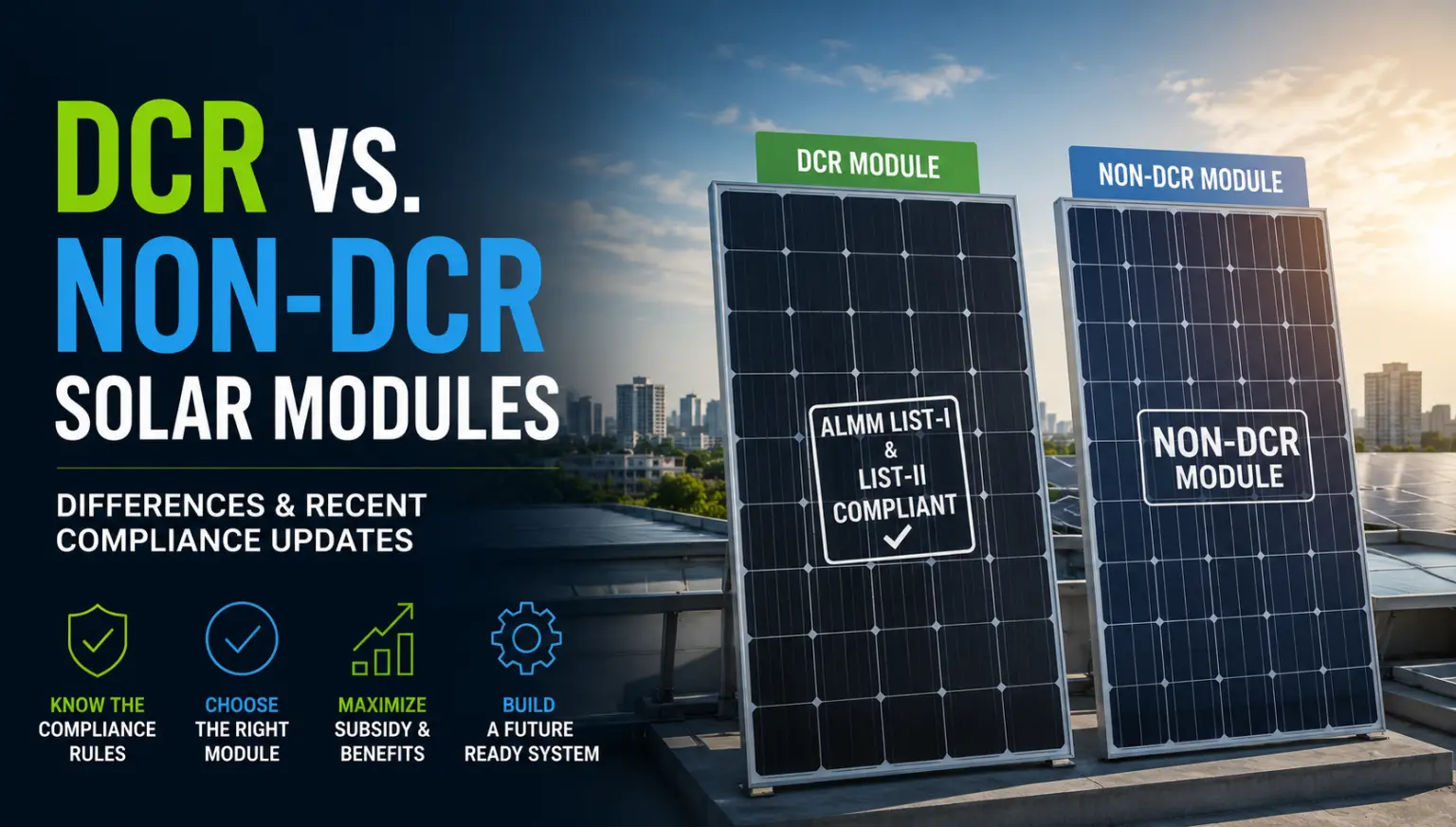
Choosing between DCR and Non-DCR solar panels is one of the most important decisions in any Indian solar project. Pick the wrong one, and you could lose your subsidy. You could also fail your net metering approval or overpay for a compliance tag you didn’t actually need.
This confusion isn’t new. But it got a lot more serious when MNRE tightened the rules around what counts as a genuine DCR module. Many installers, buyers, and even EPCs are still catching up.
So, let’s break it down. This guide covers what DCR and Non-DCR actually mean, how they differ in practical terms, and what the latest government updates mean for your project. Whether you’re planning a home rooftop, a factory shed, or a government tender, this will help you decide.
What Does DCR Actually Mean?
DCR stands for Domestic Content Requirement. In simple terms, it’s a government tag that confirms a solar module was substantially made in India. It’s not just assembled here from imported parts.
For years, the bar was fairly low. A module counted as “DCR” if it was assembled by a manufacturer on MNRE’s approved list, known as ALMM List-I. Where the cells inside came from mattered less. In fact, plenty of “Indian-made” DCR modules were built using cells imported from China, then packaged domestically.
That changed with ALMM List-II. This is a separate approved list, specifically for solar cells made in India. From June 1, 2026, a module only counts as truly DCR-compliant if two things are true together:
- It appears on ALMM List-I.
- Its cells come from a manufacturer on ALMM List-II.
So a module assembled in India using non-listed cells is now treated as non-DCR. This applies for compliance purposes, no matter who assembled it.
DCR modules are the backbone of India’s subsidy-linked solar schemes. Programs like PM Surya Ghar, PM-KUSUM, and most DISCOM net-metering schemes depend on DCR status to decide who qualifies for financial help.
What Are Non-DCR Solar Modules?
Non-DCR modules are, essentially, everything that doesn’t clear that bar. This includes fully imported panels. It also includes modules assembled in India using cells sourced from outside the country.
Non-DCR doesn’t mean lower quality. In fact, a lot of newer, high-efficiency technology reaches Indian rooftops through non-DCR supply chains. This includes TOPCon, heterojunction (HJT), and bifacial panel designs.
Why? Because Indian cell manufacturing for these newer formats is still scaling up. Buyers who don’t need subsidy eligibility often prefer non-DCR panels for this reason. They get access to newer technology at a lower cost per watt.
You’ll typically find non-DCR modules in three places:
- Private commercial and industrial (C&I) rooftop projects
- Captive power setups
- Utility-scale plants where efficiency and price matter more than subsidy access
Core Differences: DCR vs Non-DCR at a Glance
Both DCR and Non-DCR modules are built to the same durability standards. Neither one is the “downgraded” option. They’re simply engineered for different priorities, and each brings real strengths to the table.
Here’s a side-by-side look at what each option is built for.
| Factor | DCR Modules | Non-DCR Modules |
| Manufacturing | Cells and assembly both done in India, using ALMM List-II certified cells, full traceability from wafer to panel | Cells (and sometimes assembly) sourced globally, giving access to a wider international technology base |
| Typical efficiency | Roughly 19–21%, built on proven, field-tested mono-PERC technology | Roughly 21–26%, including newer TOPCon, HJT, and bifacial formats |
| Degradation rate | Standard linear degradation, typically under 0.5–0.6% per year, backed by 25-year performance guarantees | Standard linear degradation, typically under 0.4–0.55% per year depending on cell technology, also backed by 25-year performance guarantees |
| Cost per watt | Competitive pricing that reflects strong domestic supply chain investment | Competitive pricing shaped by global scale and a wider manufacturer base |
| Subsidy eligibility | The only route to PM Surya Ghar, PM-KUSUM, and most net-metering subsidy schemes | Best suited to projects that don’t need subsidy approval, with full freedom on brand and technology choice |
| Warranty | Standard 25-year performance warranty | Standard 25-year performance warranty |
| Availability | A fast-growing domestic base, with capacity expanding every ALMM revision | An established, wide range of brands and cutting-edge technologies |
| Where it’s used | Subsidized residential, agricultural, and grid-tied projects | Private, behind-the-meter, captive, and exempted commercial projects |
Both categories carry the same 25-year performance warranty and hold up to similarly rigorous quality standards. Neither is more “durable” or “reliable” than the other; they’re simply certified for different purposes. The real question isn’t which module is better. It’s which one matches what your specific project needs to qualify for.
Efficiency and pricing figures shift often for both categories, as cell capacity additions and technology upgrades roll out on both sides. So, always check current rates and specifications with your EPC before finalizing a budget.
What Changed in 2026: The ALMM List-II Mandate
This is where things got real for the industry. MNRE first signaled the List-II cell requirement in December 2024. That gave manufacturers and developers about 18 months to prepare.
When June 1, 2026 arrived, the ministry followed through. No blanket extension was granted. Here’s what that means for you right now.
The cell origin now decides everything. A module can hold ALMM List-I status and still count as non-DCR. That happens if its cells aren’t on List-II. MNRE also created a new sub-category, List-I(a), for modules that meet quality standards but skip List-II cells. These can only be used in specifically exempted projects.
Projects already underway got some room, but not much. Developers who had made real progress before the deadline could apply for a case-by-case exemption. This covered projects with completed module installation, secured financial closure, or valid land and connectivity approvals. However, the window to submit these claims through the DCR Verification Portal closed on June 30, 2026.
Residential subsidy consumers have a separate path. Under a “Give It Up” style provision, residential consumers under PM Surya Ghar can choose to skip the central subsidy. If they do, the June 2026 deadline doesn’t apply to them. Instead, they follow earlier scheme rules until March 31, 2027.
Tender-based projects can carry exemptions too. If a government tender’s last bid date fell before MNRE’s cutoff, that project can skip the List-II requirement. This holds even if the project is commissioned later. Still, any separate DCR requirement in the tender continues to apply.
The bottom line? If your project touches a subsidy, a net-metering connection, or open access, verify List-II cell compliance. Don’t just check List-1 module status. Confirm before you sign off on a module brand.
How to Decide: Which Panels Should You Use?
Here’s a simple way to think through it.
Choose DCR modules if:
- You’re applying for a central or state subsidy.
- Your project falls under PM Surya Ghar, PM-KUSUM, or a similar MNRE-linked scheme.
- Your DISCOM requires net-metering approval, which now almost always ties back to DCR and ALMM List-II compliance.
- You want the traceability and long-term supply security that comes with a fully domestic manufacturing chain.
Choose Non-DCR modules if:
- Your installation is private and doesn’t need grid export or subsidy.
- You’d rather prioritize efficiency and upfront cost.
- You’re comfortable checking brand reputation and certifications yourself.
- Your project qualifies for a documented exemption, such as pre-cutoff tender bids.
Here’s a simple way to remember it. DCR exists to build India’s domestic solar manufacturing base. Non-DCR exists to give the market access to newer technology and competitive pricing. Neither one is universally “better.” The right call depends on what your project needs to qualify for.
A Quick Example
Consider a homeowner in Hyderabad installing a 5kW rooftop system under PM Surya Ghar. This homeowner needs DCR modules with List-II certified cells. No exceptions. Otherwise, the subsidy application gets rejected during verification.
Now, compare that to a food processing unit running a 500kW captive rooftop system. This system has no grid export and no subsidy application. In that case, the owner can reasonably choose a higher-efficiency non-DCR module. Since compliance isn’t a factor, the priority becomes maximizing generation per rupee spent.
Compliance Checklist for Buyers and EPCs
Before you finalize any module order, run through this checklist:
- Confirm whether your scheme, tender, or DISCOM requires DCR plus ALMM List-II compliance.
- If claiming DCR status, verify both the cells and the assembly are Indian-made. Don’t trust a datasheet label alone.
- Cross-check the module and cell manufacturer against the current ALMM List-I and List-II on the MNRE website. These lists get revised every few months.
- For borderline projects, check the DCR Verification Portal (solardcrportal.nise.res.in) for traceability and certificate status.
- Ask your installer directly which category they’re quoting and why. Get it in writing on the proposal.
Conclusion
So, is DCR or Non-DCR the right choice? There’s no single answer. It depends entirely on what your project needs to achieve.
If subsidy eligibility, net-metering, or a government scheme is involved, DCR compliance with ALMM List-II cells is no longer optional. That’s been true since mid-2026. If you’re running a private, unsubsidized installation, non-DCR options can offer better efficiency and pricing. Just make sure you do your own diligence on quality first.
Either way, talk to your EPC partner early. Have this conversation before modules are ordered, not after your subsidy application gets flagged for non-compliance.
Talk to Hydromo’s solar experts for a free site assessment. We’ll help you confirm the DCR/Non-DCR Module before you commit to it.
FAQ’s
1. What is a DCR solar module?
A DCR, or Domestic Content Requirement, solar module is a panel where both the cells and the final assembly happen in India, verified against MNRE’s ALMM List-I and List-II. That’s what makes it eligible for India’s central and state solar subsidy programs.
2. What is a Non-DCR solar module?
A Non-DCR solar module is one that uses imported cells, or is fully imported, even if it gets assembled here in India. These panels don’t qualify for government subsidies, but they’re extremely common in private commercial, industrial, and off-grid projects.
3. What’s the actual difference between DCR and Non-DCR solar panels?
It really comes down to two things: where the panel was made, and whether it qualifies for subsidy. DCR panels are built from India-made cells and are required for any subsidized government scheme, while Non-DCR panels can use imported cells and typically go into private, unsubsidized projects. Quality-wise, both meet the same durability standards, one isn’t built “better” than the other.
4. Is DCR compulsory for PM Surya Ghar Yojana?
Yes, it is. PM Surya Ghar: Muft Bijli Yojana requires DCR-compliant modules, full stop. If you install Non-DCR panels instead, your application simply won’t clear subsidy verification.
5. Can I still get a solar subsidy if I choose Non-DCR panels?
No, Non-DCR panels don’t qualify for central or state solar subsidies in India. If you go that route, your installation gets treated as a private, non-subsidized project, and you’ll be covering the full cost yourself.
6. What is ALMM List-II, and how does it affect DCR status?
ALMM List-II is MNRE’s approved list of domestic solar cell manufacturers, it exists to confirm that a module’s cells, not just its final assembly, were actually made in India. Since June 1, 2026, a panel only counts as DCR-compliant if it’s on ALMM List-I and its cells come from a List-II certified manufacturer.
7. Are DCR panels less efficient than Non-DCR panels?
Not inherently, efficiency comes down to the cell technology used, not the DCR label itself. DCR panels usually run on mono-PERC tech, sitting around 19–21% efficiency, while some Non-DCR panels use newer TOPCon or HJT technology that can reach 21–26%. That said, Indian manufacturers are adopting these newer technologies too, so the gap keeps narrowing.
8. Do DCR and Non-DCR panels come with different warranties?
Not really, both typically carry the same standard 25-year performance warranty. What actually varies is the manufacturer and brand, not whether the panel happens to be DCR or Non-DCR.
9. Which solar panels do I need for net metering in India?
Most DISCOMs ask for DCR-compliant, ALMM-listed modules for net-metering approval, especially on subsidized residential and agricultural connections. Rules shift a bit from state to state, so it’s worth a quick check with your local DISCOM before you commit to a panel.
10. Are Non-DCR solar panels lower quality than DCR panels?
No, not at all. Quality comes down to the manufacturer’s certifications, the cell technology, and build standards, DCR status doesn’t tell you anything about how well-built a panel is.
11. Which is better for a home rooftop system DCR or Non-DCR?
If you’re planning to claim a government subsidy, DCR is the clear choice, since schemes like PM Surya Ghar simply won’t accept Non-DCR panels. If you’re skipping the subsidy altogether, Non-DCR is a perfectly reasonable option too.
12. Which is better for a commercial or industrial project DCR or Non-DCR?
For C&I projects that don’t need subsidy or net-metering approval, a lot of buyers lean toward Non-DCR panels for the extra efficiency and technology options. That said, DCR still holds up well for businesses that care about domestic supply chain traceability, it really comes down to what your project needs, not which panel is “better” overall.
13. How do I check whether a panel is actually DCR-compliant?
Cross-check the manufacturer and cell supplier against MNRE’s current ALMM List-I and List-II, that’s the most reliable way to confirm it. You can also use the DCR Verification Portal (solardcrportal.nise.res.in) to trace a specific module’s certificate.
14. What happens if a subsidized project accidentally uses Non-DCR panels?
It usually gets flagged and rejected during subsidy or net-metering verification. That’s why it pays to confirm module and cell certification before installation, fixing this after the system’s already up and running is a much bigger headache.
15. Is there any extension on the 2026 ALMM List-II deadline?
No, there’s no blanket extension past June 1, 2026. A limited, case-by-case exemption window was open through the DCR Verification Portal for certain ongoing projects, but that closed on June 30, 2026.