
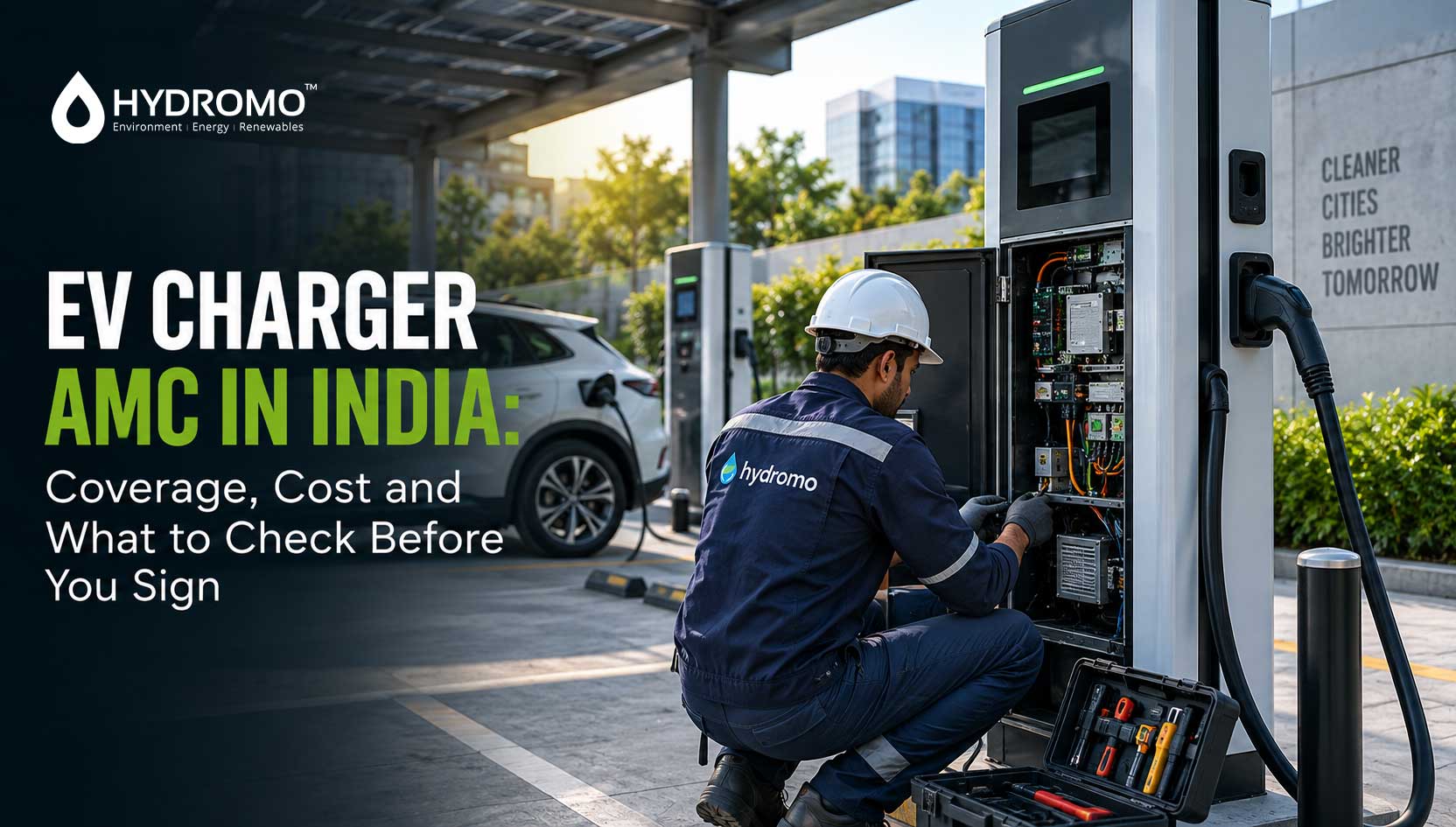
A charger that won’t dispense power is worse than no charger at all. It sits there advertising a broken business. That’s usually the moment site owners start asking about an EV charger AMC. An EV charging station annual maintenance contract is a fixed-fee agreement where a service provider handles scheduled inspections, software updates, connector and cable servicing, and breakdown response for a defined period, usually 12 months. In India, a basic EV charger annual maintenance contract for a single AC unit typically runs ₹15,000–₹50,000 a year; DC fast chargers cost more to maintain and can run considerably higher depending on power rating and scope.
That range is wide because AMC scope isn’t standardised the way, say, a car service package is. Two providers quoting for the same charger can differ by 3x depending on what’s actually included. Here’s what to check before signing.
One clarification up front: this is about the cost of keeping a charger running, not the cost of buying and installing one. If you’re still at the purchase-decision stage, our EV Charging Station Cost in India guide breaks down per-kWh pricing, installation costs, and ROI. This article picks up after that decision is made, once the charger is live and the question becomes “what does it cost to keep it working.”
What an EV Charging Station AMC Actually Covers
Most EV charger maintenance contracts in India bundle four categories of work, and they’re not equally important.
Preventive maintenance is where most AMCs actually earn their keep. Monthly or quarterly visits to check the enclosure, connectors, RFID readers, display screens, and cooling fans catch a loose connector or a failing fan before it takes the charger offline entirely.
Software matters just as much as hardware here. Firmware updates, OCPP connectivity checks, and remote diagnostics through the charge point management system keep the unit talking to the billing network. A charger that’s physically fine but can’t process a payment is just as useless as one that’s broken.
Then there’s the connector itself. CCS2 guns and cables take the worst physical abuse on any site: dragged across pavement, dropped, occasionally run over. They fail more often than any other component, so a contract that treats them as a consumable rather than an afterthought is worth more than one that doesn’t mention them at all.
Finally, breakdown response: a committed window, often 24 to 48 hours, sometimes same-day for commercial sites, for anything that fails outside the scheduled visits.
What tends to get left out of budget contracts is less obvious. DISCOM-side power quality checks, earthing and surge protection testing, load-sharing calibration for dual-gun units. None of these show up on generic AMC checklists, but they’re often exactly where real downtime starts.
Labour-Only vs. Comprehensive AMC
This distinction matters more than the headline price. A labour-only AMC covers the technician’s time: inspection, diagnosis, minor repairs. Spare parts get billed separately as they’re needed. A comprehensive AMC (sometimes called CAMC) folds parts into the fixed annual fee, so a blown power module or a replacement gun doesn’t trigger a surprise invoice.
Comprehensive contracts cost more upfront, usually 20–40% above labour-only pricing. For a single home or apartment charger, labour-only is often fine. Failure rates are low and parts are cheap. For a commercial site running multiple DC chargers at high daily cycle counts, comprehensive coverage is usually the better bet, because a single power module replacement on a 60kW unit can cost more than a year of labour-only fees.
What EV Charging Station AMC Actually Costs in India
Rough numbers, based on what’s typically quoted across the market:
- AC chargers (7.4kW–22kW): ₹15,000–₹30,000 per unit annually for labour-only; ₹25,000–₹45,000 for comprehensive
- DC fast chargers (30kW–60kW): ₹40,000–₹80,000 annually depending on scope, with some commercial DC AMC packages quoted around ₹70,000 for a comprehensive plan
- High-power DC (120kW+): Priced per site after a technical assessment, power electronics complexity and cooling system requirements push these well above standard packages
Three things move the price more than anything else: charger count (multi-unit sites get per-unit discounts), response-time commitment (same-day response costs more than a 48-hour window), and whether the contract is with the OEM/authorised partner or a third-party servicer. OEM-backed AMCs tend to cost more but come with genuine spare parts and firmware access that third parties sometimes can’t match.
Why Skipping the AMC Is a False Economy
The math that convinces most site owners is simple. A 60kW DC charger doing even modest utilisation can generate ₹15,000–₹25,000 in revenue or savings per month (see our cost and ROI breakdown for how that payback math works station-wide). A week of downtime waiting for an unscheduled repair costs more than most annual AMC fees, and it eats directly into that payback window. There’s a reputational cost too. A charger showing “unavailable” on an app for days pushes users toward a competing network permanently, not just for that one session.
There’s also a warranty angle that gets missed. Several OEMs require documented preventive maintenance to keep the hardware warranty valid. Skip the AMC, and a covered failure can turn into an out-of-warranty repair bill.
Choosing an EV Charger Maintenance Contract Provider
A few questions worth asking before signing anything:
Is the response window in writing, with a penalty clause if it’s missed? Verbal promises about “quick service” mean nothing once there’s an actual outage. Does the provider stock spares locally, or do parts ship in from another city? A two-week wait for a connector defeats the purpose of having a contract at all. And does the AMC include remote monitoring, or only physical visits? Remote diagnostics catch things a technician wouldn’t notice on a monthly visit: a stuck relay, a firmware fault developing slowly over weeks.
Hydromo runs EV charging infrastructure covering 60kW and 120kW DC public chargers built for commercial complexes, dealerships, and fleet operations. AMC packages get scoped per site after an assessment of charger count, expected daily cycles, and DISCOM connection type, rather than sold at a flat one-size price. A charger doing 40 sessions a day needs a different maintenance rhythm than one doing four.
The Bottom Line
Don’t shop an EV charger AMC on price alone. A ₹15,000 labour-only contract with a 5-day response window can cost far more in lost revenue than a ₹35,000 comprehensive plan with same-day service. Match the contract to how hard the charger actually gets used, get the response time in writing, and confirm whether spares are included before the invoice arrives, not after.
“Running EV chargers without a maintenance plan? Talk to Hydromo’s EV infrastructure team for a site-specific AMC quote, scoped to your charger count, usage pattern, and DISCOM setup, not a flat rate.”
Frequently Asked Questions
What does an EV charger AMC include?
Standard coverage includes scheduled preventive inspections, firmware and software updates, connector/cable servicing, and breakdown response within a defined time window. Comprehensive AMCs also include spare parts; labour-only contracts bill parts separately.
How much does an EV charging station AMC cost in India?
AC chargers typically cost ₹15,000–₹45,000 a year depending on coverage type. DC fast chargers run higher, often ₹40,000–₹80,000 annually, with high-power DC units priced after a site-specific assessment.
Is an AMC mandatory for EV charging stations?
It’s not legally mandatory, but several charger OEMs require documented preventive maintenance to keep the hardware warranty valid. Commercial sites also generally can’t justify the downtime risk of going without one.
What’s the difference between a warranty and an AMC?
A warranty covers manufacturing defects for a limited period at no extra cost. An AMC is a paid service contract covering routine maintenance, wear-and-tear servicing, and breakdown response, it typically continues after the warranty period ends, and sometimes runs alongside it.
How often should an EV charger be serviced under an AMC?
Most contracts schedule preventive visits monthly or quarterly, with additional inspections after high-usage periods or extreme weather events. High-cycle commercial DC chargers often warrant monthly checks; low-usage residential AC units can often go quarterly.
Can I switch EV charger maintenance contract providers before renewal?
Usually yes, but check the contract for lock-in clauses and notice periods first. Switching mid-contract may also affect any linked hardware warranty if the original provider is OEM-authorised and the new one isn’t.