
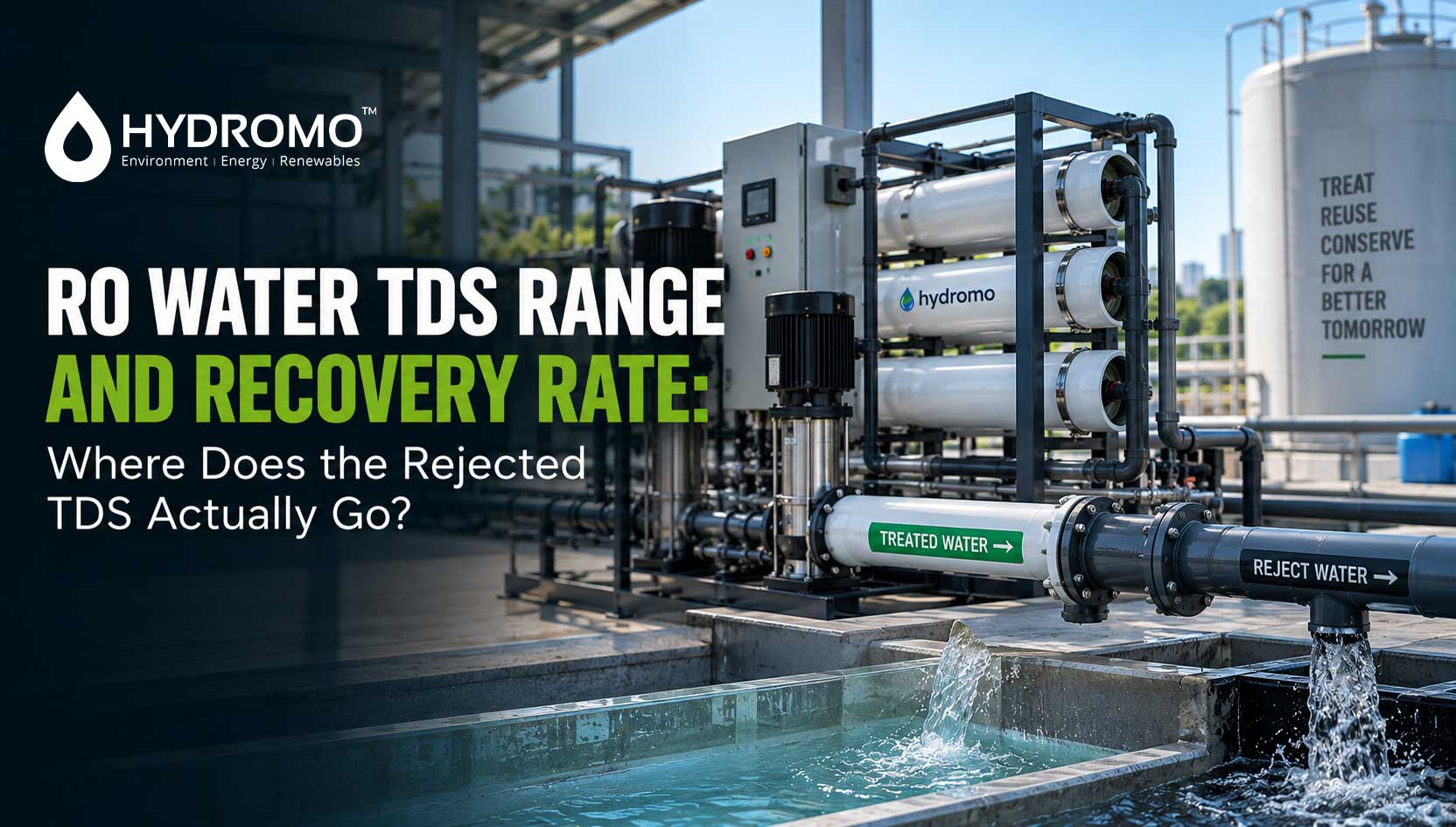
A 2000 LPH RO water plant treating 1200 ppm borewell water doesn’t destroy 1200 ppm worth of dissolved solids. It concentrates them into a smaller stream and sends that stream somewhere: usually to a drain, sometimes to a soak pit, occasionally into a monsoon storm drain where nobody’s checking. That “somewhere” is the part of the RO water TDS range conversation that gets skipped, and it’s the part that decides whether your plant runs quietly for years or turns into a compliance problem.
Most guidance on RO water TDS level stops at “the ideal RO water TDS range is 50-150 ppm. “True, but incomplete. The concentrate stream, not the product water, is where the TDS load your feed water carries actually ends up, and how much of it you’re generating depends entirely on your plant’s recovery rate.
What Recovery Rate Actually Means
Every RO water plant splits incoming feed water into two streams: permeate (the clean, low-TDS water you wanted) and concentrate or reject (the leftover water carrying almost everything the membrane pulls out). Recovery rate is the percentage of feed water that becomes permeate.
A plant running at 60% recovery, treating 3,000 litres of feedwater an hour, produces 1,800 litres of usable water and 1,200 litres of reject. That rejection isn’t clean water lost. It’s fed water with the dissolved solids concentrated into a smaller volume, and depending on your ratio, that concentration factor can run 2.5 to 4 times the feed TDS.
Recovery rate isn’t a fixed spec. It’s chosen, or should be, based on feed TDS, because pushing recovery too high on high-TDS water causes scaling on the membrane surface long before you’d expect it. This is exactly why the same 2000 LPH RO water plant quoted by two vendors can behave completely differently in the field: one is running 75% recovery on water it shouldn’t be, and the other is running a conservative 55% and lasting three times as long.
The Math Nobody Shows You
Take a plant treating 1200 ppm feed water at 55% recovery. Mass balance says the dissolved solids that don’t leave with the permeate stay in the concentrate. Roughly:
Concentrate TDS ≈ Feed TDS × (1 ÷ (1 − Recovery))
At 55% recovery, that’s 1200 ÷ 0.45, which works out to roughly 2,650 ppm in the reject stream, more than double the feed. Push the same feed water to 75% recovery, and the concentrate climbs past 4,800 ppm. That’s exactly the kind of number that turns a mildly saline drain discharge into a genuine scaling and disposal problem, and exactly why “just increase the recovery rate to save water” isn’t free advice.
This is also why the National Green Tribunal’s 2019 order on RO systems set a floor, not just a ceiling. It directed that domestic RO recovery shouldn’t fall below 60%, with a push toward 75%, specifically to cut down water wastage. For commercial and industrial RO water plants, that ratio gets balanced against membrane life instead, and 50-65% recovery on brackish borewell water in Hyderabad and Telangana (typically 500-1500 ppm) is a realistic, sustainable band rather than something to be improved away.
Where the Concentrate Actually Needs to Go
For a small RO purifier, a few litres of reject water an hour to the kitchen drain is a non-issue. For a commercial RO water plant running 2,000-10,000 LPH, the range most hotels, hospitals, and mid-sized industrial buyers land in, the daily concentrate volume adds up fast, and where it goes stops being an afterthought.
Flushing and gardening reuse. Concentrate TDS in the 1,500-3,000 ppm range is generally still usable for toilet flushing lines or non-edible landscaping, provided it isn’t loaded with scale-forming hardness that will clog the piping over time. This is the cheapest disposal route and the one most sites default to.
Cooling tower makeup. Industrial sites already running cooling towers can sometimes blend RO reject into makeup water, within limits set by the tower’s own cycles-of-concentration tolerance. It needs checking case by case: rejecting water that’s too high in chlorides accelerates corrosion in the tower circuit.
Soak pits and storm drains. Common in practice, rarely compliant. TSPCB norms around Hyderabad’s industrial clusters increasingly flag this during inspections, particularly for pharma and food processing units where discharge is monitored more closely.
Zero Liquid Discharge. For sites where feed TDS runs high (above 2,000-2,500 ppm) or local discharge norms don’t allow any liquid effluent, the concentrate stream needs further treatment: evaporation, crystallization, or at minimum a holding-and-tankering arrangement. This is the same principle behind Zero Liquid Discharge systems for pharmaceutical and process industries, and it gets expensive fast, which is exactly why getting the recovery rate right at the design stage matters more than fixing it after commissioning.
Reading TDS as an Early-Warning Signal, Not Just a Spec Check
Most operators check output TDS and move on if it looks fine. The more useful habit is watching the relationship between three numbers over time: feed TDS, permeate TDS, and concentrate TDS.
A membrane that’s beginning to foul or scale shows a slow, specific pattern: permeate TDS creeps upward while flow rate hasn’t dropped yet. By the time the flow rate visibly falls, you’re usually looking at a full membrane clean-in-place or replacement rather than a routine flush. Logging all three TDS points weekly, rather than just testing product water, catches that drift 2-4 weeks earlier in most cases we’ve seen, early enough that a CIP cycle solves it instead of a membrane change.
The recovery rate itself is diagnostic too. If a plant designed and commissioned at 60% recovery is now delivering less permeate for the same feed flow, that’s pressure or pump wear showing up before anything else does.
Getting the Design Right the First Time
Recovery rate isn’t something to negotiate down after the fact. It needs to be set against your actual feed water TDS before the plant is built, not after the first membrane change surprises you with a bill. A plant designed for 1200 ppm feed at a sensible 55-60% recovery, with a clear plan for where the concentrate goes, costs marginally more to spec correctly and considerably less to run over five years than one pushed to squeeze out extra permeate at the expense of membrane life and disposal headaches.
“Not sure what recovery rate your RO water plant should be running, or where your reject water should go? Request a free feed-water assessment and get a plant design that’s sized right the first time. Talk to Hydromo’s engineers.”
FAQs
What is a good recovery rate for an RO water plant on borewell water?
For feed TDS between 500 and 1500 ppm, which covers most Hyderabad and Telangana borewell sources, 50-65% recovery is a realistic, sustainable range. Pushing higher on high-TDS water shortens membrane life and increases concentrate TDS sharply.
How much more concentrated is RO reject water than the feed?
Depending on recovery rate, concentrate TDS typically runs 2 to 4 times the feed TDS. At 50% recovery it’s roughly double; at 75% recovery on the same feed it can be closer to 4 times, which is why recovery rate and disposal planning need to be decided together.
Can RO reject water be reused?
Yes, within limits. Reject water in the 1,500-3,000 ppm range, which is commonly reused for toilet flushing or non-edible gardening. Above that, or with high hardness, it usually needs dilution, further treatment, or a dedicated discharge plan rather than direct reuse.
Is there a legal minimum recovery rate for RO systems in India?
The National Green Tribunal’s 2019 order set a recovery floor of 60% for domestic RO systems below 500 ppm TDS, moving toward 75%, specifically to curb water wastage. Commercial and industrial systems are typically designed case by case against feed water quality rather than a fixed mandate.
How do I know if my RO plant’s recovery rate has dropped?
Falling permeate output for the same feed flow, combined with rising differential pressure across the membrane, usually signals declining recovery, often from scaling or fouling. Logging feed, permeate, and concentrate TDS weekly catches this earlier than waiting for a visible flow drop.
When does an RO water plant need zero liquid discharge instead of simple reject disposal?
When feed TDS runs above roughly 2,000-2,500 ppm, or when local pollution control norms don’t permit any liquid discharge, straightforward reject-to-drain isn’t viable and the concentrate stream needs evaporation, crystallization, or tankering as part of a ZLD setup.