
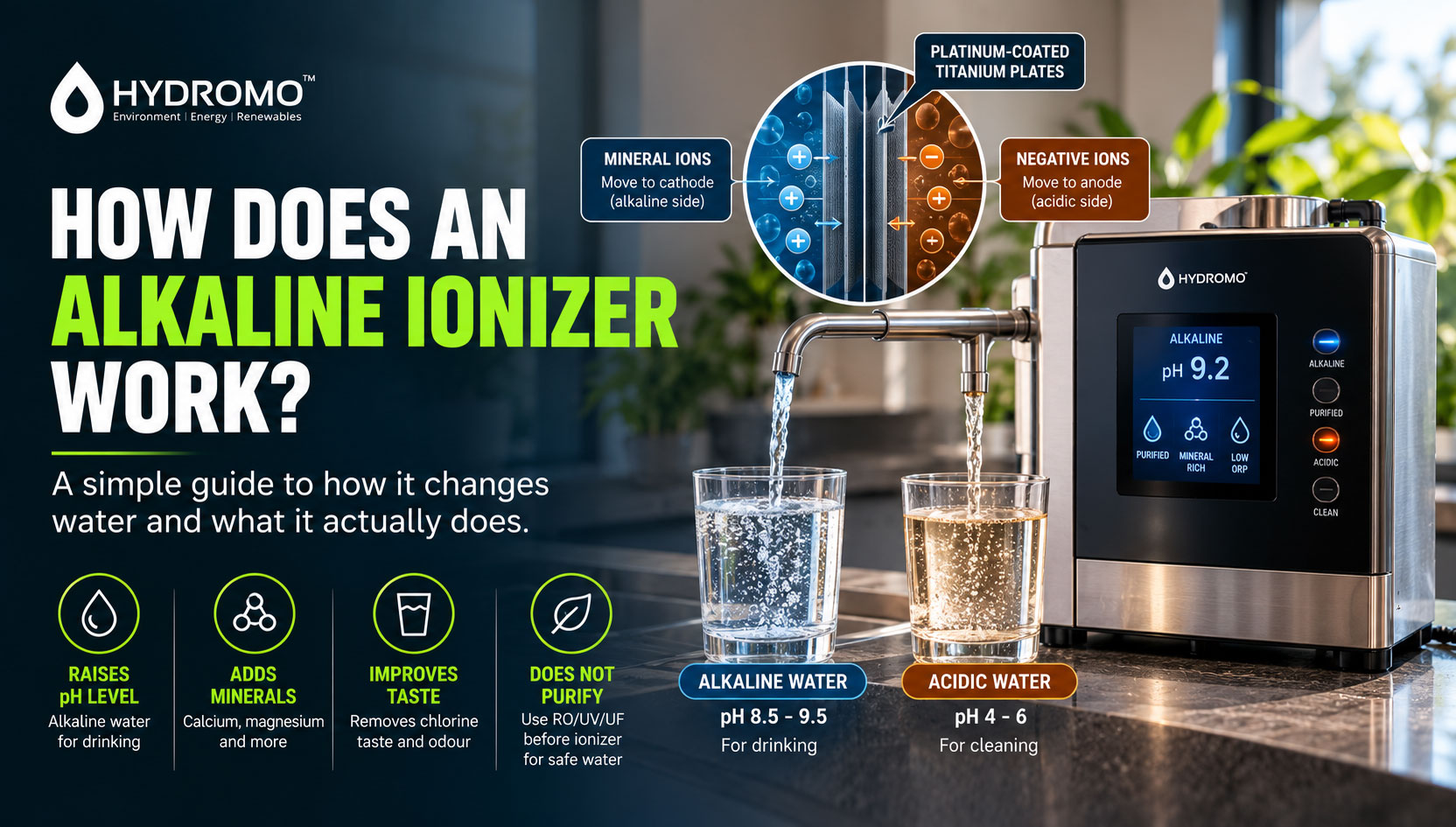
An alkaline ionizer splits tap water into two streams using a small electric current. One stream comes out alkaline (higher pH) for drinking. The other comes out acidic and is sent down the drain or used for cleaning. That is the whole trick. The ionizer changes the chemistry of the water. It does not turn dirty water into clean water.
That one distinction clears up most of the confusion around these machines, so keep it in mind as you read.
What is an alkaline water ionizer?
An alkaline water ionizer is a countertop or under-sink appliance that runs water through an electrolysis chamber. Inside are several thin titanium plates coated with platinum. A built-in filter, usually activated carbon, sits in front of the chamber.
People also call it a water ionizer or an alkaline water machine. All three names mean the same device: a filter, a pair of electrodes, and a tap with two outlets. If you want to see how the different models compare, Hydromo has a guide to the best digital alkaline water ionizers for home use.
How does an alkaline ionizer work?
Think of it as a sorting station for the minerals and ions already dissolved in your water.
1. Filtering first. Water enters the unit and passes through the carbon filter, which takes out chlorine, some taste and odour compounds, and part of the sediment.
2. Electricity second. The filtered water flows between the plates. Direct current is applied, so some plates become positively charged (anodes) and others negatively charged (cathodes).
3. Separation third. A thin membrane keeps the two sides apart. Positively charged minerals such as calcium, magnesium, potassium and sodium drift toward the cathode side. Negatively charged ions such as chloride and sulphate drift toward the anode side.
4. Two outlets. The cathode side leaves the machine as alkaline water, usually in the pH 8.5 to 9.5 range. The anode side leaves as acidic water, often around pH 4 to 6.
Water with almost no dissolved minerals conducts electricity poorly, so an ionizer works best on water that still contains some calcium and magnesium. Feeding it pure RO water with zero TDS gives weak results.
How does water ionization work at the chemical level?
Water ionization here means electrolysis. When current passes through water, a small amount of the water molecules split.
At the cathode, water gains electrons and forms hydrogen gas and hydroxide ions (OH⁻). Extra hydroxide pushes the pH up, which is why that side turns alkaline. A little dissolved hydrogen stays in the water, and that is what gives it a negative reading on an ORP meter. If you have seen that number on a product label, this explainer on what ORP is in alkaline water and why it matters covers it in more detail.
At the anode, water loses electrons and forms oxygen gas and hydrogen ions (H⁺). Extra hydrogen ions pull the pH down, which is why that side turns acidic.
Most machines let you pick a level, often from mild to strong. A higher setting uses more current or slows the flow so the water spends longer between the plates.
How does a water ionizer improve water quality?
The answer has two parts.
What it genuinely changes:
- It raises pH and increases the share of dissolved alkaline minerals in the drinking stream.
- The carbon filter reduces chlorine taste and smell, so the water usually tastes softer.
- Dissolved hydrogen gives the water a negative ORP reading.
Hydromo’s piece on why alkaline water is considered better than normal water goes through the taste and mineral side of this.
What is still debated:
- Claims about immunity, skin, hair and general wellness are popular. You can read the case people make in how alkaline water may support immunity, alkaline water for skin and hair and 7 benefits of alkaline water. Strong clinical evidence for these claims is limited. Small studies exist. Large, well-controlled ones do not.
- Your stomach acid is far stronger than any alkaline water, so the pH of what you drink does not change your blood pH. The topic of body acidity comes up often, and this article on acidosis explains why people talk about it so much.
So when someone asks how a water ionizer improves water quality, the fair answer is this: it improves taste, adjusts pH and adds mineral content. It does not make unsafe water safe.
Does an alkaline water ionizer purify water?
No. Does an alkaline water ionizer purify water? It does not, and this is the most common misunderstanding.
Electrolysis does not kill bacteria or viruses. It does not remove arsenic, fluoride, lead, pesticides or high TDS. A basic carbon filter helps with chlorine and some organics, but it is not a replacement for a proper purification stage.
If your source water is borewell, tanker or municipal supply with unknown quality, put a purifier first (RO, UV or UF depending on the test results), then add the ionizer after it. Remineralise if needed, because an ionizer needs minerals to work. Order matters: purify, then ionize.
One more point for Indian households. The drinking water standard IS 10500 sets an acceptable pH range of 6.5 to 8.5. Many ionizers can go above that at their highest setting, so a strong setting is not automatically better. Starting near pH 8.5 to 9 is a sensible approach.
Things to check before buying
- Plate count and coating. More platinum-coated titanium plates generally mean better ionization at higher flow rates.
- Filter replacement cost. Ask what a replacement cartridge costs and how often it is needed.
- Your water test. Get your TDS, hardness and pH tested first. Very hard water scales the plates. Very soft or very low TDS water barely ionizes.
- Acidic water outlet. Check that the drain is easy to connect, since a part of every litre goes to the acidic stream.
- Cleaning cycle. Scale builds up on the plates over time, so look for a self-cleaning mode.
To compare specific models, start with the digital alkaline water ionizer guide. For more reading on the subject, the alkaline water category collects everything in one place. If hydrogen-rich water and skincare interest you, there is also this post on the hydrogen beauty potion.
Next step: If you are not sure whether your water needs purification, ionization, or both, request a free water test and site assessment from Hydromo’s team in Hyderabad before you choose a water ionizer. The right setup depends on your source water, not on the brand name.
Quick FAQ
1. How does an alkaline ionizer work in one line?
Ans. It uses electrolysis to separate filtered water into alkaline and acidic streams.
2. Is an alkaline ionizer the same as an RO purifier?
Ans. No. RO removes dissolved contaminants. An ionizer changes pH and mineral balance.
3. Can I use ionized water for cooking and tea?
Ans. Yes, though strongly alkaline water can change the taste and colour of tea.
4. Who should avoid high pH water?
Ans. People with kidney conditions or on medication should speak to a doctor first.