
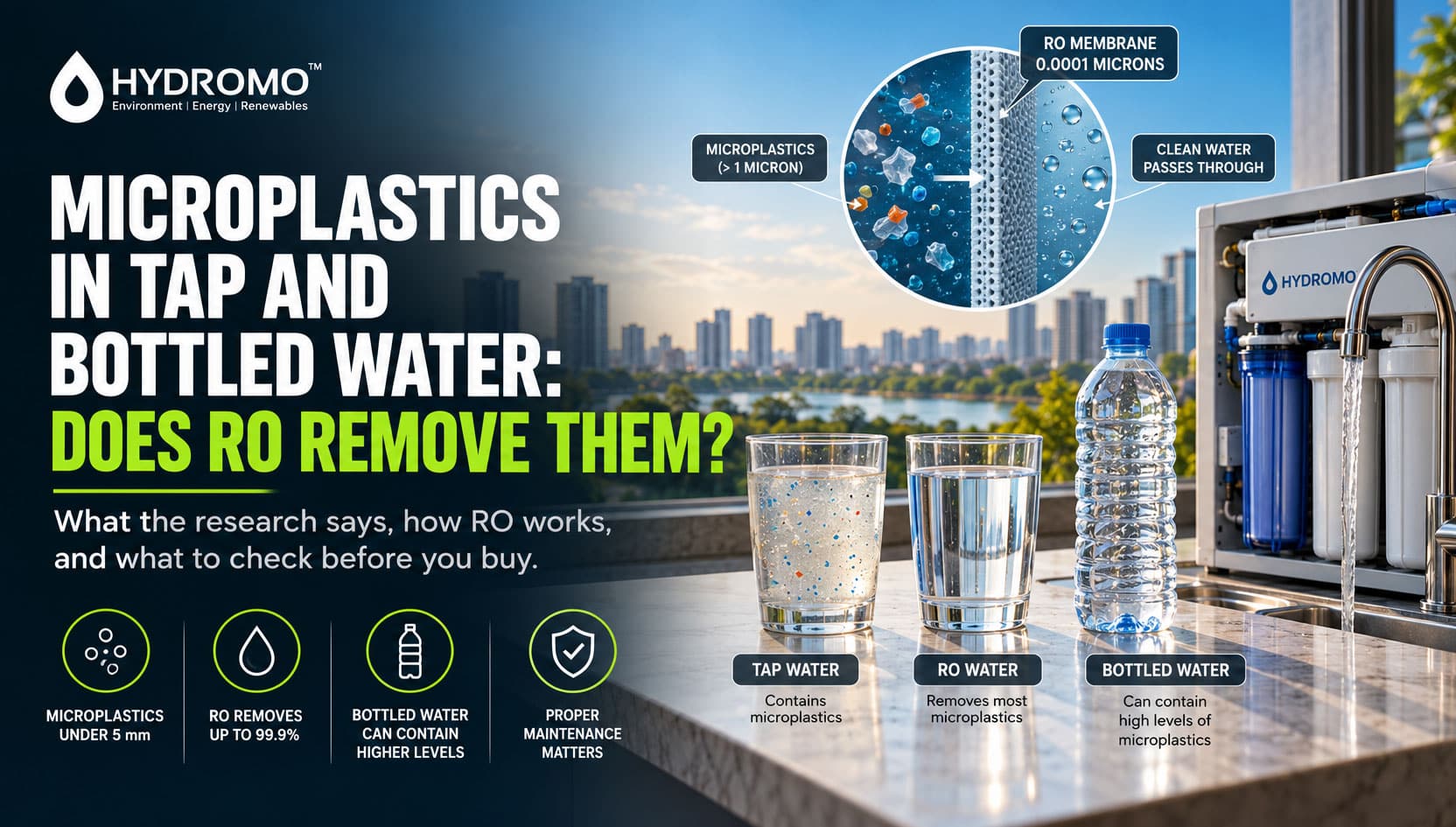
Yes. A working reverse osmosis (RO) system removes most microplastics from drinking water. The reason is size. RO membrane pores measure about 0.0001 microns, over 10,000 times smaller than microplastics. Particles that large cannot pass through. RO is still not a guarantee, though. A worn membrane, skipped filter changes or a poorly built unit can undo the benefit. Here is what the research says and what to check before you buy.
How microplastics end up in your glass
Microplastics are plastic fragments under 5 mm. Nanoplastics are smaller than 1 micron, which is far too small to see. They come from laundry fibres, packaging waste, tyre dust and plastic that slowly breaks down in rivers and lakes.
Municipal treatment catches a large share of them. A study of a Barcelona drinking water plant measured an overall removal of 93%, with sand filtration doing most of the work. The same study found that ultrafiltration and reverse osmosis removed microplastics better than ozonation and carbon filtration. So tap water is not free of microplastics, but the load is usually low by the time it reaches you.
Bottled water is not the safer choice
Many people switch to bottled water out of worry, and that tends to backfire. A January 2024 Columbia/Rutgers study found roughly 240,000 plastic particles per liter of bottled water, about 90% of them nanoplastics. Tap water in comparable studies carried far fewer. The bottle, the cap and the bottling process all contribute. Heat and reuse likely add more, which matters in a city like Hyderabad, where cans and bottles often sit in hot vehicles and stores for days.
How RO removes microplastics
An RO system pushes water at pressure through a semi-permeable membrane. Water molecules pass through. Dissolved salts, heavy metals and plastic particles stay behind and leave with the reject stream. Sediment and carbon pre-filters sit ahead of the membrane and catch larger particles first, which protects it.
Lab results are commonly quoted at up to 99.9% removal. Treat that as a best case. Those numbers come from controlled tests, and your result depends on feed water quality, membrane age and how the system is maintained.
Where RO falls short
Three limits are worth knowing.
First, RO units contain plastic themselves, including housings, tubing and storage tanks. Some research suggests that prolonged use and membrane fouling can break down membrane materials and release tiny fragments. The effect appears small next to what the membrane removes, but it is a reason to keep up with maintenance.
Second, few home RO units are certified specifically for microplastic removal. Ask the seller what was actually tested and at what particle size.
Third, domestic RO systems send a good share of the feed water to drain. Reuse it for mopping, plants or cleaning rather than letting it go down the sink.
On health, the evidence is still thin. The World Health Organization’s 2019 review found no evidence of risk at current levels but flagged how limited the data is. Reducing exposure is sensible. Panic is not.
What to check before buying an RO system
- Test your feed water TDS first. High TDS shortens membrane life and changes the system you need.
- Look for sediment and carbon pre-filtration, plus UF if your water is turbid.
- Ask for the membrane’s rated capacity and replacement interval in writing.
- Choose food-grade tubing and housings, and check how the storage tank is made.
- Plan filter changes on a calendar. Late replacement is the most common reason a good system underperforms.
Residential and commercial buyers
Apartments, hospitals, hotels and factories need more than a countertop purifier. Commercial RO plants add pre-treatment, antiscalant dosing and monitoring, so the membrane keeps working at the same level for years. Hydromo designs commercial and industrial RO systems for sites across Hyderabad, Telangana and Andhra Pradesh, and records feed-water TDS, pressure, flow and recovery at commissioning so the operator has a clear baseline.
Planning a drinking water system for your building? Request a Free Site Assessment from Hydromo and get a proposal based on your actual feed water.
Frequently asked questions
Does RO remove nanoplastics as well as microplastics?
Mostly yes. Nanoplastics are still much larger than the membrane pores. Removal depends on membrane condition, so a worn or damaged membrane can let more through.
Is RO water safer than bottled water?
For microplastics, usually yes. Bottled water carries particles from its own packaging, while RO-treated tap water starts with a lower load and filters most of what remains.
Do boiling, UV or carbon filters remove microplastics?
Boiling helps a little. One widely reported study found that boiling hard tap water for five minutes removed up to 90% of microplastics, mainly because the particles get trapped in scale. UV kills microbes but does not remove particles. Carbon filters remove some larger fragments, not nanoplastics.
Can an RO purifier add microplastics to my water?
Possibly in small amounts, from aged membranes or plastic components. Regular servicing keeps this minimal. The net effect of a well-maintained system is still a large reduction.
How often should I change the RO membrane?
It depends on feed water and usage, but many membranes last two to three years in households and pre-filters need changing every six to twelve months. High TDS or heavy use shortens that.
Are microplastics in drinking water harmful?
Nobody knows yet. Research on human health effects is ongoing, and current evidence does not show clear harm at typical exposure levels. Cutting exposure where it is easy to do so is a reasonable precaution.
Is RO necessary if my tap water already looks clean?
Clear water can still carry dissolved salts and tiny particles. If microplastics are your only concern, a good UF or RO system is the most dependable fix. Test your water first so you buy only what you need.