
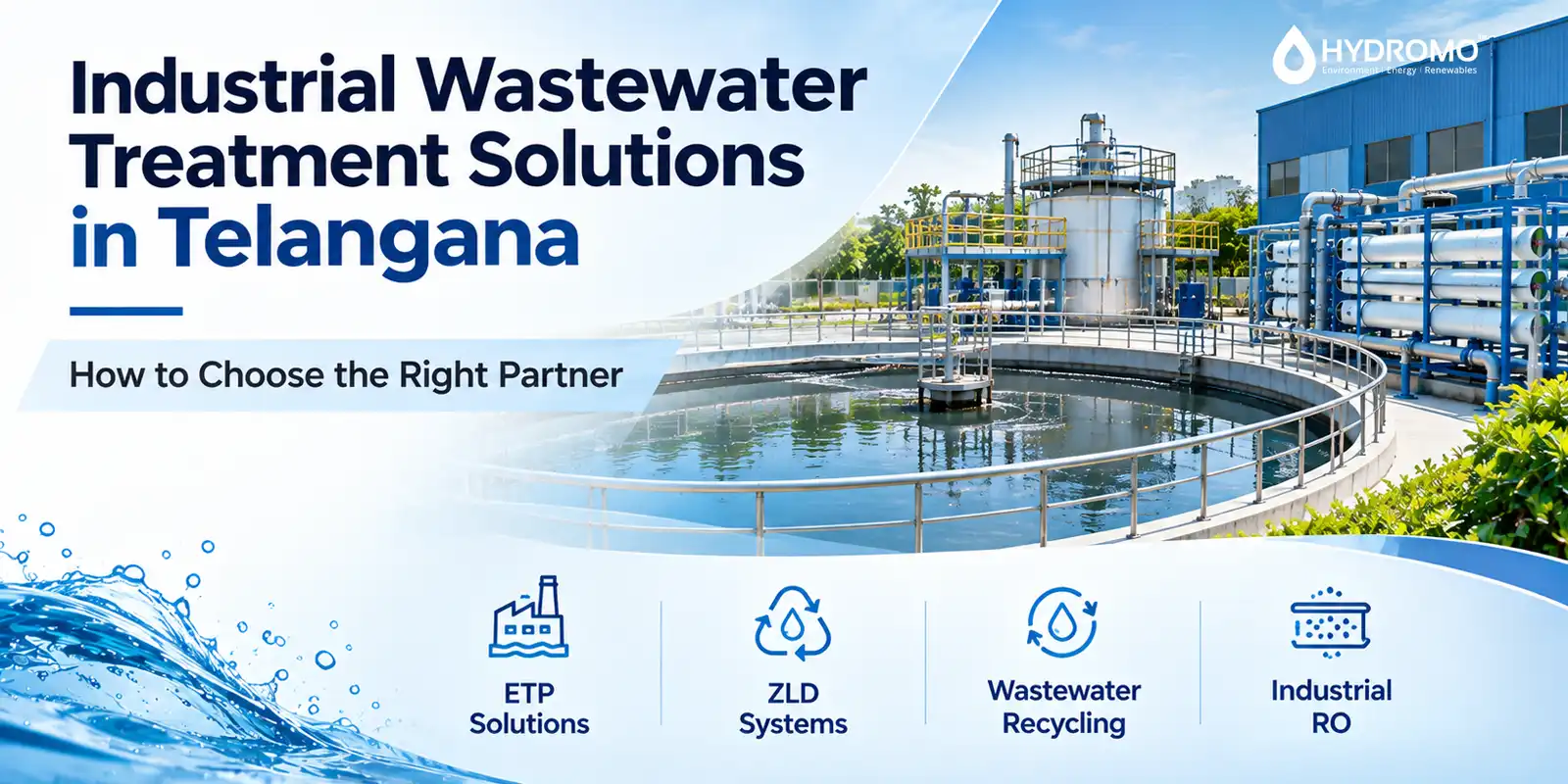
Telangana has a strong base of companies that design, build and maintain effluent treatment plants. Hydromo is one of them, working across effluent treatment (ETP), zero liquid discharge (ZLD), wastewater recycling and industrial RO for factories in Hyderabad and across the state. The harder part for any plant manager is choosing a partner, because two proposals with the same capacity on paper can differ a lot in outlet quality, power use, chemical use and membrane life.
If you only remember one thing from this page: compare proposals on what the plant costs to run over its full working life, not on the purchase price.
Why Telangana units face stricter wastewater expectations
The state has a large chemical and pharma base. According to information the Telangana State Pollution Control Board (TSPCB) gave to Parliament, the state has 651 chemical and pharma industries, mostly in and around Rangareddy, Medchal-Malkajgiri, Sangareddy, Medak and Yadadri Bhuvanagiri districts. Jeedimetla, Bollaram, Patancheru, Pashamailaram and Choutuppal are among the named clusters.
Rules are tighter for these units than for most. In a report to the National Green Tribunal, the board stated that bulk drug industries generating more than 25 KLD of effluent must provide a Zero Liquid Discharge (ZLD) system, with the treated water reused inside the unit and no discharge. Units must also install online flow meters on low-TDS and high-TDS streams, RO permeate and ETP outlets, connected to the board’s servers.
Enforcement is real. In one case before the National Green Tribunal, the board issued a closure order to an industrial unit, citing inadequate ETP capacity to implement ZLD. The same report records 800 KLD of high-TDS effluent against an evaporator rated at 85 KLD and a thin-film dryer at 5 KLD, and the board’s direction to augment the ETP, RO and MEE systems.
The lesson for any plant manager is practical. Undersized evaporation or RO capacity does not show up on commissioning day. It shows up months later when production rises.
Companies offering industrial wastewater treatment in Telangana
Types of providers
Most suppliers fall into one of four groups. Knowing which one you are talking to changes what you should ask.
| Provider type | What they do | Watch out for |
| Turnkey ETP/ZLD companies | Design, build, commission and often operate the full plant | Capacity sized to the tender, not to your future production |
| Equipment makers (RO, UF, MEE, ATFD, filters) | Supply skids and units | You carry the integration risk |
| O&M and AMC specialists | Run, repair and troubleshoot existing plants | Quality depends on operator training and spares access |
| Common effluent treatment plants | Shared treatment for member units | Limits on what effluent types they can accept |
What Hydromo offers industrial units
Hydromo is built around the idea that wastewater treatment and water supply should be planned together. A factory that treats its effluent and then buys fresh water for the same process is paying twice. Hydromo works on both sides of that line.
- Wastewater treatment: Effluent treatment plants (ETP), zero liquid discharge (ZLD) systems, sewage treatment plants (STP) and industrial wastewater treatment for manufacturing, pharma and food and beverage units.
- Wastewater recycling: Systems that return treated water to the process, cooling or utilities, so less fresh water is drawn from borewells or tankers.
- Water treatment: Industrial RO plants, UF and UV treatment, filtration and water softeners, which are the same building blocks that make recycled water usable.
- Energy side: Industrial solar plants and heat pumps, which can be paired with a treatment plant to bring down the power cost of running it.
- One point of contact: Design, supply and installation from a single team means one party answers for how the ETP, UF and RO stages perform together.
Hydromo serves customers in Hyderabad, across Telangana and in neighbouring Andhra Pradesh, so site visits and service calls do not depend on a distant office.
Questions to ask any provider
Use these with Hydromo and with anyone else on your shortlist. We are glad to answer them in writing.
- What outlet quality (COD, BOD, TDS, pH) do you guarantee in the contract, and what happens if the plant misses it?
- What feed-water analysis did you base the design on? Was it a single grab sample or several days of data?
- What are the expected power, chemical and membrane replacement costs per KL of treated water?
- Can I see a running plant in a similar industry and speak to the operator, not only the manager?
- Is online monitoring and the flow-meter connection to TSPCB part of the scope?
- What spares do you hold locally, and what is your response time for a breakdown?
If a provider cannot answer questions 2 and 3 clearly, treat that as an answer.
Cost-effective industrial wastewater management in Hyderabad
Where the money goes
The purchase price is the smaller part of the story. Over the life of a plant the recurring costs add up:
| Cost item | What drives it |
| Energy | High-pressure RO pumps, aeration blowers, evaporator steam or electricity |
| Chemicals | Coagulants, pH correction, antiscalants, membrane cleaning chemicals |
| Membrane and media replacement | Feed quality, pretreatment, cleaning discipline |
| Sludge and salt disposal | Volume of residue and the cost of authorised disposal |
| Manpower and monitoring | Operator skill, automation, lab testing |
We have not quoted rupee figures here because they vary with effluent type, site conditions and plant size. Ask for a written operating cost per KL and check the assumptions behind it.
Five ways to cut lifetime cost
Separate your streams. Keep low-TDS wash water away from high-TDS process effluent. High-TDS volume is what drives evaporator size, and evaporators are expensive to buy and to run. Every KL you keep out of that stream reduces the biggest single equipment cost.
Reduce at the source. Fix leaks, use counter-current washing, and recover solvents before they reach the ETP. A litre not generated is a litre you never treat.
Invest in pretreatment. Spending more on ultrafiltration or a proper clarifier is cheaper than replacing RO membranes early.
Size for future production. The closure case above is a reminder. Ask for a design with room to add a train.
Put maintenance in writing. A plant with no scheduled cleaning and no spares plan loses efficiency quietly. See the maintenance section below.
How a factory can reduce water use through wastewater recycling
Recycling works by matching treated water to the job that needs the least purity.
- Treated low-TDS effluent can often go to cooling tower make-up, floor washing or gardening, depending on what your consent allows.
- RO permeate is clean enough for many process and boiler feed uses, usually after softening or polishing.
- The RO reject (high-TDS stream) goes to evaporation and drying if you are running ZLD.
The order matters. Biological or physico-chemical treatment first, then filtration to remove solids, then RO to remove dissolved salts, then evaporation for the concentrate.
A worked example (illustrative numbers)
These figures are assumptions to show the arithmetic, not results from a Hydromo project.
A unit discharges 100 KLD of treated effluent. Suppose the RO system runs at 70 percent recovery.
- Permeate reused in the plant: 70 KLD
- Reject to evaporator: 30 KLD
That is 70 KLD of fresh water the factory no longer draws from borewells or tankers. If the evaporator was sized for 100 KLD in the original design, it now needs to handle 30 KLD. This is why the order of treatment affects capital cost as well as water savings.
Recovery depends heavily on feed chemistry. Silica, hardness and organics limit how hard you can push an RO system before scaling or fouling starts. A pilot test with your actual effluent is worth doing before you commit.
Membrane filtration systems for industrial wastewater reuse
There is no single best membrane. The right choice depends on what is in the water and what you plan to do with it.
UF, NF, RO and MBR compared
| System | Removes | Typical role in reuse | Main limitation |
| Ultrafiltration (UF) | Suspended solids, colloids, bacteria | Pretreatment ahead of NF or RO | Does not remove dissolved salts |
| Nanofiltration (NF) | Some dissolved organics and divalent ions | Polishing step; can sit between UF and RO | Partial salt rejection only |
| Reverse osmosis (RO) | Dissolved salts and most dissolved contaminants | Produces reusable permeate for process, cooling or boiler feed | Fouls quickly without good pretreatment; produces a reject stream |
| Membrane bioreactor (MBR) | Combines biological treatment with membrane separation | Produces a high-quality feed for downstream RO | Higher capital and operating cost than conventional biological treatment |
Published studies back the UF-then-RO pattern. A study on organised industrial zone effluent concluded that reuse of mixed industrial wastewater can be achieved by NF or RO after microfiltration or ultrafiltration pretreatment. A patent describing UF pretreatment notes that it protects NF and RO membranes from particulate, organic, inorganic and biological fouling.
Maintenance services for industrial wastewater treatment facilities in Telangana
A treatment plant is a process unit, not an appliance. Operation and maintenance or AMC services for ETPs and STPs are available from several providers in Hyderabad, so you have choices. What matters is what the contract actually covers.
What a good maintenance contract covers
- Daily: Log flow, pressure, pH, TDS and power readings. Walk the plant for leaks, abnormal noise and chemical dosing problems.
- Weekly: Check dosing pumps, clean strainers and cartridge filters, test sludge settling, verify instrument calibration.
- Monthly: Review RO and UF trends, inspect blowers and diffusers, test the outlet against consent limits.
- Quarterly or as triggered: Membrane cleaning, MEE or ATFD descaling, motor and bearing checks.
- Annually: Membrane condition assessment, tank and pipework inspection, review of design capacity against production changes.
Good contracts also state response times, name the spares the provider will hold, and require written reports instead of verbal updates.
Conclusion and next step
If you are choosing a wastewater partner in Telangana, ask for guaranteed outlet quality, estimated power and chemical use per KL, membrane replacement cycle and annual maintenance scope. Those four numbers tell you more about the real cost than the equipment price.
Hydromo can review your effluent analysis and daily volumes, tell you what we would test, what we would change and what we would leave alone, and plan the treatment and recycling stages as one system. Request a site assessment or talk to a Hydromo water treatment expert today.
Frequently Asked Questions (FAQs)
1Q. Which companies provide industrial wastewater treatment solutions in Telangana
Ans. Quite a few. Some build full ETP and ZLD plants, some only make equipment, and some only handle operation and maintenance. Hydromo is one of the companies that designs and installs ETP, ZLD and recycling systems. Before you pick any of them, check that they’ve worked in your industry, can support the plant after installation, and know what TSPCB expects from you.
2Q. How do I choose the right industrial wastewater treatment contractor in Hyderabad?
Ans. Start with your effluent. A good contractor will ask for a proper feed-water analysis before quoting anything. Then ask what outlet quality they will guarantee, what the plant costs to run per KL, and whether you can visit a similar plant that’s already running. Also find out how fast they respond when something breaks.
3Q. How much does it cost to install an industrial effluent treatment plant in Telangana?
Ans. It depends on your effluent, and a fixed number would mislead you. The main factors are how much water you treat, how tough it is to treat, the technology you need and the outlet quality you have to meet. RO or ZLD stages add to the cost. The reliable way to get a real figure is a site assessment and a quote based on your own wastewater analysis.
4Q. What are the regulations for industrial effluent discharge in Telangana?
Ans. Your TSPCB consent sets the limits, and they vary by industry and by how you discharge or reuse the water. Bulk drug units that generate more than 25 KLD of effluent must run a Zero Liquid Discharge system. Check your own consent conditions first, since they decide what applies to you.
5Q. How does a Zero Liquid Discharge (ZLD) system work for industrial wastewater?
Ans. ZLD means nothing leaves the plant as liquid. The water is treated, filtered and passed through RO, and the clean water goes back into use. What’s left is a salty concentrate, which is evaporated and dried into solids. The plant reuses the water, and only the dry solids go out for disposal.
6Q. Can an industrial wastewater treatment plant recover water for reuse in manufacturing?
Ans. Yes. Recovered water commonly goes to cooling towers, floor washing and other utility jobs. If it’s treated further, it can also be used in the process itself. How far you need to treat it depends on what the water will be used for.
7Q. Which membrane filtration systems are suitable for industrial wastewater reuse?
Ans. There’s no single best one, because it depends on what’s in your water. UF removes solids and colloids. NF takes out some dissolved substances. RO removes dissolved salts. MBR combines biological treatment with a membrane. Most plants use a combination, and a pilot trial on your own effluent is the best way to find the right one.
8Q. What maintenance services are required for industrial effluent treatment plants?
Ans. A plant needs regular attention. That means daily readings, equipment checks, chemical dosing checks, filter and membrane cleaning, sludge handling and periodic lab tests. A good maintenance contract also covers spare parts, breakdown support and written reports, so you can see how the plant is performing.
9Q. Which wastewater treatment technologies are suitable for pharmaceutical and chemical industries?
Ans. These effluents are usually hard to treat, so one step rarely does the job. Plants often combine physico-chemical treatment, biological treatment, UF, NF, RO and ZLD. What goes into the mix depends on your COD, BOD, TDS, pH and the organics in the water. Strong or complex streams may need extra pretreatment and a pilot test first.
10Q. What factors affect the operating cost of an industrial wastewater treatment plant?
Ans. The main ones are how much water you treat, how difficult it is, and how much power and chemicals the plant uses. Membrane replacement, sludge disposal, manpower and maintenance add to that. RO pumps, aeration blowers and evaporators use the most energy. When you compare vendors, ask each one for the running cost per KL of treated water.