
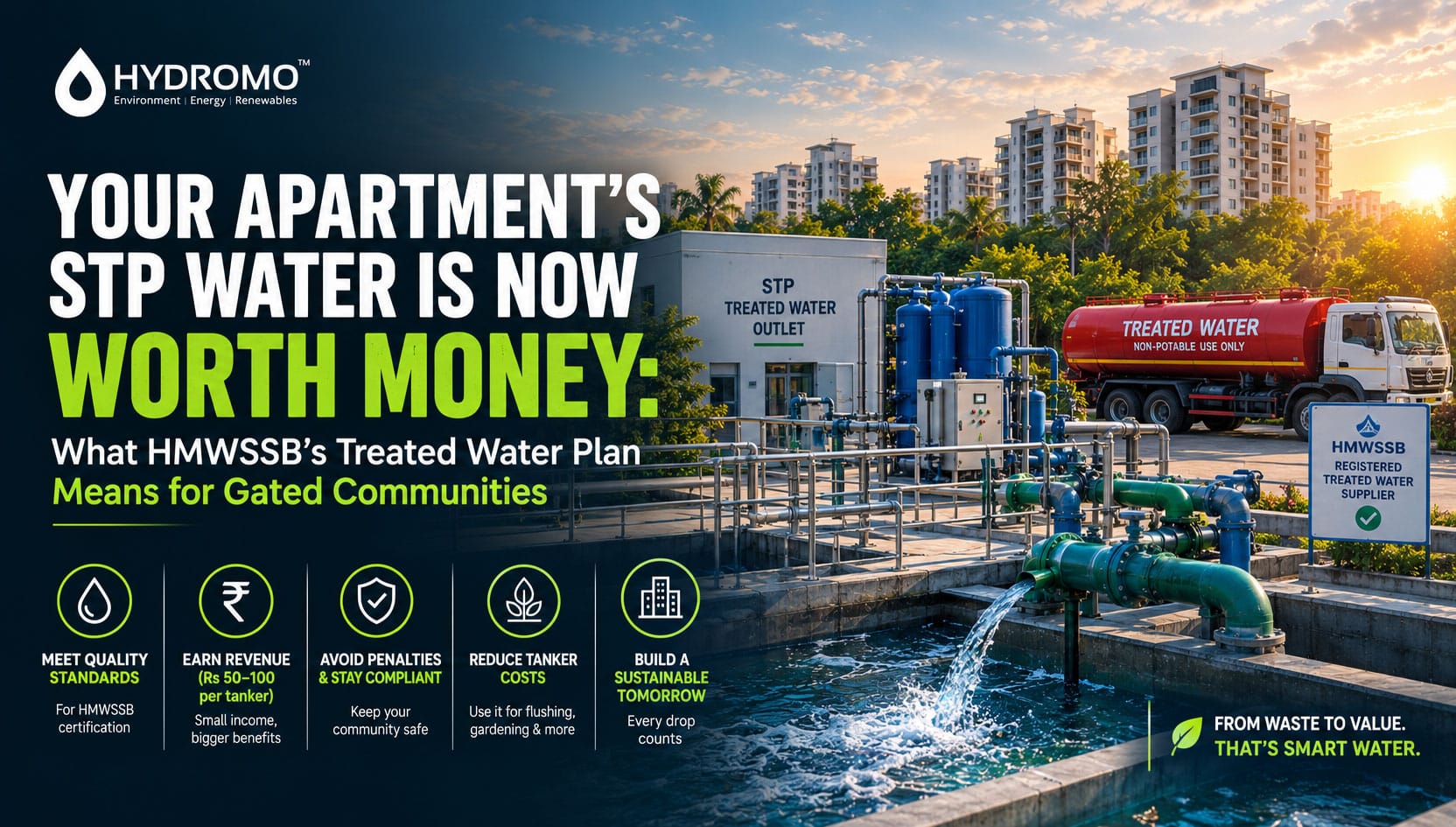
Gated communities in Hyderabad send roughly 200 million litres of treated water a day out of their STPs, and most of it ends up in nearby lakes and nalas. At the same time, the city is short of water and residents are paying for tankers. HMWSSB has noticed the mismatch, and it now wants to buy that treated water back.
If you sit on an apartment committee, this affects you. Whether it pays off depends almost entirely on one thing: what comes out of your STP’s outlet pipe.
What is HMWSSB actually asking apartment communities to do?
HMWSSB has asked RWAs that run private STPs to register with the board. Registered plants will be surveyed, geo-tagged and added to a database. The board plans to certify them as treated-water suppliers, inspect them regularly, and let them post how much water they have available on an online portal, so nearby users can be matched to a supplier.
The water is meant for non-potable use: construction, landscaping, cleaning and industry. Reports also say the board will run red-coloured tankers for collection, with a “Dial Your Tanker” service, starting as a pilot with three tankers. Drinking water stays on the blue tankers.
The registration date the board first announced was October 1. It has passed, so call HMWSSB or check their website for the current status before you plan anything.
How much money are we talking about?
Less than most committees will hope. The reported rate is Rs 50 to Rs 100 per tanker. For a community producing, say, 100 KLD, the income will not change your maintenance budget.
The real value sits elsewhere:
- Compliance. HMWSSB has already fined a commercial establishment in Jubilee Hills Rs 1 lakh for letting treated STP water run onto a public road. Registered, documented reuse puts you on the right side of that.
- Lower tanker bills. Treated water used for flushing, car washing and garden irrigation inside your own community replaces water you would otherwise buy.
- A clean record. If your outlet water is regularly tested and logged, a complaint from a neighbour or an inspection becomes a non-event.
So the headline is catchy, but the honest summary is this: the payment is small, and avoiding penalties and tanker costs is the bigger win.
What does your STP need to meet before it can supply water?
I have not seen HMWSSB publish a final list of quality limits for supplier certification. The board has said certified plants will be checked against prescribed standards, so get the exact numbers from the board and do not rely on anyone’s summary. What you can prepare now is the list of things an inspector will almost certainly look at.
A valid pollution control board consent. Check that your Consent to Operate has not expired. Many apartment STPs have a consent that lapsed years ago and nobody noticed.
Outlet water that passes a lab test. The usual parameters are BOD, TSS, pH, turbidity, residual chlorine and faecal coliform. Get a sample tested at an accredited lab, not just the TDS pen the operator carries. A clear-looking outlet can still fail on coliform.
A tertiary stage. A plant that stops at secondary treatment often cannot deliver water that is safe for tanker handling and reuse. Pressure sand filtration, activated carbon and disinfection (chlorination or UV) are the usual add-ons.
A flow meter and a logbook. If you cannot say how many litres left the plant yesterday, you cannot register as a supplier. Daily flow, chemical dosing and monthly lab reports should be on paper or on a screen.
A separate, labelled treated-water tank. No cross-connection with the drinking water line. This is a safety point that inspectors take seriously.
A trained operator. Someone who is on site every day, including Sundays, and knows what to do when the blower trips.
Why do so many apartment STPs fail on outlet quality?
Usually it is not a bad design. It is the slow drift after handover.
Occupancy rises above what the plant was sized for. A blower stops and the replacement is delayed for weeks. Sludge is not removed on schedule. The operator is paid so little that the job becomes a daily walk-around rather than an actual check. And the tertiary stage, if there was one, was switched off to save electricity.
A plant that is running is not the same as a plant that is meeting its outlet norms. Most committees only find the difference when a complaint arrives.
What should the committee do now?
- Find your Consent to Operate and check the validity date.
- Send an outlet sample to an accredited lab and keep the report.
- Check how many KLD the plant actually receives against its design capacity.
- Inspect the aeration, blowers, filters and disinfection stage. Note what is not working.
- Fix the gaps, or get a professional audit to tell you which ones matter.
- Contact HMWSSB for the current registration process and quality criteria.
- Decide how much treated water you will reuse yourself before offering the rest.
Is your STP ready for treated water supply?
If you are not sure what your outlet water would show, test it before you register. Hydromo can audit your STP, check your outlet quality, and tell you what needs fixing and what does not. Book a Free Water Audit or Talk to Hydromo Experts at +91 7995201717.
Frequently asked questions
Is it compulsory for my apartment STP to register with HMWSSB?
The board has urged and invited RWAs to register, and the announcement describes interested plants being certified. I have not seen it described as compulsory, but confirm with HMWSSB directly, because rules around reuse are changing and the state is also drafting a wastewater reuse policy.
How much will HMWSSB pay for treated water?
The reported rate is Rs 50 to Rs 100 per tanker. The pilot is small, so treat it as a possible bonus and not as income to plan around.
Can treated STP water be used for drinking?
No. It is for non-potable use only: flushing, gardening, construction, cleaning and some industrial processes.
Our STP is more than ten years old. Is it still worth registering?
It depends on the outlet test result. If the plant passes after minor repairs, yes. If it needs a new aeration system or a tertiary stage, get a cost estimate first. A revamp is often cheaper than a new plant.
What happens if we do nothing?
You can keep operating as before, but discharging treated water onto roads or into drains can attract penalties, as the Rs 1 lakh fine showed. Documented reuse is the safer option.