
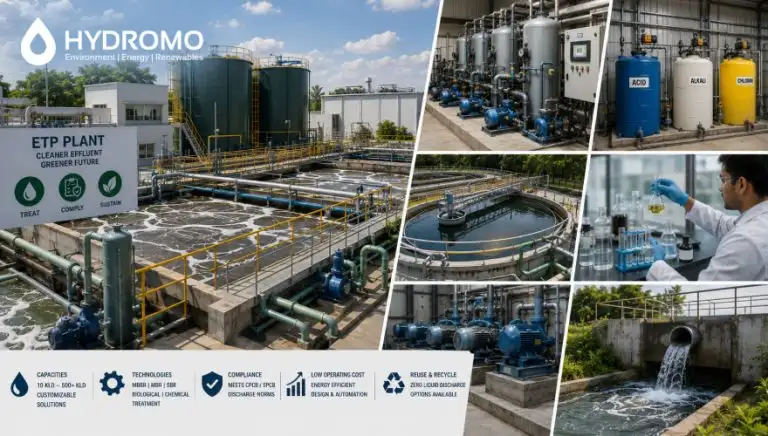
Most factory owners get their first real shock not from the ETP itself, but from how differently two vendors price the same requirement. One quote lands at ₹18 lakh, another at ₹32 lakh, and both claim to be for a “100 KLD plant.” Before you sign anything, it’s worth understanding what drives ETP plant cost in India, since the capacity number on a quotation tells you far less than most buyers assume.
This guide covers what shapes the price, what realistic budgets look like at different capacities, and where costs tend to hide once the plant is running.
What Is an ETP Plant?
An effluent treatment plant treats industrial wastewater before it’s discharged or reused, removing suspended solids, organic load, oils, and, in some cases, heavy metals and color. Any factory generating process wastewater, not domestic sewage, which falls under an STP instead, typically needs one to meet discharge norms set by the State Pollution Control Board.
This isn’t optional infrastructure. Industries are required to treat effluent to prescribed standards before discharge, and operating without adequate treatment can mean penalties or a denied consent to operate, which is exactly why getting the investment right matters more than chasing the lowest quote.
Why Does ETP Plant Cost Vary?
Plant capacity sets the baseline, but it’s rarely what separates a good quote from an inflated one. Two plants of identical capacity can differ by lakhs depending on everything below.
Wastewater characteristics matter more than most buyers expect. High COD or BOD load, dyes, oils, or heavy metals all demand additional treatment stages that simpler effluent, say from a beverage unit, doesn’t need.
Treatment technology shifts pricing directly. MBBR remains the more economical, widely used option; MBR delivers cleaner output but typically costs 20–35% more on the capital side.
Automation level is a genuine choice. Manual controls cost less to install but need closer supervision. PLC/SCADA-based systems with online pH, DO, and flow monitoring add several lakhs but reduce day-to-day operator dependency.
The material of construction, RCC versus MS or FRP tanks, affects both upfront cost and long-term durability, particularly for corrosive effluent.
Discharge standards, civil work, installation, location, and compliance requirements all add further variation: Tighter norms mean extra treatment stages; greenfield civil work can add 30–40% over equipment cost; remote sites push up transport and labor; and mandatory monitoring or ZLD requirements raise both capital and running costs.
Estimated ETP Plant Cost in India by Capacity
| Plant Capacity | Estimated Price Range | Suitable For |
| 10–25 KLD | ₹8–18 Lakhs | Small industries |
| 25–50 KLD | ₹15–28 Lakhs | Medium industries |
| 50–100 KLD | ₹22–38 Lakhs | Growing industries |
| 100 KLD | ₹25–40 Lakhs | Large manufacturing units |
| 200 KLD | ₹45–80 Lakhs | Large factories |
| 500 KLD | Contact for a quotation. | Large industrial plants |
These figures are indicative, not fixed quotations. The actual effluent treatment plant price depends on wastewater quality, treatment process, automation level, and site-specific civil requirements; two facilities at the same capacity can land at meaningfully different numbers once their effluent is actually tested.
100 KLD ETP Plant Cost Explained
A 100 KLD ETP is common enough across mid-sized manufacturing units that it’s worth unpacking what the number actually covers. Core equipment, tanks, aerators, clarifiers, and dosing systems form one part of the budget, but civil work for RCC tanks and foundations is often the bigger line item on a greenfield site.
Pumps and blowers need sizing around actual flow and aeration demand, not a generic capacity figure; undersized equipment hurts treatment performance, and oversized equipment wastes power. Piping and electrical work form a steady chunk of cost regardless of technology choice, and automation is where the biggest optional spend sits: a basic manual-control unit lands toward the lower end of the range, while SCADA-based monitoring pushes it toward the top. Installation and commissioning typically run a few weeks once equipment arrives, assuming civil work is already complete, and none of this yet accounts for ongoing operating costs, covered further down.
Industries That Commonly Require an ETP
- Pharmaceuticals — often dealing with solvents and trace organics that demand advanced treatment
- Chemical manufacturing — variable effluent load depending on the process
- Food processing — typically high organic load, moderate treatment complexity
- Textile—color and chemical-heavy effluent, often needing tertiary treatment
- Dairy — high organic content, generally well-suited to biological treatment
- Automobile manufacturing — oils, greases, and metal finishing effluent
- Electroplating—heavy metals, requiring specialised removal stages
- Paper & pulp — high volume, high organic and chemical load
- Beverage manufacturing — comparable to food processing in treatment needs
Each of these carries a different baseline cost even at matching capacity, because the effluent itself sets the treatment complexity.
Hidden Costs Buyers Often Overlook
The purchase price is the visible number. Real ownership cost includes several recurring items that rarely make the initial conversation: electricity (largely aeration and pumping), chemicals for pH correction and disinfection, sludge disposal scaling with plant size, labor for daily operation, spares for pumps and blowers, annual maintenance contracts, compliance testing, and periodic equipment servicing.
Together, these typically add 15–25% to the total investment over three to five years. Buyers who compare only the purchase price often pay more later through breakdowns, non-compliance issues, or a plant that never performs as designed.
How to Reduce Overall ETP Cost Without Compromising Performance
Right-sizing the plant is the single biggest lever. Oversizing ties up capital unnecessarily; undersizing forces a retrofit within a few years, which usually costs more than getting it right from the start. A proper effluent characterization study before design prevents both mistakes.
Choosing technology based on actual wastewater data, rather than defaulting to the most advanced option available, avoids paying for treatment capability you don’t need. MBBR handles a large share of industrial effluent well and costs less than MBR; save MBR for cases where discharge norms genuinely require it.
Energy-efficient blowers are worth the marginal extra cost upfront, since aeration typically accounts for 60–70% of an ETP’s power draw. Combining smaller effluent streams into one adequately sized plant, instead of running multiple small units, also improves the cost-per-KLD significantly. And working with a provider who tests your effluent before quoting, rather than pricing off capacity alone, tends to prevent the redesigns and change orders that quietly inflate budgets mid-project.
Conclusion
ETP plant cost in India depends on far more than the KLD number on a quotation; wastewater characteristics, treatment technology, automation, and civil scope all move the price, sometimes by lakhs, even at matching capacity. The ranges in this guide offer a starting point for budgeting, not a substitute for a proper site assessment.
If you’re planning an industrial wastewater treatment system and want a cost estimate based on your actual effluent rather than a generic capacity figure, it’s worth consulting an experienced ETP provider who can assess your site and wastewater directly before quoting.
Talk to our expert team—free consultation: hydromo.in | +91 7995201717
Frequently Asked Questions
What is the average ETP plant cost in India?
It varies widely by capacity and effluent type, but mid-sized industrial ETPs (50–100 KLD) commonly range from ₹22–40 lakh, with smaller and larger plants scaling accordingly.
What is the 100 KLD ETP plant cost?
Typically ₹25–40 lakh, depending on treatment technology, automation level, and civil scope. Complex effluent (pharma and textile) pushes this toward the higher end.
What affects effluent treatment plant costs the most?
Wastewater characteristics and treatment technology tend to move the number more than capacity alone; two plants of the same size can differ significantly based on effluent complexity.
How much space is required for an ETP?
This depends on capacity and technology, but as a rough guide, expect more space for civil-heavy, tank-based systems and less for compact or containerized units.
How long does ETP installation take?
Equipment installation and commissioning typically take a few weeks once civil work is complete; the civil construction phase itself can add several more weeks depending on site conditions.
What are the operating costs of an ETP?
Ongoing costs include electricity, chemicals, sludge disposal, labor, and maintenance, commonly 15–25% of the initial investment annually once the plant is fully operational.
Can an ETP be upgraded later?
Yes, in most cases capacity or treatment stages can be added, though it’s more cost-effective to size the plant correctly at the outset than to retrofit later.
Does a smaller plant always cost less?
Not proportionally. Fixed costs like engineering, controls, and commissioning spread across less volume in smaller plants, so cost per KLD is usually higher for small capacities than for larger ones.