
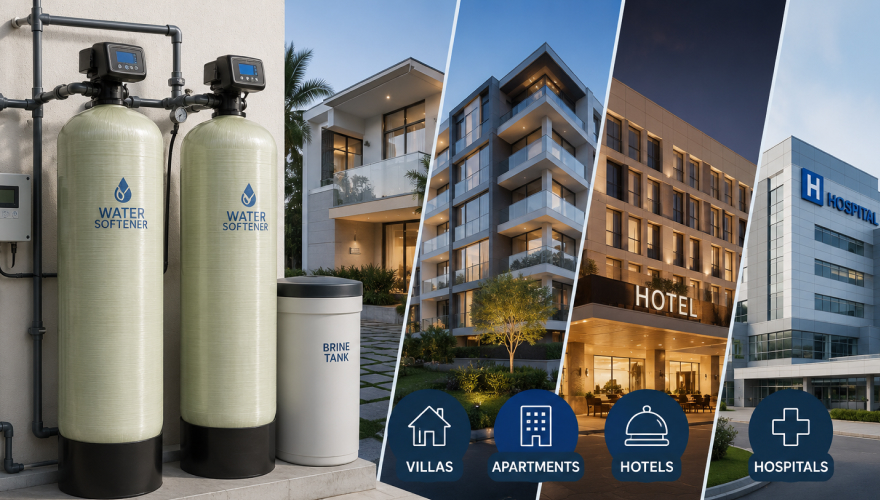
If your taps leave white crust on faucets, your skin feels itchy after a shower, or your hotel’s boiler keeps breaking down, hard water is almost certainly the culprit. Across Hyderabad, Telangana, and much of South India, groundwater hardness levels routinely exceed 500 mg/L, well above the BIS acceptable limit of 200 mg/L. Whether you’re managing a gated community in Kondapur or running a 100-bed hospital in Visakhapatnam, a water softener isn’t a luxury; it’s infrastructure.
Here’s everything you need to know before buying water softeners for villas, apartments, hotels & hospitals in 2026.
What Does a Water Softener Actually Do?
A water softener removes dissolved calcium and magnesium ions, the minerals that make water “hard” through a process called ion exchange. Hard water enters a resin tank filled with sodium-charged beads. The calcium and magnesium swap places with the sodium, and softened water flows out the other side.
The result? No scale buildup in pipes, no soap scum in bathrooms, longer-lasting appliances, and noticeably softer skin and hair. For commercial users like hotels and hospitals, the difference in boiler efficiency and linen quality alone can justify the investment within the first year.
5 Signs Your Home/Property Needs a Water Softener
You don’t need a lab test to suspect hard water. These signs show up quickly:
1. White or yellowish scale on taps and fixtures: That crusty buildup on your bathroom fittings is calcium carbonate. It’s the most visible symptom of hard water and one of the hardest to scrub off.
2. Soap won’t lather properly: Hard water reacts with soap to form a sticky residue instead of a foam. If you’re using twice the shampoo or soap and still not getting a good lather, hard water is likely why.
3. Frequent geyser or boiler breakdowns: Scale deposits act as insulation inside heating elements. A 6mm layer of scale can reduce heating efficiency by up to 40%, driving up electricity bills and causing premature equipment failure.
4. Rough, stiff laundry: Hotels and hospitals washing linens daily notice this quickly. Hard water makes fabrics feel scratchy and fades colors faster, increasing linen replacement costs significantly.
5. Skin dryness and hair fall: Hard water strips natural oils from skin and hair. Dermatologists in Hyderabad frequently trace unexplained skin conditions back to water quality at home.
Water Softener Cost for Apartments, Villas, Hotels & Hospitals
Pricing depends on flow rate, regeneration type, and whether it’s a standalone unit or integrated with an existing water treatment setup.
| Property Type | Typical Capacity Needed | Approximate Cost Range (2026) |
| 2–3 BHK Apartment / Villa | 500–1,000 LPH | ₹18,000 – ₹45,000 |
| Gated Community (50–200 flats) | 2,000–5,000 LPH | ₹85,000 – ₹250,000 |
| 3-Star to 5-Star Hotel | 5,000–20,000 LPH | ₹200,000 – ₹800,000 |
| Hospital (50–300 beds) | 5,000–15,000 LPH | ₹180,000 – ₹650,000 |
These figures cover the unit, installation, and initial commissioning. Annual maintenance (resin recharging, salt refills, servicing) typically adds 8–12% of the equipment cost per year. Automatic regeneration systems cost more upfront but require significantly less manual intervention, which is worth considering for hospitals and hotels where water demand is continuous and unpredictable.
Water Softener vs. RO System for Villas: Which One Do You Actually Need?
This is one of the most common questions homeowners ask, and the honest answer is they solve different problems.
An RO system purifies water and removes bacteria, dissolved solids, heavy metals, and most contaminants. It’s designed for drinking water and typically treats 15–25 liters per hour at the point of use (your kitchen tap).
A water softener doesn’t purify water; it targets the hardness minerals that damage appliances, pipes, skin, and hair. It treats all the water entering your property, not just the drinking water.
For most villas in Hyderabad or Vijayawada, the ideal setup is both a water softener at the point of entry (treating all water flowing into the building) combined with an RO purifier at the kitchen tap for drinking water. Softened feed water also extends the life of your RO membrane by 30–50%, reducing replacement costs over time.
If budget forces a choice, and your TDS is below 500 mg/L but hardness is high, start with the softener. If TDS is high and you’re concerned about drinking water purity, start with the RO.
Commercial Water Softener Installation Guide
For hotels, hospitals, apartment complexes, and industrial facilities, installation is more involved than a residential unit, but the process follows a clear sequence.
Step 1: Water Quality Testing
Before any equipment is specified, a proper water audit is essential. Hardness level (in ppm or mg/L), TDS, pH, iron content, and flow rate data determine the right system size and resin type. Skipping this step is the most common reason commercial softeners underperform.
Step 2: System Sizing
A softener sized too small will either fail to treat all the water or require constant regeneration. For hospitals, you’ll want to account for peak demand (morning rounds, surgery prep, laundry cycles). Hotels need to factor in occupancy variation across seasons.
Step 3: Inlet and Bypass Plumbing
The softener is installed on the main supply line, after any pressure tanks or storage and before distribution. A bypass valve is mandatory; it allows the system to be serviced without shutting off water to the entire facility.
Step 4: Brine Tank Setup and First Regeneration
The brine tank is filled with food-grade softener salt. During commissioning, the resin is charged, and an initial regeneration cycle is run to verify correct operation, flow rates, and output hardness.
Step 5: Control System Programming
Automatic systems can be timer-based or demand-initiated. Demand-initiated regeneration, which triggers based on actual water usage, is more efficient and recommended for facilities with variable demand like hospitals and hotels.
Step 6: Post-Installation Testing
Output hardness should be verified with a test kit immediately after commissioning and again at 30 days. A properly functioning system should bring hardness below 50 mg/L consistently.
Why Hydromo for Water Softener Solutions in Hyderabad and Telangana?
Hydromo has designed and installed water softening systems in various residential complexes, five-star hotels, govt. hospitals, and pharmaceutical manufacturers in Hyderabad, Vijayawada, and Visakhapatnam. We don’t just sell units; we play a vital role in water audits, advising on the most appropriate water system for your site and offering long-term AMC support.
Our systems are sourced from proven manufacturers and are designed for Indian water conditions and have a local person to service the systems, with a response time of 24/48 hours.
Ready to Fix Your Hard Water Problem?
Whether you’re a villa owner in Hyderabad, a facility manager at a hospital, or a developer planning a new gated community, Hydromo’s team can assess your water quality, recommend the right system, and handle installation end-to-end.
Talk to our expert team—free consultation: hydromo.in | +91 7995201717
FAQ:
How long does a water softener last?
A well-maintained commercial water softener typically lasts 10–15 years. Resin beds may need replacement every 8–10 years depending on usage and water quality.
Does softened water affect drinking water taste?
Softened water has a slightly higher sodium content. For most people this is negligible, but if you’re on a low-sodium diet or treating water for a dialysis unit, an additional RO stage for drinking water is advisable.
How much salt does a commercial softener use?
It varies by hardness level and volume treated. A mid-sized hotel processing 10,000 liters per day might consume 5–8 kg of salt per regeneration cycle.
Can a water softener be installed in an apartment without a plumber?
Residential units under 500 LPH can be self-installed with basic plumbing knowledge, but professional installation is recommended to ensure warranty coverage and optimal performance.