
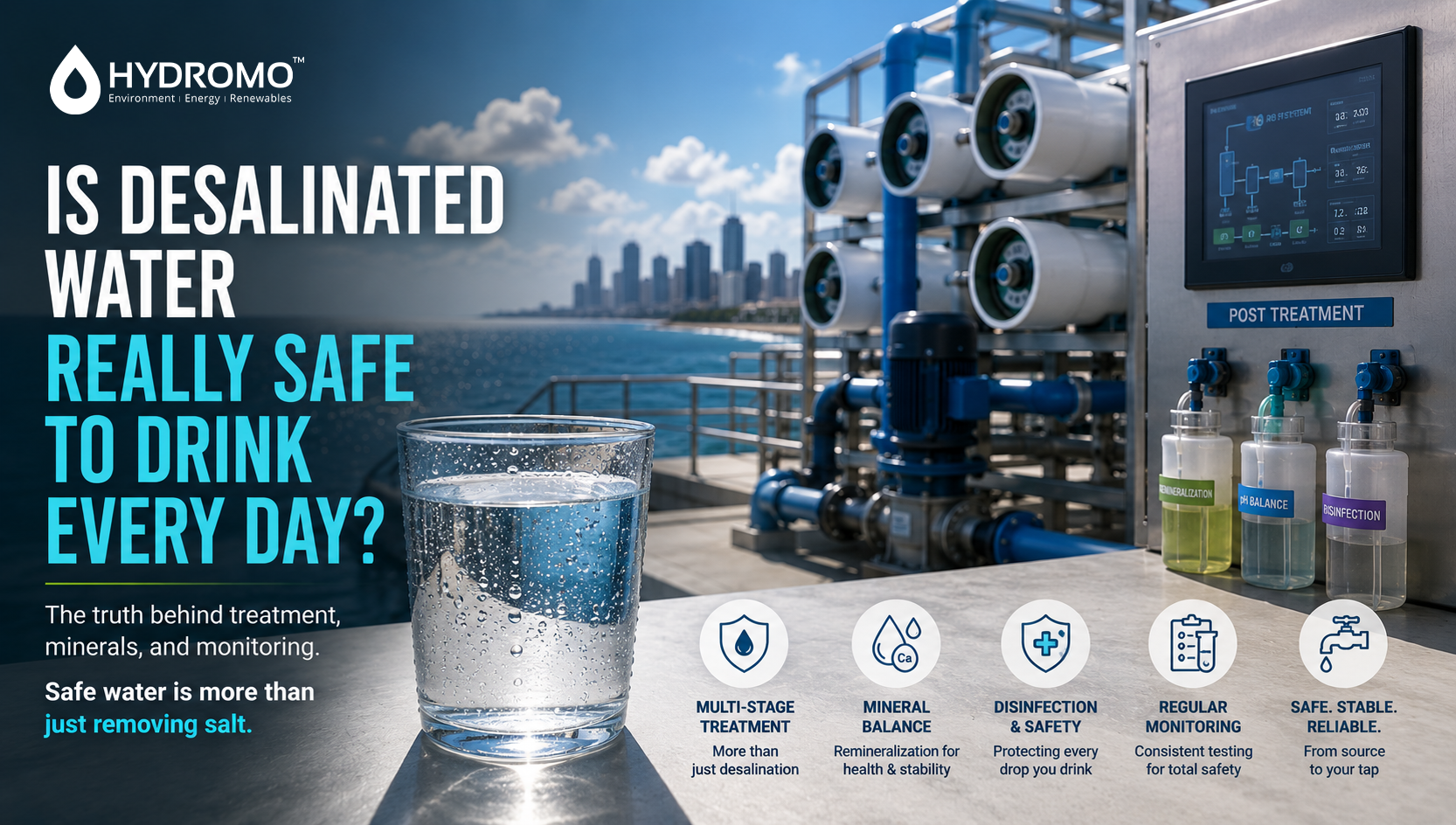
Yes, properly treated and monitored desalinated water can be safe to drink every day. But that safety doesn’t come from the desalination step alone, it comes from everything that happens after it. Removing salt from seawater or brackish water is only the first part of the job. What happens next, disinfection, remineralization, pH correction, storage, and ongoing testing, is what actually determines whether the water coming out of your tap is safe to drink day after day.
If you’re relying on desalinated water at home, in a hotel, hospital, or industrial facility, the real question isn’t “is desalination safe?” It’s “is this particular system, from source to tap, being run and monitored the way it should be?”
Is Desalinated Water Safe to Drink Every Day?
Shortly: yes, when the full treatment chain is working correctly. Desalination itself, usually reverse osmosis (RO), is highly effective at stripping out salts, most dissolved solids, and many contaminants. That’s not in question. What’s less understood is that RO-treated water, straight off the membrane, isn’t finished drinking water. It’s typically low in minerals, slightly acidic, and can be corrosive to pipes if sent straight into a distribution system. Water utilities and treatment operators know this, which is why credible desalination plants always include post-treatment steps before the water reaches a consumer.
Properly treated desalinated water can be safe for daily drinking. Removing salt is only one part of producing safe drinking water, the rest of the process matters just as much.
What Happens to Water During Desalination?
Most desalinated water today comes from reverse osmosis, where seawater or brackish water is pushed through a semi-permeable membrane under pressure. The membrane blocks salt, most dissolved contaminants, and a large share of microorganisms, letting mostly pure water pass through.
That’s the part people usually picture when they hear “desalination.” But the water that comes off the membrane isn’t ready to drink as-is. It’s essentially stripped water, very low in total dissolved solids (TDS), missing the minerals people are used to, and chemically unstable. This is exactly why desalination plants don’t stop at the RO step. The finished quality of the water depends on what’s added and controlled afterward, not on the membrane alone.
What Makes Desalinated Water Safe for Daily Drinking?
A handful of things need to happen consistently, not just once during commissioning:
- Disinfection to control microbial risk after the membrane stage and during storage
- Remineralization or stabilization, usually by dosing calcium (often as lime or calcite) and adjusting alkalinity, so the water isn’t corrosive to pipes and fittings
- pH correction, since RO-treated water tends to be mildly acidic before adjustment
- Routine water-quality monitoring, not a one-time test, but ongoing checks of pH, hardness, residual disinfectant, and microbial indicators
- Well-maintained storage tanks and distribution lines, since water quality can degrade between the plant and the tap if tanks aren’t cleaned or pipes are old and scaled
None of this is exotic. It’s standard water treatment practice. But it has to actually be done, and done consistently, for daily consumption to be safe over the long run.
Does Desalinated Water Have Enough Minerals?
This is probably the most common concern people raise, and it deserves a straight answer: freshly desalinated water, before remineralization, is naturally low in calcium, magnesium, and other minerals. That’s a normal outcome of the treatment process, not a defect.
Two things are worth understanding here. First, drinking water is generally only a modest contributor to your total daily mineral intake, food is the primary source for most people. Second, this is exactly why remineralization exists as a standard treatment step. Facilities typically add calcium and adjust alkalinity to bring the water into a stable, non-corrosive range, though magnesium and other trace minerals are sometimes addressed less consistently across different systems.
Low TDS by itself doesn’t mean the water is unsafe, but it’s also not proof of anything. TDS tells you about mineral content, not about microbial safety, disinfection byproducts, or whether the water is corrosive. Judging safety by TDS alone is a common mistake.
What Are the Possible Risks?
When desalinated water is poorly managed, a few realistic issues can show up:
- Inadequate remineralization or stabilization, leaving water corrosive enough to pick up metals from pipes and fittings over time
- Gaps in disinfection, allowing microbial regrowth, especially in warm climates or systems with low disinfectant residual
- Contaminants not fully addressed, such as boron, which RO membranes remove less efficiently than salts and which needs separate attention in some source waters
- Poor storage conditions, tanks that aren’t cleaned regularly, or that allow stagnant water to sit for long periods
- Aging or poorly maintained distribution lines that reintroduce contamination downstream of an otherwise well-treated supply
None of these are reasons to assume desalinated water is inherently risky. They’re reasons the system, not just the treatment technology, needs to be monitored end to end.
How Can You Tell If Desalinated Water Is Safe?
A practical checklist for homeowners, facility managers, and business owners:
- Confirm the water meets applicable drinking-water standards for your region
- Ask whether the supply undergoes regular, independent laboratory testing
- Check pH, hardness, and residual disinfectant levels, not just TDS
- Confirm the treatment train includes proper post-treatment (remineralization/stabilization), not just RO
- Inspect or ask about storage tank maintenance and distribution line condition
- Don’t treat a low TDS reading as proof of safety on its own
Desalinated Water vs Regular Drinking Water
| Factor | Desalinated Water | Conventional Freshwater |
| Salt/TDS | Usually much lower | Varies by source |
| Minerals | Usually lower before post-treatment | Naturally variable |
| Treatment requirement | Requires controlled treatment and post-treatment | Depends on source quality |
| Drinking safety | Depends on treatment and monitoring | Depends on source and treatment |
| Monitoring | Essential | Essential |
Neither source is automatically healthier than the other. Safety in both cases comes down to how well the water is treated, stabilized, and monitored before it reaches a tap.
So, Can You Drink Desalinated Water Every Day?
The real question isn’t whether desalinated water is inherently safe or unsafe. It’s whether the complete system, source water, membrane treatment, disinfection, remineralization, storage, and distribution, consistently delivers water that meets recognized drinking-water quality standards. When it does, daily consumption isn’t a concern. When any part of that chain is neglected, that’s where problems creep in.
Practical takeaways:
- Desalination removes salt effectively, but that alone doesn’t make water safe to drink
- Post-treatment remineralization, pH correction, disinfection are what makes desalinated water stable and suitable for daily use
- Low mineral content isn’t automatically dangerous, but it does need to be addressed through proper treatment
- Ongoing monitoring matters more than any single test result
For facilities and businesses evaluating or operating desalination and RO systems, getting the post-treatment and monitoring right is where Hydromo’s water treatment expertise comes in, from RO plant design to remineralization and ongoing water quality management.
FAQ
Does desalinated water contain minerals?
Freshly desalinated water is naturally low in minerals like calcium and magnesium. Treatment plants typically add minerals back during a remineralization step to stabilize the water before distribution.
Is desalinated seawater healthy?
Properly treated desalinated seawater is not considered unhealthy for regular consumption. Drinking water is only one part of overall mineral intake, and food remains the main dietary source for most people.
Does desalination remove all contaminants?
Reverse osmosis removes most salts and a wide range of contaminants, but it doesn’t address every element equally well—boron is one example that may need separate attention. This is why finished water quality depends on the complete treatment process, not the membrane alone.
Why is remineralization needed after desalination?
Water straight off an RO membrane is low in minerals and can be corrosive to pipes. Remineralization adds back calcium and adjusts alkalinity and pH to make the water stable and suitable for distribution and daily use.