
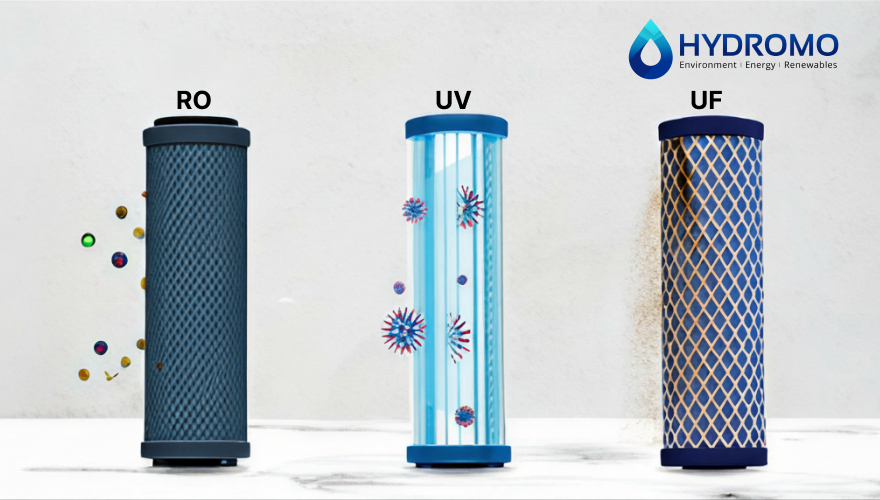
Choosing the right water purifier isn’t as simple as picking the cheapest model online.
Confused between RO vs UV vs UF? Learn the key differences and choose the right water purifier for your home.
Your home’s water quality decides everything. Let’s break down the real differences so you can stop second-guessing.
RO Water Treatment Plant Process
Reverse Osmosis (RO) is the heavy-duty option most people think of when they hear “water purifier.” It works by pushing water through a super-fine semi-permeable membrane under high pressure. The membrane has pores as tiny as 0.0001 micron — smaller than even dissolved salts, heavy metals, fluoride, arsenic, and pesticides.
Here’s how the full process usually goes in a good RO system:
1. Sediment filter catches visible dirt, sand, and rust.
2. Activated carbon filter removes chlorine, bad smell, and organic chemicals.
3. The RO membrane does the main job — it blocks almost everything except pure water molecules.
4. Many modern units add a UV lamp or UF stage afterward for extra safety, plus a TDS controller so the water doesn’t taste flat or overly bitter.
RO needs electricity to create that pressure. Out of every 3 litres you put in, you typically get 1 litre of pure water and 2 litres of wastewater (which you can still use for plants or cleaning). It’s perfect for borewell or tanker water where TDS is above 300 ppm. Advanced versions even have pH-balancing cartridges because plain RO can make water slightly acidic. If your area has hard, salty, or chemically contaminated water, RO is the only technology that actually reduces TDS effectively.
UV Water Treatment Plant
UV purification is completely different — it doesn’t filter anything out; it just zaps germs. Water flows through a chamber with a UV lamp that blasts ultraviolet rays. These rays damage the DNA of bacteria and viruses so they can’t multiply or make you sick.
UV purifiers are simple: usually just a sediment filter, carbon filter, and the UV chamber. They run on electricity but don’t need extra pressure, so they work fine with normal tap water flow. The big advantage? They don’t waste any water and keep all the natural minerals intact.
But UV has one major limitation — it only kills microbes. The dead bacteria and viruses stay in the water unless there’s also a UF membrane. And it does absolutely nothing about dissolved salts, hardness, or chemicals. That’s why UV is recommended only when your TDS is below 200-300 ppm and the main problem is microbiological contamination (like in municipal supply during monsoon).
UF Water Treatment Plant
Ultra Filtration (UF) sits in the middle. It uses a hollow-fibre membrane with 0.01 micron pores. Water is forced through these tiny holes by normal tap pressure — no electricity required. The membrane physically blocks bacteria, viruses, cysts, and all suspended particles. Unlike UV, UF actually removes the germs instead of just killing them.
UF is fantastic for people who face frequent power cuts or want zero maintenance hassle. It works great on municipal tap water where TDS is already low (under 300 ppm) and the water is mostly clear. The downside? It cannot remove dissolved solids, salts, or heavy metals. So if your water comes from a borewell or has high TDS, UF alone won’t cut it.
Difference Between RO, UV and UF Water Purifier
Here’s the quick, no-nonsense comparison every buyer should know:
- Electricity: RO and UV need power. UF works without it.
- TDS Removal: Only RO removes dissolved salts and metals. UV and UF leave TDS untouched.
- Microbes: RO and UF physically remove them. UV kills them but doesn’t filter the dead bodies (unless it has UF too).
- Water Wastage: RO wastes water. UV and UF waste almost none.
- Membrane Size: RO (0.0001 micron) > UF (0.01 micron) > UV (no membrane).
- Best For: RO for high-TDS borewell/tanker water; UV or UF for low-TDS municipal supply.
If your water TDS is above 300 ppm, go for RO (ideally with UV + UF combo). Below 300 ppm and mostly microbial issues? UF or UV is enough and saves money.
FAQ
Q1. Which purifier is best if my TDS is 800 ppm?
RO is the only choice. UV or UF cannot reduce TDS.
Q2. Does RO water taste bad?
Only older plain RO systems do. Modern ones with TDS controllers or mineral cartridges give sweet, natural-tasting water.
Q3. Can I use UF during power cuts?
Yes! That’s its biggest advantage over RO and UV.
Q4. Is UV enough for municipal water?
Usually yes, but adding UF makes it safer because it physically removes the dead microbes too.
Q5. Do I really need to check TDS before buying?
Absolutely. One simple TDS meter test can save you from buying the wrong technology.
At the end of the day, the right purifier isn’t about brand hype — it’s about matching the technology to your water. For reliable, well-engineered solutions that combine RO, UV, and UF where needed, check out Hydromo.