
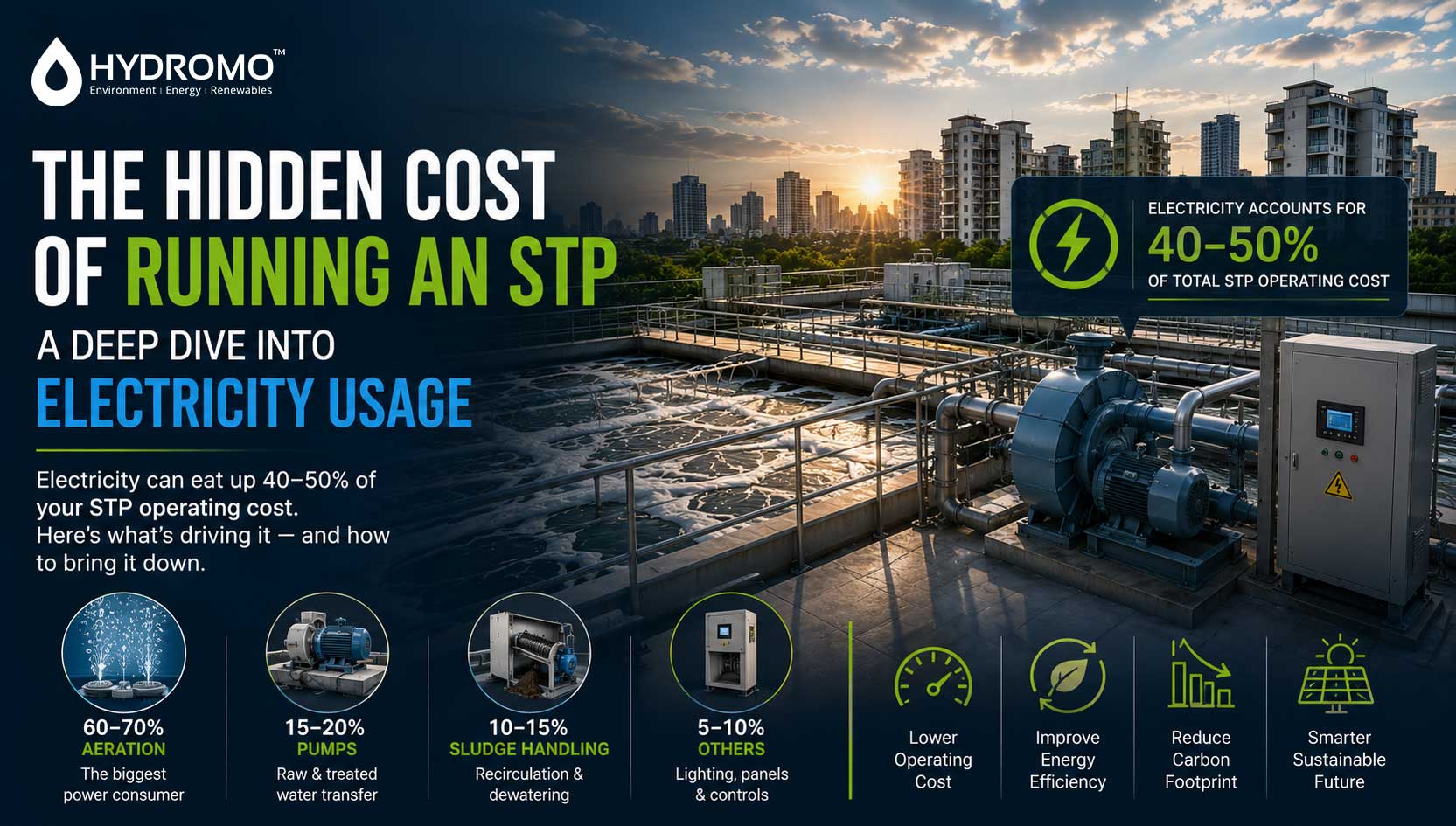
Here’s a number that surprises most facility managers: electricity alone can eat up 40–50% of everything you’ll ever spend running your STP. Not chemicals, not manpower, not the AMC. Just power. And if nobody’s ever shown you the breakdown, there’s a good chance your plant is quietly overspending right now.
What counts as normal STP power consumption?
There’s no single number here, because it depends heavily on the technology inside your plant. But industry data gives us a workable range: STP electricity usage in India typically falls between 0.5 and 1.5 kWh per cubic metre (KL) of sewage treated. That’s a wide band, and where you land in it says a lot about how efficient your plant actually is.
Here’s roughly what that looks like in real numbers:
- 10 KLD plant: around 15–20 kWh/day, which works out to roughly ₹2,000–3,500 a month at typical commercial tariffs
- 50 KLD plant: around 60–90 kWh/day, or about ₹8,000–14,000 a month
- 100–200 KLD plant: commonly ₹40,000–70,000 a month in total running cost, of which power is the biggest chunk
Technology matters more than most people assume. Older, conventional activated-sludge systems, still common in aging apartment complexes and municipal plants, sit at the higher end, often 1.1 to 1.6 kWh per cubic metre, because they rely on high-pressure diffusers and return-sludge pumps that run almost continuously. Moving Bed Biofilm Reactor (MBBR) systems, which have become the default for new installations over the last several years, typically bring that down to 0.75–1.1 kWh/m³. Attached-growth and biofilm-based designs push it lower still, since bacteria live on fixed media instead of needing constant aggressive mixing to stay suspended.
So if your plant is on the older end of that range and you haven’t looked at the technology behind it, there’s a real chance you’re paying 30–50% more in electricity than a comparable plant needs to.
Where does the electricity actually go?
This is the part most facility managers never get a straight answer on. Break down a typical STP’s power draw and one process dominates everything else: aeration. Pumping air into the biological treatment tank to keep bacteria alive and working typically accounts for 60–70% of total STP electricity consumption. The blowers run almost around the clock, and if they’re oversized, poorly maintained, or running on old diffuser membranes, you’re paying for air you don’t need.
The rest is split between raw sewage and treated water transfer pumps, sludge recirculation and dewatering equipment, and a smaller share for lighting, panels, and control systems. Notice what’s missing from that list, chemical dosing barely registers on the power bill. It’s almost entirely mechanical and electrical load, which is actually good news, because mechanical and electrical load is something you can redesign, retrofit, and optimise.
Why STP operating cost keeps climbing even when the plant “hasn’t changed”
A few quiet culprits show up again and again during energy audits:
Oversizing. A plant sized for peak future occupancy but running at 40% load today still pumps air and moves water as if it’s near capacity, because most older control systems don’t scale down gracefully.
Ageing diffusers. Fine-bubble diffuser membranes lose efficiency as they age and foul. A blower working against a clogged diffuser burns more energy to deliver the same oxygen transfer.
No variable frequency drives (VFDs). Blowers and pumps running at a fixed speed 24/7, instead of modulating with actual load, waste a significant chunk of energy during low-flow hours (typically late night).
Manual, not automated, dissolved oxygen control. Without DO sensors and automated blower control, operators tend to run aeration “a bit extra” just to be safe, which adds up fast over a year.
Practical ways to bring STP energy consumption down
You don’t need to rebuild the plant to see meaningful savings. In rough order of impact:
1. Install VFDs on blowers and major pumps. This alone is often the single highest-ROI energy upgrade for an existing STP, since blowers run continuously and any reduction compounds daily.
2. Add DO-based automated aeration control instead of running blowers at a fixed rate around the clock.
3. Replace or clean fouled diffusers on a defined maintenance schedule rather than reactively.
4. Right-size for actual current flow, not just design capacity, many plants are oversized for years before occupancy catches up.
5. Consider a technology upgrade if your existing plant is a conventional activated-sludge design. Moving to MBBR or an attached-growth system during a major overhaul can structurally lower the kWh/m³ baseline.
6. Track energy per KL treated monthly, not just the total bill. This single metric tells you immediately if something has drifted out of tune, a rising kWh/KL number is usually the earliest warning sign of a maintenance issue.
7. Pair the STP with rooftop solar, where roof space allows. For 24/7 loads like aeration blowers, solar can offset a meaningful share of daytime consumption and shorten payback significantly.
The bigger picture
Energy typically accounts for 40–50% of an STP’s total operating cost over its lifetime, and operating costs over a plant’s working life run 3 to 5 times the original capital cost. That means the electricity decision you make (or don’t make) at design stage, or the retrofit you keep postponing, has more financial weight than almost anything else about the plant, more than the brand of blower, more than the tank material, more than most of what gets debated during procurement.
If you’re evaluating a new STP, ask your vendor for the expected kWh/m³ figure in writing, not just the capital cost per KLD. If you’re running an existing plant, an energy audit, even a basic one comparing your actual monthly kWh/KL against the benchmarks above, usually pays for itself within a few months by flagging exactly where the waste is.
FAQ Section
Q1. How much electricity does a 100 KLD STP consume per day?
A well-designed 100 KLD STP running on MBBR technology typically consumes around 75–110 kWh per day (0.75–1.1 kWh/m³). Older conventional activated-sludge plants of the same size can consume 110–160 kWh per day.
Q2. Why is my STP’s electricity bill higher than what my vendor quoted?
Usually it comes down to one of three things: the plant is running under actual load but the blowers weren’t sized to scale down, diffusers have fouled over time and are less efficient, or there’s no automation controlling aeration based on real-time oxygen demand.
Q3. Which part of an STP uses the most power?
Aeration blowers, by a wide margin, typically 60–70% of total electricity consumption. Pumps for sludge and water transfer make up most of the rest.
Q4. Can solar power run an STP?
Yes, and it’s increasingly common. Since STPs draw power almost continuously, solar works best as a partial offset, covering daytime aeration and pumping load, paired with grid power for night-time operation, unless battery storage is added.
Q5. Does upgrading from conventional activated sludge to MBBR actually reduce electricity usage?
In most real-world cases, yes, commonly by 25–40%, because MBBR eliminates the need for constant high-intensity mixing and return-sludge pumping that conventional systems depend on.
Q6. How do I calculate my STP’s electricity cost per month?
Multiply your plant’s average daily kWh consumption by your electricity tariff (₹/unit), then by 30. For a rough capacity-based estimate without metering, use 0.5–1.5 kWh per KL treated as your working range, depending on plant age and technology.
Planning a new STP or retrofitting an old one? Talk to Hydromo’s engineers for a customized proposal that accounts for capital cost and 10-year electricity cost, not just the quote on paper.