
A facility manager at a mid-sized IT park in Hyderabad asked us a fair question last month: “We pay a massive daytime electricity bill. Can we get a PM Surya Ghar subsidy like our employees are getting for their homes?” The honest answer surprised him. No, his office building couldn’t. But his employees’ apartment complex, just down the road, actually could, for the common areas.
That mix-up is common, and it’s worth clearing up before you spend time on paperwork that won’t lead anywhere, or assume solar isn’t worth it for your building just because the subsidy doesn’t apply to it.
Does PM Surya Ghar Apply to Commercial Buildings?
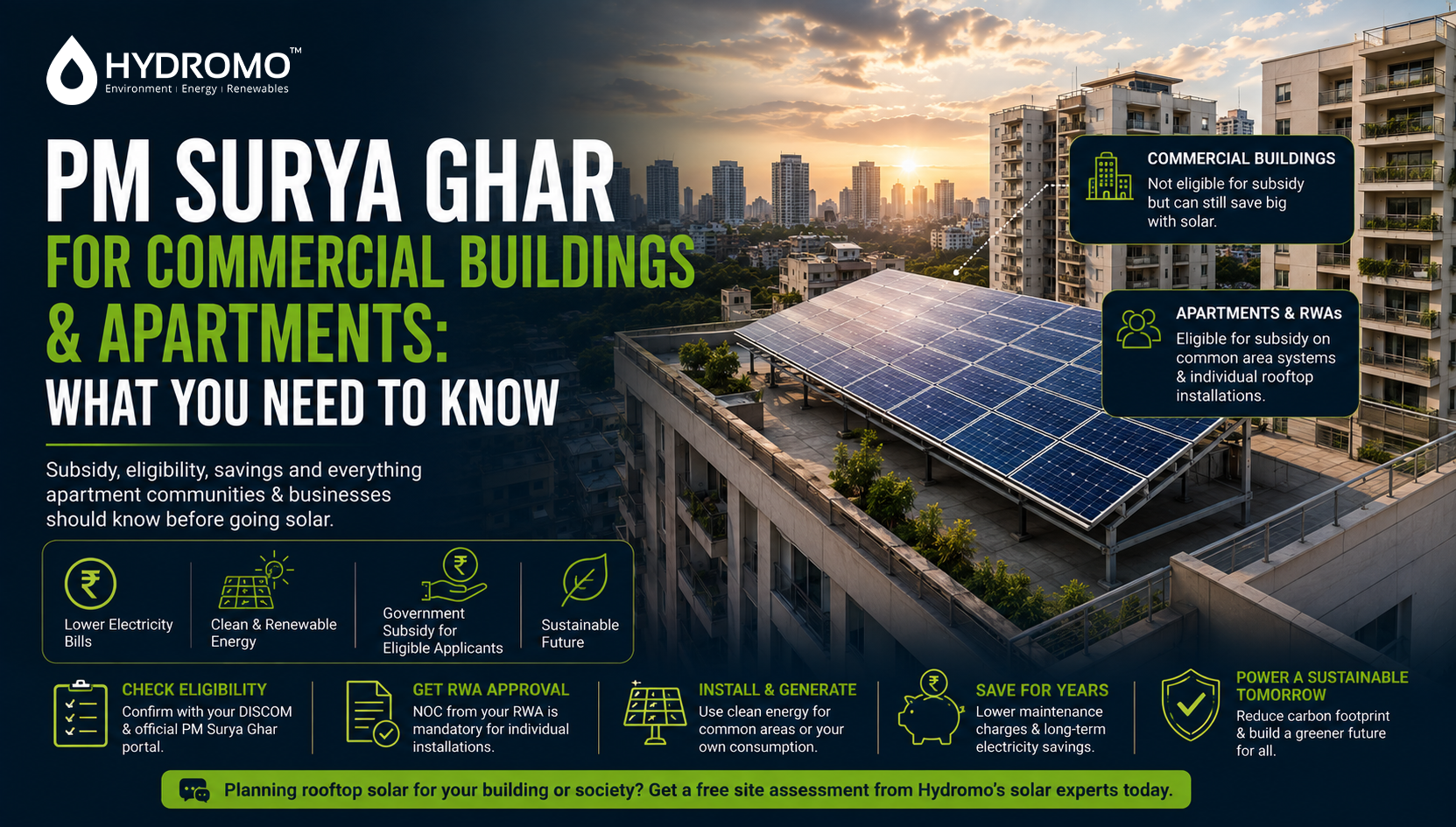
No, not directly. The Ministry of New and Renewable Energy (MNRE) has been explicit about this: the scheme is designed only for households. Shops, offices, hotels, hospitals, warehouses, and other commercial or industrial establishments are not covered under PM Surya Ghar, regardless of the building’s size.
This doesn’t mean commercial rooftop solar isn’t viable, it clearly is, and plenty of businesses install it profitably without any central subsidy. It just means the subsidy figures you see quoted online belong to a residential scheme, not something a commercial electricity connection can claim.
What About Apartments and Housing Societies?
This is where it gets more interesting, and where a lot of Hyderabad and Vijayawada apartment communities are leaving money on the table simply because nobody explained the rules clearly.
Two separate routes exist:
- Individual flat owners can apply for their own rooftop system on their allotted terrace space, provided they have a No Objection Certificate from the Resident Welfare Association (RWA), since the roof is technically common property.
- The RWA or Group Housing Society (GHS) itself can apply for a system that powers common-area electricity, lifts, corridor lighting, water pumps, and similar shared loads. This falls under a separate GHS/RWA subsidy slab, not the individual household one.
Before assuming either route applies to your building, confirm current eligibility, roof ownership documentation, and net-metering requirements with your DISCOM and on the official portal, since local implementation can vary slightly by state and utility.
Subsidy Numbers: Household vs GHS/RWA
| Category | Subsidy Structure | Cap |
| Individual residential household | ₹30,000/kW for the first 2 kW, ₹18,000/kW for the 3rd kW | ₹78,000 total, for systems of 3 kW and above |
| GHS / RWA (common facilities, incl. EV charging) | ₹18,000/kW | Up to 500 kW capacity, calculated at a benchmark of 3 kW per residential unit in the society |
Individual flat systems and RWA common-area systems are counted and applied for separately. It’s worth having your society’s managing committee confirm which route, or combination, makes sense before committing.
How Can Apartments Benefit From Rooftop Solar?
Common-area electricity is usually a fixed, unavoidable cost passed on to residents through maintenance charges. A solar system sized for the terrace can offset a meaningful chunk of that load, lifts, security systems, common lighting, clubhouse power, water pumps, and STP running loads are all daytime-heavy consumption patterns that line up well with solar generation hours. Lower common-area bills usually mean lower or more stable maintenance charges for everyone in the building.
What About Commercial Buildings, Then?
Even without a central subsidy, rooftop solar can still make strong financial sense for offices, hotels, and hospitals, because these buildings typically consume most of their electricity during daylight hours, exactly when solar generates. The economics here depend on your electricity tariff slab, available shadow-free rooftop area, your building’s actual consumption profile, local DISCOM regulations for commercial net metering, and the financing route you choose, outright purchase, a loan, or a RESCO (pay-per-unit) model where a third party owns and maintains the system.
Subsidy vs Savings: Don’t Confuse the Two
A subsidy is a one-time reduction in what you pay upfront to install the system. Savings are the ongoing reduction in your electricity bill over the 20-plus year life of the panels. Commercial buildings get zero subsidy under this scheme, but they can still see strong long-term savings. Apartments that do get a subsidy still need to evaluate whether the remaining investment, financing, and maintenance make sense for their specific consumption pattern.
A Simple Hypothetical Example
Say an apartment complex’s common areas draw 40 units of electricity a day, and an RWA-installed rooftop system generates roughly 32 units a day on average (these are illustrative numbers, not a guarantee, actual generation depends on system size, location, and shading). That system could offset roughly 80% of common-area daytime consumption, with the balance still drawn from the grid. Actual savings depend on the DISCOM’s net-metering terms and the tariff structure applied to common-area connections.
Checklist Before Installing
- Total shadow-free rooftop area available
- Structural suitability of the roof for panel load
- Actual electricity consumption pattern (individual vs common area)
- Sanctioned electrical load and existing wiring capacity
- DISCOM’s net-metering and commercial connection rules in your city
- Roof ownership and RWA approval documentation
- Long-term operations and maintenance plan
- Vendor’s MNRE empanelment status and installation track record
Is PM Surya Ghar Worth Considering for Your Building?
If you manage an apartment community, it’s genuinely worth exploring, the RWA subsidy route is underused, and common-area savings benefit every resident. If you run a commercial building, don’t expect a central subsidy, but don’t write off solar either; get a proper site assessment done, because tariff and consumption patterns often make commercial rooftop solar pay for itself within a few years regardless. Either way, the right first step is an actual rooftop and consumption assessment, not a generic online calculator.
Key Takeaways
- PM Surya Ghar is a household-only scheme; shops, offices, hotels, and industrial buildings are excluded.
- Individual apartment owners and RWAs/GHS can both apply, through separate subsidy routes.
- Household subsidy: up to ₹78,000, capped at 3 kW. RWA/GHS subsidy: ₹18,000/kW for common facilities, up to 500 kW.
- Commercial buildings get no subsidy under this scheme but can still see strong ROI from rooftop solar due to daytime consumption patterns.
- Always confirm current eligibility and net-metering terms with your DISCOM before applying.
FAQs
1. Can commercial buildings get PM Surya Ghar subsidy?
No. PM Surya Ghar is a household-only scheme. Offices, shops, hotels, hospitals, and industrial buildings are not eligible for the central subsidy, regardless of their size or electricity consumption.
2. Can apartment societies install rooftop solar?
Yes. Housing societies can install rooftop solar in two ways, individual flat owners can apply for their own system with an RWA No Objection Certificate, or the RWA/GHS can apply for a shared system that powers common-area electricity.
3. Does PM Surya Ghar cover common-area electricity in apartments?
Yes, through the separate GHS/RWA subsidy slab. It offers ₹18,000 per kW for common facilities like lifts, corridor lighting, and water pumps, up to a maximum system size of 500 kW.
4. Is rooftop solar financially beneficial for commercial buildings even without a subsidy?
Often, yes. Commercial buildings typically consume most of their electricity during the day, which lines up well with solar generation. Whether it pays off depends on your tariff, rooftop area, consumption pattern, and financing route, a proper site assessment is the only reliable way to know.
5. Can an individual flat owner apply for PM Surya Ghar separately from the RWA?
Yes, but only with an NOC from the RWA, since the terrace is common property. This is a separate application from any RWA-led common-area system, and the two are tracked under different subsidy slabs.
6. Do DCR-compliant panels matter for apartment or commercial installations?
For any installation claiming a PM Surya Ghar or GHS/RWA subsidy, yes, DCR-compliant modules are a scheme requirement. Commercial buildings, since they don’t claim this subsidy, aren’t bound by the same DCR condition, though other MNRE-linked incentives may still require it.
Get Started
Managing an apartment or housing society?
Find out how much your common-area electricity bill could drop with rooftop solar. Book a Free Site Assessment and let our team check your terrace, RWA subsidy eligibility, and net-metering options in one visit.
Running a commercial building, office, or hospital?
Since PM Surya Ghar doesn’t apply, the numbers only make sense with the right sizing and financing. Request a Customized Solar Proposal based on your actual consumption pattern and rooftop area.
Not sure which category your building falls under, or want a straight answer before committing time to paperwork? Talk to a Hydromo Expert, we’ll tell you honestly whether solar makes sense for your specific building.