
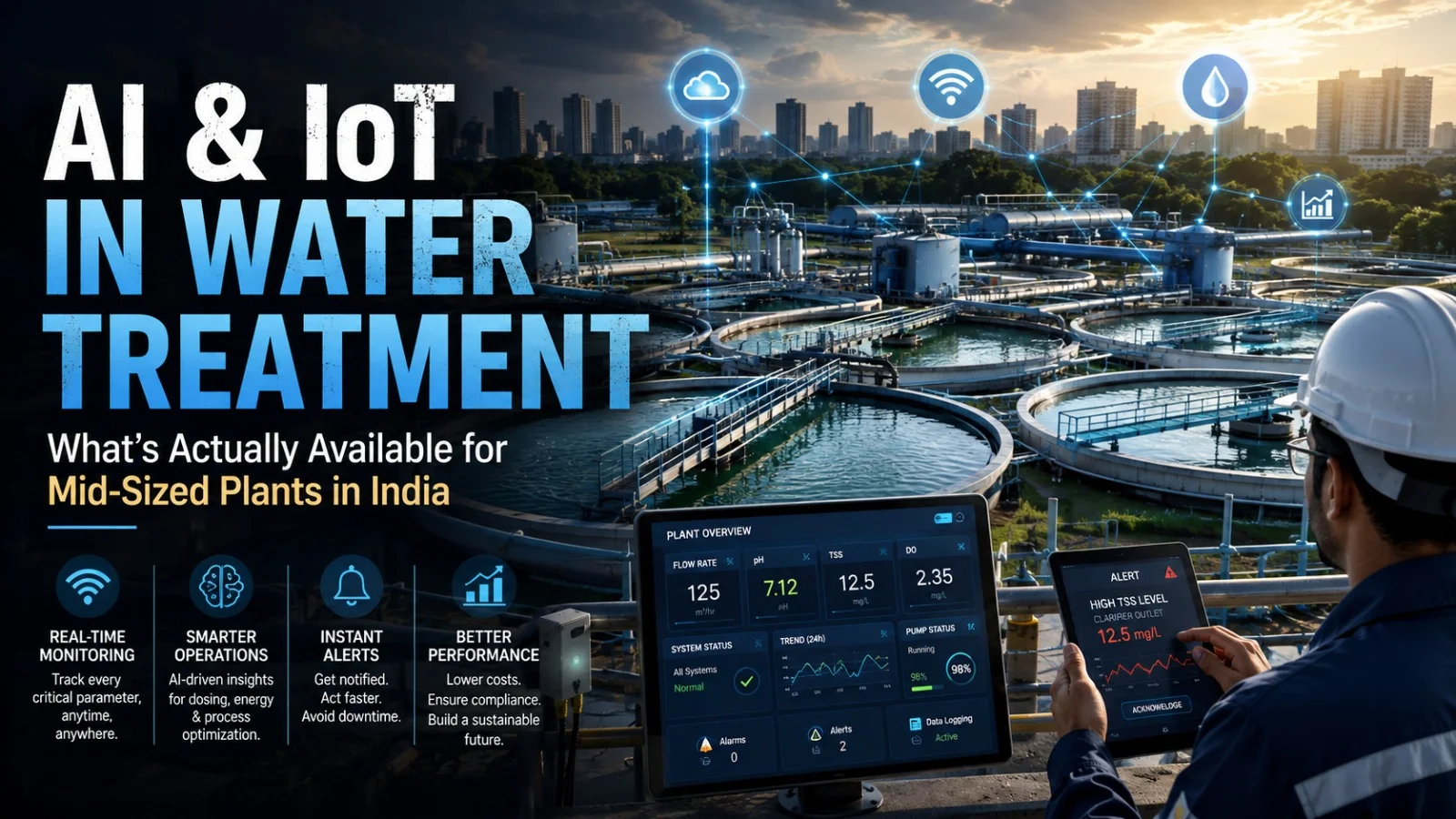
Here’s the uncomfortable truth about most STPs, ETPs, and RO plants in India: they aren’t monitored; they’re guessed at. An operator eyeballs pH and TDS twice a shift. The dosing pump runs on instinct, not flow data. And the first sign of a failing blower is usually the blower failing. This isn’t a hypothetical; it’s the default state of water treatment operations across the country, and it always seems to break at the worst possible moment: 2 a.m., the night before a pollution control board inspection.
Over the last few years, “AI and IoT in water treatment” has become one of the most talked-about phrases in the Indian water industry. Unfortunately, most of what’s written about it is aimed at mega-EPC projects, 50 MLD municipal plants, national smart-water missions, and enterprise-scale digital twins. If you’re managing a 50 KLD apartment STP, a 200 KLD hotel ETP, or a mid-sized industrial RO plant, that content simply doesn’t answer your real question: what actually works, at what cost, for a plant my size?
This article answers that question directly. No hype, no “fully autonomous plant” claims that don’t reflect ground reality in India today, just a practical look at what AI and IoT genuinely offer mid-sized treatment plants right now, what they cost to implement, and how to know if your plant is ready.
Key Takeaways
- IoT in water treatment is mature, affordable, and already widely deployed even in small plants; sensors, SCADA, and mobile alerts are not futuristic technology.
- “AI” in most Indian mid-sized plants today means predictive maintenance and dosing optimization, not self-operating plants.
- The biggest realistic wins are energy savings, reduced manual monitoring, faster fault detection, and better compliance records, not full autonomy.
- A phased approach (sensors → SCADA → analytics) is far more practical and affordable than jumping straight to “AI-powered” systems.
- ROI depends heavily on plant size, chemical/energy spend, and current manual labor cost; not every plant needs the same level of automation.
What Is IoT in Water Treatment?
IoT, or the Internet of Things, is really just about hooking up physical equipment, sensors, pumps, and valves to the internet so the data they generate can be collected, sent somewhere, and checked remotely. In a water or wastewater treatment plant, that usually shows up as a handful of things working together.
- Sensors get placed at the points that actually matter: the inlet, the aeration tank, the clarifier outlet, and the RO permeate line, and they sit there continuously tracking things like pH, TDS, flow, and turbidity.
- PLCs, or Programmable Logic Controllers, are basically the brains on site. They take in whatever the sensors are reading and use that to run equipment like pumps, blowers, and dosing systems based on logic someone has already programmed in.
- SCADA systems, short for Supervisory Control and Data Acquisition, pull all that PLC data into one central dashboard, so an operator isn’t running around the plant just to know what’s going on. One screen, the whole picture.
- Cloud dashboards take that same data and push it out to a web or mobile app, so a facility manager or plant owner can pull up plant status from wherever they happen to be, not just from the control room.
- GSM and 4G connectivity modules matter more than people think, especially for sites where broadband isn’t reliable. They let the data still get out over a mobile network instead of depending on a fixed internet line.
- Mobile alerts, usually SMS or WhatsApp, are what actually notify someone the moment something crosses a line, say, an outlet BOD going past discharge norms or a pump tripping out.
- Data logging quietly builds a time-stamped history of everything, which turns out to be useful twice over: once when you’re trying to troubleshoot a problem, and again when you need documentation for a PCB inspection.
None of this is new or experimental. Online pH, TDS, and flow sensors have been standard in Indian STPs and ETPs for years now. What’s actually shifted recently is the cost of connectivity and cloud storage coming down, which is what’s made remote dashboards and mobile alerts realistic even for smaller plants that couldn’t have justified a full SCADA setup a few years back
What Is AI in Water Treatment—Realistically?
This is where expectations need to be grounded. “AI in water treatment” in marketing material often implies a plant that thinks and acts on its own. That is not the current reality for the vast majority of Indian mid-sized plants, including most enterprise ones.
What AI realistically does today, when properly implemented, falls into a handful of practical categories:
- Predictive maintenance: analyzing motor vibration, current draw, or run-hours data to flag a pump or blower likely to fail before it does, rather than after.
- Chemical dosing optimization: using inlet flow and quality data to adjust coagulant, chlorine, or polymer dosing automatically, rather than at a fixed rate regardless of load variation.
- Energy optimization: analyzing blower and pump run patterns against actual oxygen/flow demand to reduce unnecessary energy consumption—often one of the highest operating costs in an STP.
- Fault detection: pattern recognition on sensor trends to catch developing problems (a slowly clogging membrane, a drifting sensor) before they become outright failures.
- Equipment health monitoring: tracking wear indicators over time rather than relying purely on fixed maintenance schedules.
- Trend analysis and forecasting: identifying gradual shifts in influent quality or plant performance that a human reviewing daily logs might miss.
The honest summary: AI, in today’s Indian mid-market context, means smarter decision support layered on top of good IoT data—not autonomous plant operation. Any vendor promising a “fully AI-run plant” for a mid-sized facility should be questioned closely on what that actually means in practice.
Technologies Already Available in India
| Technology | Maturity in India | Typical Use |
| Online pH sensors | Widely available, standard | Aeration tank, RO feed, final discharge monitoring |
| TDS sensors | Widely available, standard | RO plant performance, drinking water quality |
| Flow meters (electromagnetic/ultrasonic) | Widely available | Inlet/outlet flow measurement, billing, compliance |
| ORP sensors | Available, moderate adoption | Disinfection monitoring, chlorine control |
| DO (Dissolved Oxygen) sensors | Available, growing adoption | Aeration control in STPs |
| Turbidity sensors | Widely available | Filtration performance, clarifier monitoring |
| Level sensors | Widely available, standard | Tank/sump level control, pump automation |
| Smart dosing pumps | Available, growing adoption | Automated, flow-proportional chemical dosing |
| Variable Frequency Drives (VFDs) | Widely available, well-proven ROI | Pump/blower energy optimization |
| PLC automation | Mature, standard for mid-to-large plants | Core process automation and interlocks |
| SCADA systems | Mature, increasingly affordable | Centralized monitoring and control |
| Cloud dashboards | Growing fast, now affordable for small plants | Remote monitoring, multi-site oversight |
| SMS/WhatsApp alerts | Widely available, low cost | Immediate notification of faults or excursions |
| Predictive maintenance software | Emerging, mostly larger installations so far | Equipment health tracking, failure prediction |
Where AI and IoT Add the Most Value
| Application | Where It Helps Most |
| STP | Aeration energy optimization (blowers are typically the largest energy consumer), sludge age monitoring, remote alerts for compliance-critical parameters like BOD/COD/TSS |
| ETP | Dosing optimization for variable industrial effluent loads, early warning on shock loads that could upset biological treatment |
| RO Plants | Membrane fouling trend detection, recovery rate optimization, remote monitoring of permeate TDS for quality assurance |
| Cooling Towers | Cycle-of-concentration optimization, scale/corrosion inhibitor dosing control, water and chemical savings |
| Industrial Water Treatment | Batch-to-batch consistency tracking, integration with production planning for water demand forecasting |
| Commercial Buildings / Hotels | Multi-site remote monitoring without a dedicated on-site engineer at every property, guest-facing sustainability reporting |
| Hospitals | Continuous compliance documentation (critical given stricter effluent norms for healthcare facilities), reduced manual testing burden |
Comparison: Manual vs IoT-Based vs AI-Assisted Operations
| Factor | Manual Operation | IoT-Based Monitoring | AI-Assisted Operations |
| Data collection | Manual logbook, 2–3 checks/shift | Continuous, automated | Continuous, automated |
| Response to faults | Reactive, often delayed | Faster (real-time alerts) | Proactive (predictive alerts before failure) |
| Chemical dosing | Fixed/manual adjustment | Can be flow-linked automatically | Optimized dynamically based on load and quality trends |
| Energy use | Rarely optimized | Visible, can be manually adjusted | Actively optimized based on demand patterns |
| Compliance documentation | Manual, prone to gaps | Automated, time-stamped records | Automated + trend-based early warning |
| Staffing dependency | High | Moderate | Moderate (still requires trained oversight) |
| Upfront investment | Lowest | Moderate | Higher |
| Best suited for | Very small plants with tight budgets | Most mid-sized plants—the practical sweet spot today | Larger or multi-site operations with strong existing IoT foundation |
Technology, Purpose, Application, and Business Benefit
| Technology | Purpose | Typical Application | Business Benefit |
| VFDs on pumps/blowers | Match motor speed to actual demand | STP aeration, RO high-pressure pumps | Significant energy cost reduction, proven and low-risk |
| Smart dosing pumps | Flow-proportional chemical dosing | ETP coagulation, disinfection | Lower chemical consumption, more consistent treatment |
| SCADA + cloud dashboard | Centralized visibility and control | All plant types | Fewer site visits needed, faster decision-making |
| Remote alerts (SMS/WhatsApp) | Immediate notification of excursions | Compliance-critical parameters | Faster response, reduced risk of PCB non-compliance |
| Predictive maintenance sensors | Early detection of equipment wear | Pumps, blowers, motors | Reduced unplanned downtime, longer equipment life |
| Data logging/historian | Time-stamped operational record | All plant types | Audit-ready compliance records, easier troubleshooting |
Benefits: What’s Actually Achievable
- Reduced manual monitoring load: operators shift from constant manual checks to exception-based management (acting only when alerted).
- Lower energy consumption: particularly from VFD-controlled aeration and pumping, historically one of the highest-impact, best-proven automation investments in STPs.
- Optimized chemical usage: flow-proportional dosing typically reduces both over-dosing (wasted cost) and under-dosing (treatment risk).
- Faster fault detection: minutes instead of hours or days, especially valuable for facilities operating without 24/7 on-site staff.
- Reduced unplanned downtime: predictive maintenance catches developing issues before they cause a shutdown.
- Better compliance records: automated, time-stamped data logging is far more defensible during a PCB inspection than a handwritten logbook.
- Improved operational efficiency: particularly valuable for owners managing multiple sites (hotel chains, industrial groups, and apartment management companies) who can’t have a dedicated engineer at every location.
Challenges- What Vendors Often Don’t Mention
- Initial investment: sensors, PLCs, SCADA licensing, and connectivity all add cost. This needs to be weighed honestly against plant size and current operating cost.
- Staff training: automation reduces manual monitoring but increases the need for staff who can interpret dashboards and respond to alerts correctly—it doesn’t eliminate the need for skilled operators.
- Sensor maintenance: sensors drift and foul over time (especially pH and turbidity probes in wastewater applications) and need regular calibration; neglected sensors produce unreliable data, which undermines the entire system.
- Internet connectivity: many industrial and semi-urban sites still have inconsistent broadband; GSM/4G backup is often necessary and should be planned for, not treated as optional.
- Data quality: automation is only as good as the data feeding it—poor sensor placement or infrequent calibration leads to false alerts and erodes operator trust in the system.
- Cybersecurity: Cloud-connected plant systems are increasingly a target consideration; basic practices (secure passwords, network segmentation, and vendor support for updates) matter even for a mid-sized plant.
- Integration with legacy systems: retrofitting IoT/SCADA onto an older plant built without automation in mind is more complex and costly than designing it from the start—this should be scoped carefully before committing a budget.
Typical Implementation Process
- Assessment: Site audit of current plant configuration, existing instrumentation (if any), connectivity availability, and the specific problems you’re trying to solve (energy cost? compliance risk? multi-site visibility?).
- Sensor selection: Choosing the right sensors for your process (not every plant needs every sensor type—this should be need-driven, not a standard package).
- PLC/SCADA integration: Installing or upgrading the control layer that ties sensors to actual equipment control.
- Dashboard setup: Configuring the cloud/mobile interface, alert thresholds, and user access levels.
- AI analytics layer (where justified): Adding predictive maintenance or dosing optimization models once a baseline of reliable sensor data has been established—this step should generally come after, not instead of, solid IoT fundamentals.
- Staff training: Hands-on training for operators and facility managers on interpreting dashboards, responding to alerts, and basic sensor maintenance.
- Performance review: A structured review (typically at 3 and 6 months) comparing energy, chemical, and downtime metrics against the pre-automation baseline.
Signs Your Plant Is Ready for Automation
- Your operators are spending significant time on manual logging that could be automated.
- You’ve had compliance issues or PCB queries related to inconsistent or missing monitoring records.
- Energy or chemical costs are a large, poorly understood share of your operating budget.
- You manage multiple sites and lack visibility without physically visiting each one.
- You’ve had unplanned equipment failures that a maintenance history/vibration-monitoring system could plausibly have flagged early.
- Your current instrumentation, if any, is more than 8–10 years old and lacks remote connectivity.
If most of these apply, a phased IoT-first automation plan is very likely to deliver a positive return. If none apply—for example, a very small plant with low chemical/energy spend and no compliance history issues—the investment may not yet be justified, and that’s a legitimate conclusion, not a sales objection to overcome.
Is It Worth It for Mid-Sized Plants?
| Plant Profile | Recommendation |
| Small (under ~50 KLD), tight budget, low compliance risk | Start with basic online sensors + SMS alerts only; full SCADA is likely premature |
| Mid-sized (50–500 KLD) commercial/industrial, moderate compliance exposure | IoT monitoring + SCADA dashboard is generally the practical sweet spot; add predictive maintenance selectively on critical equipment |
| Multi-site operator (hotel chain, industrial group, facility management company) | A cloud dashboard with centralized multi-site visibility delivers strong ROI even before adding AI analytics |
| Larger industrial (500+ KLD) with high energy/chemical spend | Full IoT + AI-assisted dosing and energy optimization is usually justified by the scale of potential savings |
The honest recommendation: most mid-sized Indian plants get 70–80% of the realistic benefit from disciplined IoT implementation alone—reliable sensors, SCADA visibility, and mobile alerts. AI analytics layered on top add further value, but only once that foundation is solid and generates clean, consistent data.
Expert Tips
- Don’t automate a poorly designed or poorly maintained process—automation makes a well-run plant more efficient; it doesn’t fix an underlying process problem.
- Prioritize sensors on your most compliance-critical and cost-critical parameters first, rather than instrumenting everything at once.
- Insist on a calibration and maintenance schedule for sensors from day one—this is the single most common cause of automation projects quietly losing value over time.
- Ask any automation vendor for reference sites of a similar plant size and type, not just enterprise case studies.
- Budget for connectivity redundancy (GSM/4G backup) if your site has ever had internet reliability issues.
Common Mistakes to Avoid
- Jumping straight to “”AI”-branded solutions without first establishing solid, reliable IoT data collection.
- Treating automation as “set and forget”—sensors and systems still need regular human oversight and calibration.
- Under-training staff, leading to alerts being ignored or dashboards going unused after the initial rollout enthusiasm fades.
- Choosing a system that isn’t designed for India-specific realities—intermittent power, variable connectivity, dust, and humidity affecting sensor housings.
- Over-instrumenting a very small plant where the ROI simply doesn’t support the investment yet.
ROI Considerations
ROI depends on plant-specific factors rather than a universal formula: current energy and chemical spend, labor cost of manual monitoring, frequency and cost of compliance issues, and downtime cost when equipment fails unexpectedly. As a general pattern across the industry, energy-related automation (VFDs, aeration control) tends to have the fastest, most predictable payback, while predictive maintenance and AI-assisted dosing typically show their value over a longer horizon as historical data accumulates. Any credible automation proposal for your plant should include a plant-specific payback estimate based on your actual operating costs—be cautious of generic ROI percentages quoted without reference to your specific plant data.
Future Trends Worth Watching
- Edge AI: processing analytics locally on-site rather than relying entirely on cloud connectivity, useful for sites with unreliable internet.
- Digital twins: virtual models of a plant used to simulate and optimize operations before changes are made on the physical system; currently more common in large municipal/industrial projects than mid-sized plants, but costs are trending down.
- Computer vision: camera-based monitoring for tasks like sludge settling observation or visual leak detection, an emerging but still early-stage application in India.
- Autonomous optimization: increasing automation of routine adjustments (dosing, aeration) within defined safety limits, with human oversight retained rather than removed.
- ESG reporting integration: automated sustainability and water-reuse reporting is becoming increasingly relevant as corporate ESG disclosure requirements expand in India.
- Smart water networks: broader integration between treatment plants, distribution networks, and municipal systems, an area actively being developed under India’s urban water infrastructure programs.
Conclusion
AI in water treatment is genuinely useful, but not in the way most marketing content suggests. For the vast majority of mid-sized plants in India today, the real, achievable value comes from disciplined IoT implementation, reliable sensors, SCADA visibility, and mobile alerts, layered with targeted AI-assisted predictive maintenance and dosing optimization once that data foundation is solid.
The right question isn’t “should my plant have AI?” It’s “What specific problem, energy cost, compliance risk, unplanned downtime, or multi-site visibility am I trying to solve, and which technology actually solves it at my plant’s scale?” Evaluate automation based on your operational needs and numbers, not industry hype, and you’ll make a decision that holds up in year three, not just at commissioning.
If you’re evaluating automation for an STP, ETP, or RO plant and want a realistic, plant-specific assessment rather than a generic package, Hydromo’s engineering team can walk through what actually makes sense for your site’s size, budget, and compliance requirements.
Frequently Asked Questions
1. What is AI in water treatment?
AI in water treatment is really just software that looks at your sensor and operational data and helps you make better calls, things like when to service a pump, how much chemical to dose, or where you’re wasting energy. It’s there to support the person running the plant, not replace them. That’s true for pretty much every Indian installation running today.
2. What’s the actual difference between IoT and AI here?
Think of IoT as the nervous system. It’s the sensors, the connectivity, and the dashboards that gather plant data and get it in front of you. AI sits on top of that and tries to make sense of the numbers, spotting patterns and making recommendations. Without solid IoT data underneath it, the AI layer has nothing useful to work with.
3. Is water treatment in India actually running on full autopilot with AI?
Not really, no. Even most of the big enterprise plants aren’t fully autonomous. What you get today is decision support, predictive alerts, dosing suggestions, that kind of thing. A trained operator is still very much part of the picture, and that’s not likely to change anytime soon.
4. What does IoT-based monitoring actually cost for a mid-sized STP?
Honestly, it depends a lot on your plant, how many sensors you need, and whether you want full SCADA or something lighter. There isn’t a single number that fits every situation, so it’s worth getting a site-specific quote rather than trusting a generic figure. If you’re looking for the cheapest entry point, starting with a handful of essential sensors plus mobile alerts is usually it.
5. Can a small apartment STP actually benefit from this stuff?
Yes, even at a fairly basic level. Just adding online level, pH, and flow sensors with SMS alerts already cuts down a lot of the manual checking, and it’s become affordable enough that even smaller residential setups can justify it now.
6. What exactly is predictive maintenance in this context?
It’s using data your equipment already generates, motor current, vibration, and how many hours it’s run to catch a failure before it actually happens. Instead of fixing a pump after it breaks, you schedule the fix before it does.
7. Does bringing in automation mean fewer plant operators?
Not really, it just changes what they spend their time on. Instead of constantly walking the plant and checking things by hand, operators end up watching dashboards, responding to alerts, and keeping the sensors calibrated. You still need someone who knows what they’re looking at.
8. Which sensors should I actually start with?
For most STPs and ETPs, flow, pH, and level sensors covering your compliance and process critical points are the natural starting point. Once that’s in place, you can layer in things like DO, ORP, or turbidity sensors depending on what your process actually needs.
9. How is SCADA different from just having a cloud dashboard?
SCADA is generally the onsite system that’s actually wired into your equipment and controlling it. A cloud dashboard is more of a window you look through remotely to see what’s happening. A lot of modern setups blend the two, but SCADA usually implies a deeper level of actual control, not just visibility.
10. Is this kind of investment worth it for every single plant?
No, not really. If you’re running a very small plant with low compliance risk and your chemical and energy costs aren’t that high, a full system might not pay for itself. It really comes down to your plant’s size, what you’re currently spending, and whether compliance has been an issue for you, not something everyone needs to jump into the same way.