
If you manage a hotel or hospital in Hyderabad, you’ve probably dealt with two things: a heavy water bill and white crust building up on your taps, pipes, and equipment.
Both are symptoms of the same problem — Hyderabad’s water is hard, mineral-heavy, and unforgiving on infrastructure.
The solution, most people are told, is either a water softener or an RO system. What they’re not told is that the two do completely different things. Choosing the wrong one is an expensive mistake that shows up slowly — through damaged boilers, failing kitchen equipment, repeated filter replacements, and guest complaints.
Here’s how to think through it properly.
What’s Actually the Difference?
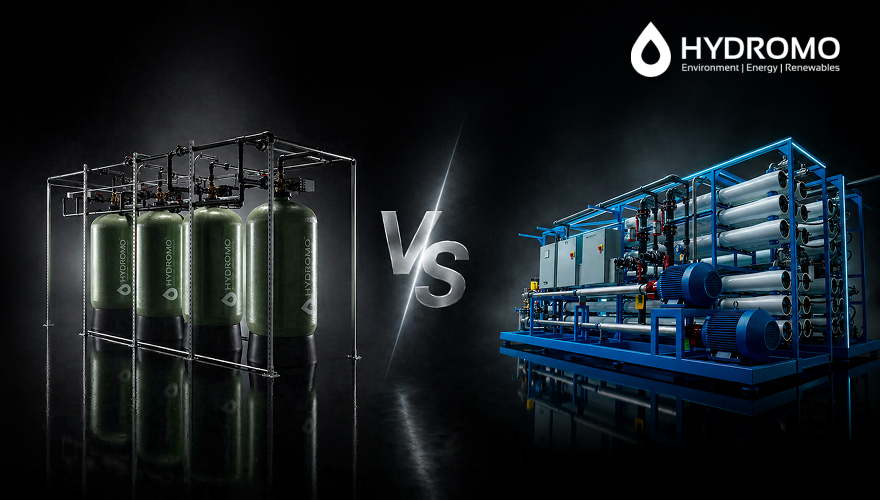
A water softener removes hardness-causing minerals — mainly calcium and magnesium — through an ion exchange process. It protects your pipes, equipment, and surfaces. It doesn’t purify the water for drinking.
An RO system (Reverse Osmosis) forces water through a semi-permeable membrane, stripping out dissolved salts, heavy metals, bacteria, and most contaminants. The benefits of reverse osmosis water include genuinely clean, safe drinking water — but an RO system doesn’t specifically target hardness in the way a softener does.
In short: a softener protects your infrastructure. An RO system protects the people who drink the water.
They’re not competing solutions. For most hotels and hospitals in Hyderabad, the right answer is both — used at different points in the water system.
How to Determine Size of Water Softener Needed
This depends on three numbers: how many people use the facility daily, how many litres of water are consumed, and your water’s hardness level (measured in ppm or mg/L). Hyderabad municipal water typically runs between 200–400 ppm hardness — that’s moderately to severely hard.
A rough formula: multiply daily water consumption (in litres) by the hardness level (in grains per gallon), and that gives you the daily softening load your system needs to handle.
For a mid-size hotel running 80–100 rooms, a system rated for 1,000–2,000 litres per hour is usually the starting point. A hospital with OT units, dialysis equipment, and large kitchen operations needs a significantly larger system — often 3,000 LPH and above.
Water Softener for 1000 Ltr Water Tank — What to Expect on Price
A softener sized for a 1,000-litre water tank typically falls in the ₹25,000–₹60,000 range for commercial-grade systems, depending on the technology (manual regeneration vs. automatic) and brand. Automatic systems cost more upfront but save significantly on salt, water, and maintenance time. For hotels and hospitals running large tanks, the ROI on automatic systems is faster.
Commercial RO Plant 1000 LPH — What Does It Cost?
A commercial RO plant with 1,000 litres per hour capacity is typically priced between ₹80,000 and ₹1,80,000, depending on the number of filtration stages, membrane quality, and whether the system includes a UV/UF stage for post-treatment. For hospitals — where water quality is a clinical requirement, not just a comfort one — skipping on membrane quality is a false economy. Budget for a better system.
The Benefits, in Plain Terms
Benefits of Reverse Osmosis Water
- Removes up to 99% of dissolved salts, heavy metals, and bacteria
- Essential for hospital kitchens, patient drinking water, and dialysis units
- Reduces Total Dissolved Solids (TDS) to safe levels — typically below 50 ppm from Hyderabad’s 300–500 ppm source water
- Eliminates dependence on packaged drinking water for guests and staff
Benefits of Water Softener
- Eliminates limescale buildup in boilers, geysers, washing machines, and pipelines
- Extends equipment lifespan by 3–5 years on average
- Reduces soap and detergent consumption by 30–50% (soft water lathers better)
- Prevents white stains on bathroom fixtures, glassware, and laundry — visible quality markers for hotel guests
For Hotels: What the Priority Should Be
Guest experience and equipment protection. Limescale on taps and in the laundry is visible and erodes perceived quality fast. A water softener handles this. If you’re also providing bottled water, installing an RO system at the kitchen and drinking water points eliminates that cost entirely over time.
For Hospitals: Non-Negotiable on Both
Hospitals need RO-grade water for patient care, and softened water for CSSD units, autoclaves, and general infrastructure. This isn’t a cost-benefit conversation — it’s a compliance and clinical safety one.
Can You Use Both Together?
Yes — and in most commercial settings in Hyderabad, this is the standard setup. Softened water feeds into the building’s main supply (protecting infrastructure), and an RO plant draws from the softened supply to produce purified drinking water. The softener extends the RO membrane’s life by reducing the load of hardness minerals hitting it.
The Bottom Line
If you’re only solving one problem, identify which one is costing you more: equipment damage and maintenance bills (softener), or water quality complaints and packaged water costs (RO).
If you’re building or retrofitting a full system, install both.
Hydromo designs and installs commercial water treatment systems for hotels, hospitals, and large facilities across Hyderabad. We assess your water quality, calculate the right system size, and handle installation and AMC.
Talk to our water treatment team — free consultation: hydromo.in |
📞 +91 7995201717
FAQs
1. Is a water softener or RO system better for drinking water quality in India?
For drinking water, RO is the right choice. Softeners don’t remove dissolved salts or bacteria — they only address hardness. If your concern is safe, clean drinking water, an RO system is what you need.
2. What’s the average price range for water softeners vs. RO systems in India?
Commercial water softeners for hotels and hospitals typically range from ₹25,000 to ₹1,50,000, depending on capacity. Commercial RO plants (1000 LPH) range from ₹80,000 to ₹1,80,000. Hydromo can provide exact pricing after a site assessment.
3. Can I get an annual maintenance contract (AMC) for my RO system in Hyderabad?
Yes. Hydromo offers AMC services for commercial RO plants and water softeners across Hyderabad. Regular servicing extends membrane life, maintains output quality, and keeps your system compliant.
4. What are the space requirements for commercial water treatment systems?
A 1,000 LPH RO plant typically needs 4–6 sq ft of floor space. A commercial softener of similar capacity needs roughly the same. Both can be installed in utility rooms, plant rooms, or dedicated water treatment areas.
5. What are the energy consumption differences between modern water softeners and RO systems?
Modern RO systems consume 0.3–0.5 kWh per 1,000 litres treated. Automatic water softeners consume minimal electricity, mainly for the control valve during regeneration. Both are low-energy systems relative to the operational benefits they deliver.
6. Can a water softener and RO system be combined for better water quality?
For hotels and hospitals in Hyderabad, almost always yes. The softener protects your infrastructure and extends your RO membrane’s lifespan. The RO delivers purified water for drinking and clinical use. Used together, they cover every water quality need in a large facility.