
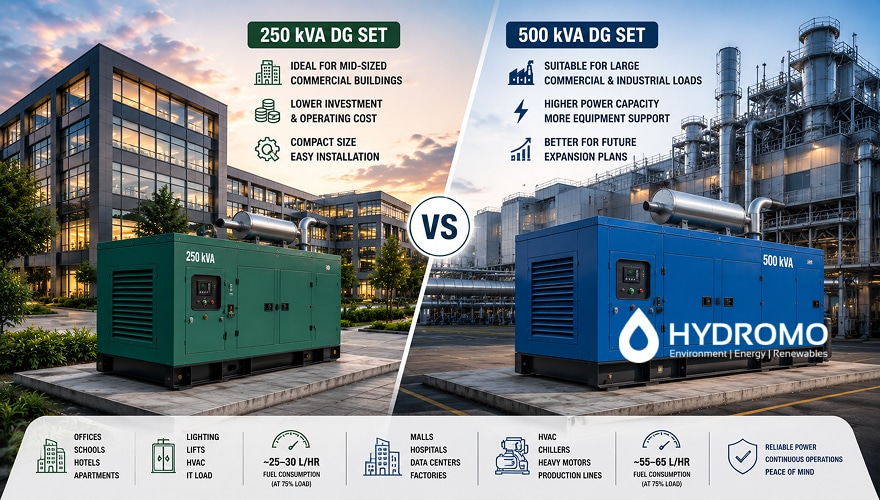
Every few weeks, someone calls us with a version of the same question: “We’re putting in a backup generator; should we go with 250 kVA or 500 kVA?” And almost every time, they’ve already got a number in mind before we’ve even talked about their building.
That’s usually the problem. People pick a capacity because a neighboring property has it or because a vendor quoted it, not because anyone actually sat down and worked out the load. A 250 kVA vs. 500 kVA DG set decision isn’t really about which one sounds “safer”; it’s about what your building draws, how it runs, and where it’s headed in the next five to ten years.
Quick answer: If your building’s essential load stays under roughly 200 kW, think a mid-sized office, school, or hotel; a 250 kVA DG set is usually enough. If you’re running heavy HVAC, production equipment, or a facility that genuinely can’t afford downtime, like malls, large hospitals, data centers, or factories, you’re likely looking at 500 kVA or above. The rest of this guide explains why, with the numbers to back it up.
First, What Actually Determines DG Set Capacity?
Generator specs are quoted in kVA, but what your equipment draws is kW. The gap between the two comes down to the power factor, usually around 0.8 for commercial installations. So on paper, a 250 kVA generator is delivering closer to 200 kW of real, usable power. This trips people up more often than you’d expect, and it’s worth getting right before you compare anything else.
There’s also a difference between standby and prime ratings. Standby is the burst capacity a generator can handle during a short outage. Prime is what it can sustain over long running hours, which matters a lot if your building leans on the DG set as a semi-regular power source rather than an occasional backup, which is common enough in parts of Hyderabad.
And then there’s starting current, which is the one variable we see underestimated the most. Motors, pumps, and compressors don’t draw their rated current when they start; they spike well above it for a few seconds. If your sizing doesn’t account for that, the generator can look “enough” on paper and still trip the first time three AC compressors kick in together.
The 250 kVA DG Set: Where It Fits
A 250 kVA DG set is the workhorse capacity for mid-sized commercial buildings in Hyderabad, and it’s the one we recommend most often for straightforward commercial loads. It handles general lighting, lifts, common-area HVAC, and standard IT load without much drama.
We typically see it doing well for the following:
- Mid-sized office buildings
- Small to mid-sized hospitals and clinics
- Schools and colleges
- Boutique hotels
- Apartment complexes and gated communities
- Standalone retail stores and showrooms
On a typical installation, you’re looking at a connected essential load of somewhere between 150 and 200 kW and fuel consumption of roughly 25–30 liters an hour once the generator is running at around 75% load, though this shifts depending on the engine brand and how hot it is outside, which in Hyderabad summers is not a small factor.
Space-wise, a 250 kVA set is genuinely easier to work with. It needs a smaller foundation, a standard acoustic enclosure, and reasonable ventilation clearance, all manageable even on tighter urban plots where every square foot of setback matters.
Where it falls short is headroom. If your building is likely to add floors, tenants, or heavier cooling loads down the line, a 250 kVA set doesn’t leave you much room to grow into.
The 500 kVA DG Set: Where It Fits
Step up to 500 kVA, and you’re in a different category of building altogether, one where downtime isn’t just annoying; it’s expensive or, in a hospital’s case, genuinely risky.
This is the capacity we point clients toward when they’re running:
- Manufacturing plants with production-line equipment
- Large hospitals with ICUs, operation theatres, and imaging equipment
- Shopping malls with multiple tenants and central air conditioning
- Data centers where downtime isn’t an option
- IT campuses with heavy, continuous cooling and server load
- Large hotels running full banquet and kitchen operations
- Broader industrial facilities, this is where Industrial generators in Hyderabad frequently go well past 500 kVA depending on the plant
A 500 kVA set gives you more comfortable headroom for simultaneous motor starts, which matters a lot in facilities running several pieces of heavy equipment at once. Fuel consumption climbs accordingly, around 55–65 liters an hour at 75% load, and you’ll need a bigger fuel tank, often 500 to 1,000 liters or more, plus a larger foundation and enclosure footprint.
The trade-off is straightforward: more capacity, more upfront cost, more space, and, if your actual load doesn’t need it, fuel you’re burning for headroom you’re not using.
Side-by-Side: 250 kVA vs 500 kVA
| Factor | 250 kVA DG Set | 500 kVA DG Set |
| Power output (approx.) | ~200 kW | ~400 kW |
| Ideal building size | Mid-sized commercial | Large commercial / industrial |
| Supported equipment | Lighting, lifts, pumps, partial HVAC | Full HVAC, chillers, heavy motors, production lines |
| Fuel consumption (75% load) | ~25–30 L/hr | ~55–65 L/hr |
| Initial investment | Lower | Higher |
| Operating cost | Lower per hour | Higher per hour, more efficient at sustained full load |
| Maintenance | Simpler, lower AMC cost | More involved, higher AMC cost |
| Installation space | Compact | Larger footprint required |
| Noise level | Lower | Higher, needs stronger acoustic treatment |
| Scalability | Limited | Better suited to future load growth |
| Best applications | Offices, schools, hotels, apartments | Malls, hospitals, data centers, factories |
Fuel Consumption: What to Actually Budget For
This is the number people underestimate most when comparing capacities, so it’s worth laying out plainly.
| Load Level | 250 kVA DG Set | 500 kVA DG Set |
| 50% load | ~18–20 L/hr | ~38–42 L/hr |
| 75% load | ~25–30 L/hr | ~55–65 L/hr |
| 100% load | ~35–40 L/hr | ~75–85 L/hr |
These are indicative figures; actual consumption depends on the engine manufacturer, altitude, ambient temperature, and how consistently the generator is loaded. Ask your supplier for the fuel chart specific to the engine you’re buying before finalizing a budget; it’s a five-minute request that saves a lot of guesswork later.
What the Total Cost Actually Includes
The generator itself is only one line item. A realistic budget for either capacity also needs to cover installation and civil work, the foundation, the acoustic enclosure, the fuel tank, an AMF (Auto Mains Failure) panel for automatic switchover, cabling and earthing, and then the ongoing costs: your annual maintenance contract and fuel. Over the generator’s working life, fuel is almost always the single biggest line item, not the machine itself.
We’re intentionally not quoting exact prices here; they move with engine brand, current emission norms, and what your specific site needs for installation. If you want real numbers, that comes after a site visit and load assessment, not from a blog post.
How to Actually Decide
If you strip away the noise, the decision comes down to a handful of questions, roughly in this order:
- What’s your connected essential load, including the starting current of your largest motors?
- Are you planning to add floors, tenants, or equipment in the next five years?
- How often and how long do you actually lose grid power?
- What’s your budget, not just upfront but across a 10–15 year lifecycle?
- Does the building have equipment that simply cannot go down, an OT, a server room, or a cold chain?
- Does the generator you’re considering meet current CPCB IV+ emission norms?
Answer those honestly, and the 250 vs 500 kVA question usually answers itself.
Mistakes We See Often
Oversizing “to be safe.” We understand the instinct, but a 500 kVA set running a 200 kW load all day is expensive fuel headroom you’re not using.
Undersizing to save on capex. This is the more painful version; a 250 kVA set installed on a building that actually needs 500 kVA ends up overloaded, tripping, and wearing out faster than it should.
Forgetting starting current. A generator that looks fine on running-load math can still fail the moment two or three motors start together.
Treating maintenance as optional. Skipped AMC visits are the fastest way to turn a good DG set into an unreliable one.
Buying on price alone. The cheapest quote upfront is rarely the cheapest generator over its working life.
Why This Matters More in Hyderabad
Anyone running a commercial property in Hyderabad’s busier corridors, HITEC City, the industrial belts around Patancheru and Bollaram, or the older commercial zones near the city center knows summer peak load and monsoon outages aren’t hypothetical. They happen, and they happen at inconvenient times.
For commercial diesel generators in Hyderabad, the generator’s spec sheet is only half the story. The other half is whether your supplier actually shows up when you need service and whether the unit meets current CPCB IV+ compliance, which is now mandatory for new installations. Industrial parks in particular tend to run heavier, more continuous loads than standalone commercial buildings, which pushes many of them toward 500 kVA and above almost by default.
Where Hydromo Fits In
We’re not going to pretend sizing a DG set is complicated; it isn’t once someone actually does the load calculation instead of guessing. That’s the part we spend the most time on with clients: working out real connected load, factoring in starting current and future plans, and then recommending a capacity that matches the building rather than a round number.
Beyond sizing, we support installation, preventive maintenance, and annual maintenance contracts for commercial and industrial projects across Hyderabad, so the generator you install today is still running reliably five years from now.
The Bottom Line
Between a 250 kVA vs 500 kVA DG set, there’s no universally “better” option, only a better fit for your building. A 250 kVA set covers most mid-sized commercial properties comfortably. A 500 kVA set earns its keep on heavier, more continuous, or genuinely mission-critical loads.
The mistake to avoid isn’t picking the “wrong” number; it’s picking a number before you’ve actually done the load calculation. If you’re planning backup power for a commercial or industrial property in Hyderabad, talk to Hydromo’s team for a proper site assessment before you commit to a capacity.
Frequently Asked Questions
Which DG set is suitable for commercial buildings?
It depends on the connected load. Most mid-sized buildings do well with a 250 kVA DG set, while larger commercial or industrial facilities typically need 500 kVA or more.
Is 250 kVA enough for an office?
For a standard office building with typical lighting, a lift, and an HVAC load, yes, 250 kVA is usually sufficient. Larger campuses with heavier cooling needs may require more.
When should I choose a 500 kVA generator?
When your facility runs heavy equipment, large chillers, or continuous production loads, or when you’re planning significant expansion in the near future.
How much fuel does a 500 kVA DG set consume?
At around 75% load, expect roughly 55–65 liters per hour, though this varies by engine and site conditions.
What is the difference between kVA and kW?
kVA is apparent power; kW is the real, usable power. The gap between them is the power factor, typically around 0.8 for commercial generators.
Are CPCB IV+ DG sets mandatory?
Yes. New diesel generator installations in India must meet CPCB IV+ emission norms, which are stricter on particulate matter and NOx emissions than earlier standards.
Which generator is better for hospitals?
Hospitals running ICUs, operation theaters, or imaging equipment generally need 500 kVA or higher, given how critical and continuous that load is.
Can generator capacity be upgraded later?
Not really as a single-unit upgrade, most sites either add a second DG set in parallel or replace the existing one. That’s exactly why sizing for future growth upfront tends to save money down the line.
How do I calculate DG size?
Total your essential connected load in kW, add starting current for your largest motors, apply a safety margin, and then convert to kVA using the power factor. A professional load assessment will always be more accurate than a desk calculation.
Where can I buy commercial DG sets in Hyderabad?
Hydromo supplies and supports commercial and industrial DG set installations across Hyderabad, including sizing, installation, and AMC services.