
Your borewell is getting saltier every year, and you’ve probably noticed. The tanker truck you called last summer is charging more this summer. And the municipal line? It shows up when it feels like it, not when you need it.
None of that is going to fix itself. Waiting it out isn’t a strategy, it’s just a slower way of running out of options.
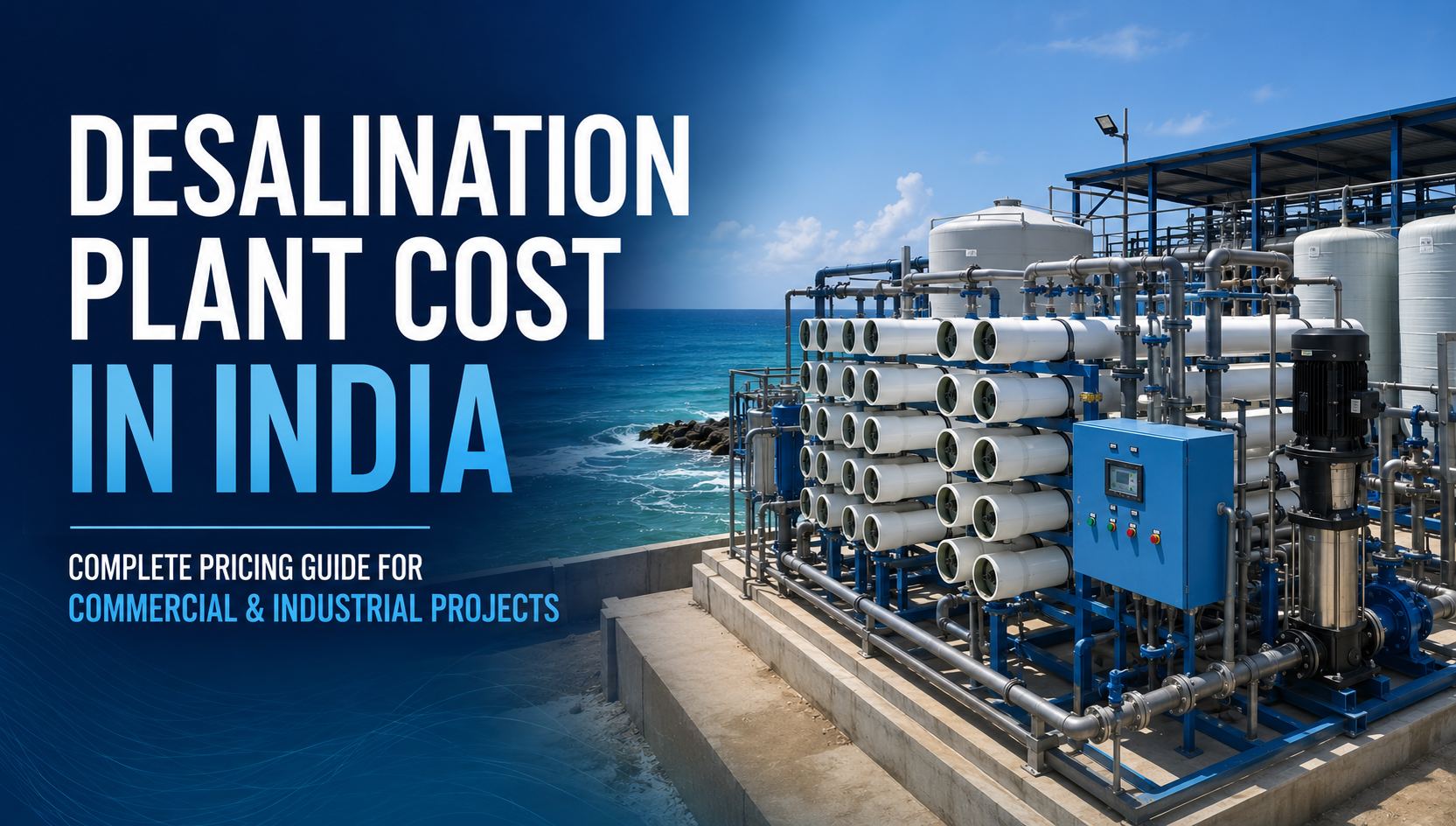
So people are turning to the one water source that never runs dry: the sea. The catch is, it costs money to make seawater drinkable, and nobody likes spending money without knowing what they’re actually paying for. Fair enough. Let’s fix that right now. So here’s the number people actually search for desalination plant cost in India: typically ranges from ₹4–7 lakh for a small 1 KLD unit to ₹8–12 crore for a large 1000 KLD industrial plant, depending on your water source, TDS level, automation, and site civil work.
Why More Businesses in India Can’t Ignore Desalination Anymore
Municipal water wasn’t built for the demand it’s facing today, and it’s showing. Coastal factories, hotels, ports, and townships have all grown faster than the pipelines feeding them. Meanwhile, seawater is quietly seeping into groundwater near a lot of coastlines, so even the borewells that used to work fine are turning salty.
Put those two problems together, and desalination stops being a backup plan. It becomes the plan.
Desalination Plant Cost in India: What You’ll Actually Pay
Nobody can give you one flat number here, and if someone tries, walk away, they haven’t asked about your water source, your capacity, or anything else that actually determines the price. Here’s a realistic cost range for a seawater RO desalination plant, covering equipment, membranes, pumps, automation, and standard civil work:
| Capacity (KLD) | Estimated Installed Cost (INR) | Approx. Cost per KLD |
| 1 KLD | ₹4,00,000 – ₹7,00,000 | ₹4,00,000 – 7,00,000 |
| 5 KLD | ₹15,00,000 – ₹25,00,000 | ₹3,00,000 – 5,00,000 |
| 10 KLD | ₹25,00,000 – ₹40,00,000 | ₹2,50,000 – 4,00,000 |
| 25 KLD | ₹50,00,000 – ₹80,00,000 | ₹2,00,000 – 3,20,000 |
| 50 KLD | ₹85,00,000 – ₹1.3 Cr | ₹1,70,000 – 2,60,000 |
| 100 KLD | ₹1.4 Cr – ₹2.1 Cr | ₹1,40,000 – 2,10,000 |
| 250 KLD | ₹2.8 Cr – ₹4.2 Cr | ₹1,10,000 – 1,70,000 |
| 500 KLD | ₹4.8 Cr – ₹7 Cr | ₹95,000 – 1,40,000 |
| 1000 KLD | ₹8 Cr – ₹12 Cr | ₹80,000 – 1,20,000 |
These numbers are working estimates, not fixed quotes. Actual pricing depends on feedwater quality, TDS level, automation level, civil work, land conditions, and project-specific needs. Big municipal plants (50–150 MLD, like the ones in Chennai and Jamnagar) run into hundreds of crores, a completely different league from a commercial or industrial unit, so don’t let those headline numbers scare you off.
Desalination Plant Cost in Visakhapatnam, Andhra Pradesh
Andhra Pradesh has one of the longest coastlines in the country, and its ports, aquaculture units, and industrial belts around Kakinada, Machilipatnam, and Nellore aren’t waiting around for municipal upgrades. Pricing tracks the national numbers above fairly closely, though land and civil work often cost a bit less outside the bigger metros, which helps, since every rupee saved on installation is a rupee that doesn’t need financing.
Visakhapatnam isn’t a “maybe someday” market for desalination, it’s already a hub. Busy ports, major refineries, and a hospitality sector that’s tired of hoping the monsoon behaves. A mid-size 50–100 KLD commercial plant here typically lands between ₹85 lakh and ₹2.1 crore, and the biggest swing factor is simply how close the site sits to the coastline; shorter pipelines mean lower costs.
Seawater Desalination Plant Cost vs. Industrial Desalination Plant Cost
These two phrases get used like they mean the same thing. They don’t, and mixing them up can throw your budget off.
A seawater desalination plant treats ocean water, which carries around 35,000–45,000 ppm of dissolved salt, a heavy load that takes real pressure and real energy to remove. An industrial desalination plant, on the other hand, might be treating seawater, salty borewell water, or even recycled effluent, depending on where the factory sits.
Here’s the part that actually matters for your wallet: brackish groundwater is far cheaper to treat than seawater, because the membranes aren’t fighting nearly as much salt. If your site has decent brackish groundwater access instead of relying purely on the sea, your capex and your monthly power bill both come down.
Technology Comparison: Seawater RO vs. Brackish Water RO vs. Thermal Desalination
| Parameter | Seawater RO | Brackish Water RO | Thermal Desalination |
| Initial Cost | High | Moderate | Very High |
| Operating Cost | High (energy-intensive) | Low to Moderate | Very High |
| Energy Consumption | 3.5–5 kWh/m³ | 1–2.5 kWh/m³ | 8–15 kWh/m³ (equivalent) |
| Best Applications | Coastal industries, hotels, ports | Inland factories, groundwater areas | Power plants, refineries with waste heat |
| Maintenance | Moderate–High (membrane fouling risk) | Low–Moderate | High (scaling, corrosion) |
Thermal desalination only really survives near power plants and refineries, where it can piggyback on waste heat that would otherwise go nowhere. Outside that specific setup, it rarely makes financial sense, the running costs are brutal.
Installation Cost: The Part People Forget to Budget For
Equipment cost is only half the story. Installation typically adds another 15–25% on top, covering foundation work, intake and outfall pipelines, electrical panels, automation wiring, and commissioning. Rocky terrain or a long stretch between the plant and the coastline pushes this figure even higher, so don’t be the person who budgets only for the machine and gets blindsided by the civil work invoice.
Operating & Maintenance Cost
Plan for roughly 8–12% of your total investment every year in O&M. That covers membrane replacement (usually every 3–5 years), pre-treatment supplies, chemical dosing, and routine servicing. Cut corners here to save a few lakhs now, and you’ll almost certainly pay double that later in emergency membrane replacements. It’s one of those costs that punishes shortcuts hard.
Electricity Consumption and Operating Expenses
Seawater RO is the power-hungry part of this whole equation, typically 3.5–5 kWh for every cubic metre of water it produces. Above 50 KLD, that stops being a small line item and starts showing up clearly on your monthly electricity bill. This is exactly why energy recovery devices have become standard on mid-to-large systems: they pull pressure back out of the leftover brine stream and can cut energy use by 30–40%. Skip them, and you’re basically throwing away free energy every single day.
Which Industries Actually Need a Desalination Plant?
- Hotels and resorts on the coast that don’t want to drain the local groundwater every guest checks in
- Ports that need process and utility water without waiting on someone else’s supply chain
- Pharmaceutical units that can’t compromise on consistent, low-salt input water
- Food processing plants where bad water quality means a bad product, full stop
- Power plants running desalinated water through boilers and cooling systems
- Coastal industries with no dependable freshwater source anywhere nearby
- Commercial buildings and townships stuck in water-stressed coastal zones with no better option
How to Choose the Right Desalination Plant
Start with your actual daily water needs, not a rounded-up number someone guessed at a meeting. Get the source water tested for salt content and other contaminants first; this one step alone avoids most of the expensive mistakes people make later. Then match the plant’s capacity, membrane type, and automation to real usage, not to a worst-case scenario that may never happen.
Common Mistakes Buyers Make Before Purchasing
- Sizing the plant on a guess instead of a proper water test
- Skipping pre-treatment to save money upfront, then paying for it in early membrane failures
- Picking the cheapest quote without checking membrane quality or automation grade
- Ignoring brine disposal compliance until it turns into a regulatory headache
- Forgetting power backup, so the plant shuts down the moment the grid does
Tips to Reduce Long-Term Operating Costs
- Add energy recovery devices from day one, retrofitting later costs more
- Get pre-treatment right; it protects the single most expensive part of the system
- Choose membranes suited to your specific water source, not a generic default
- Follow a fixed maintenance schedule instead of waiting for something to break
- Consider blending brackish and seawater sources if the site allows it
Why the Supplier You Pick Matters More Than the Price Tag
A desalination plant is supposed to run for 15–20 years. That’s not a purchase you rush through on the lowest quote. A supplier who actually designs around your water chemistry will save you money on electricity and membrane replacements for two decades straight. A supplier who hands you a generic package will cost you that same money back, just spread out and disguised as “maintenance.” Ask for references. Ask how fast they respond to a service call. Ask what happens if a membrane fails at 2 AM, because eventually, it will.
Final Thoughts
The desalination plant cost in India can range from a few lakhs for a small commercial unit to several crores for a large industrial system, and the right number depends entirely on your water source, your required capacity, and your site conditions. But one thing holds true no matter the scale: getting the design right at the start always costs less than fixing a badly built plant later. Waiting for the water problem to sort itself out won’t save you money either, it just delays the invoice.
If you’re evaluating a desalination system for a hotel, factory, port facility, or commercial property anywhere in Telangana, Andhra Pradesh, or coastal India, Hydromo can walk you through a proper water test and a realistic, project-specific quote.
Get in touch with Hydromo’s water treatment experts for a customized desalination plant proposal today.
FAQs
1. How much does a desalination plant cost in India?
Costs range from roughly ₹4–7 lakh for a 1 KLD unit to ₹8–12 crore for a 1000 KLD system. The final price depends on feedwater TDS, technology, automation level, and site-specific civil work requirements.
2. What is the cost of a seawater desalination plant per litre?
Treated water production cost typically falls between ₹35–55 per kilolitre for a well-designed seawater RO plant, factoring in electricity, membrane wear, and chemicals, though this varies by scale and energy recovery efficiency.
3. Is desalinated water safe to drink?
Yes. After RO treatment and post-treatment mineral addition, desalinated water meets Indian drinking water standards. Municipal-scale plants in Chennai and other coastal cities already supply desalinated water to households.
4. How long does a desalination plant last?
A well-maintained RO desalination system typically operates for 15–20 years, though membranes need replacement every 3–5 years and pumps require periodic servicing.
5. What is the difference between seawater and brackish water desalination?
Seawater has much higher TDS (35,000–45,000 ppm) than brackish water (1,000–10,000 ppm), so seawater RO needs higher pressure, tougher membranes, and more energy, making it costlier to build and run.
6. How much electricity does a desalination plant use?
Seawater RO plants typically consume 3.5–5 kWh per cubic metre of water produced. Energy recovery devices can cut this by 30–40%, significantly lowering monthly power costs.
7. Which industries in India use desalination plants the most?
Ports, refineries, power plants, coastal hotels, pharmaceutical units, and food processing facilities are the biggest adopters, largely because they need consistent water quality without depending on strained municipal supply.
8. What is the desalination plant cost in Andhra Pradesh?
Pricing generally follows national benchmarks, though land and civil work costs outside major metros can be slightly lower, making mid-size plants marginally more affordable than in cities like Chennai or Mumbai.
9. Can a small business or hotel afford a desalination plant?
Yes, small commercial units starting around 5–10 KLD cost roughly ₹15–40 lakh installed, which is realistic for hotels, resorts, and mid-size commercial properties in coastal water-stressed areas.
10. How do I choose the right desalination plant capacity?
Base it on an actual water audit of daily consumption plus a reasonable growth buffer (typically 15–20%), rather than estimating. Oversizing wastes capital; undersizing forces a costly retrofit later.