
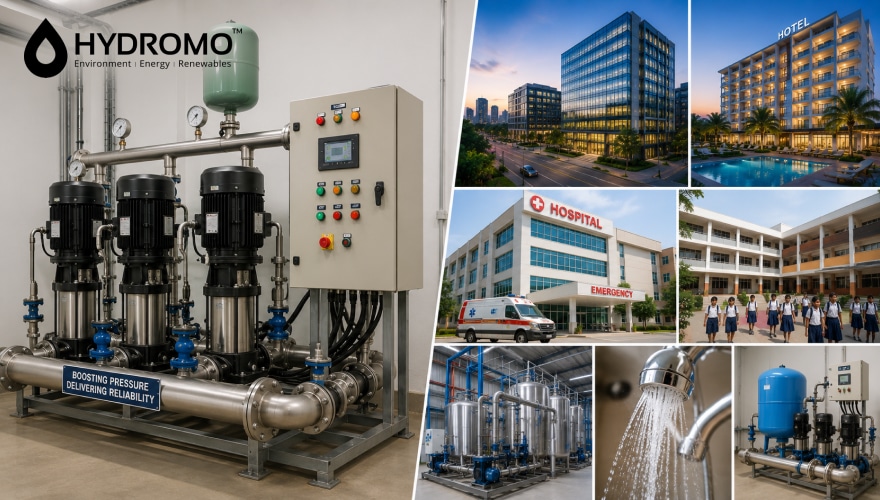
For a home, weak pressure is annoying. For a business, it’s a guest complaint, a compliance issue, or a wasted hour of staff time troubleshooting instead of working. That’s the real difference, and it’s exactly why commercial pressure booster pumps are engineered differently from the domestic units built for a single bathroom.
Have to know what commercial-grade booster systems do, where they’re used across Vijayawada’s business landscape, how to size one correctly, and what ongoing service actually looks like once it’s installed.
What Makes a Commercial Pressure Booster Pump Different?
A domestic booster pump is built to serve a handful of outlets in a single home. A commercial system has to do something much harder: deliver consistent, reliable pressure across multiple floors, multiple outlets, and unpredictable demand spikes, often running for hours at a stretch without a break.
That means commercial booster systems are built around the following:
- Higher horsepower motors (often 3 HP and above) to move larger volumes of water
- Multiple pumps working in tandem (duty-standby or duty-assist configurations), so if one pump is under load or needs servicing, another takes over automatically
- Pressure tanks or VFDs (Variable Frequency Drives) that keep pressure steady even when demand jumps suddenly, say, when three floors flush at once
- Continuous-duty design, built to run for extended hours without overheating or losing efficiency
- Remote monitoring/control options in larger installations, so facility teams can track performance without physically checking the pump room
In short, a domestic pump is built to survive occasional use. A commercial pump is built to work like it’s on payroll.
How a Commercial Booster System Works
The mechanics aren’t wildly different from a domestic setup; it’s the scale and intelligence built into the system that change.
1. Water enters the booster system from the municipal line, sump, or storage tank.
2. Multiple centrifugal or multistage pumps work together, with a control panel deciding how many pumps need to run based on real-time demand.
3. Pressure sensors constantly monitor the system, automatically increasing or reducing pump speed (with VFD-enabled systems) to match usage.
4. Water is delivered at consistent pressure to every floor and outlet, whether it’s one tap running or fifty.
This “smart load-sharing” is what allows a hotel, hospital, or commercial tower to run water-dependent operations (laundry, kitchens, HVAC, restrooms) all at once without one area starving another of pressure.
Types of Commercial Pressure Booster Systems
| System Type | Best Suited For | Key Advantage |
| Duty-Standby Booster System | Hotels, hospitals, commercial buildings | The backup pump kicks in automatically if the primary pump fails, zero downtime |
| Duty-Assist Multi-Pump System | High-rise commercial towers, malls | Multiple pumps share load during peak demand, reducing wear on any single unit |
| VFD-Controlled Booster System | Buildings with fluctuating demand (hotels, hospitals) | Adjusts pump speed in real time, saving energy during low-demand hours |
| Hydro-Pneumatic Booster System | Offices, educational institutions | A pressure tank reduces pump cycling and extends equipment life |
| Vertical Multistage Booster | High-rise buildings, industrial parks | High head output in a compact footprint, ideal where space is limited |
| RO Feed Booster Pump | Water treatment plants, industries | Delivers stable inlet pressure required for RO membranes to perform properly |
Where Vijayawada Businesses Actually Need This
| Business Type | Typical Pain Point | Why a Booster System Matters |
| Hotels & Hospitality | Guest complaints about weak showers on upper floors | Guest experience directly ties to consistent water pressure |
| Hospitals & Healthcare Facilities | Multiple wards, dialysis units, OTs needing simultaneous water supply | Inconsistent pressure isn’t just inconvenient; it can affect patient care and sterilization processes |
| Commercial Complexes & Office Towers | Restrooms and pantries across many floors, peak-hour demand spikes, | Prevents “first floor gets water, top floor doesn’t” complaints |
| Educational Institutions | Large campuses, hostels, multiple washroom blocks | Handles high simultaneous usage during class breaks |
| Industrial Parks & Factories | Process water, cooling systems, cleaning operations | Booster pumps ensure production processes aren’t held up by inadequate pressure |
| Builders & Real Estate Developers | Need a reliable system specified before handover to residents/tenants | Getting it right during construction avoids costly retrofits later |
| Water Treatment Setups (RO/STP) | Low inlet pressure reduces treatment efficiency | Booster pumps maintain the pressure treatment systems are designed around |
Choosing the Right System: What Facility Managers Should Actually Ask
Sizing a commercial system isn’t a “bigger is always better” decision; oversized systems waste energy, and undersized ones fail under real demand. Here’s what actually goes into the calculation:
1. Simultaneous demand, not total demand It’s not about how many taps exist in the building; it’s about how many realistically run at the same time during peak hours.
2. Building height and layout More floors mean a higher head requirement. Horizontal pipe runs (common in sprawling single-story commercial complexes) add friction loss that also needs to be accounted for.
3. Redundancy requirements: can your business afford zero water pressure if one pump fails? For hospitals and hotels, the answer is almost always no, which is why duty-standby configurations are standard, not optional.
4. Energy efficiency VFD-enabled systems cost more upfront but significantly reduce electricity consumption over years of continuous operation, often paying for the difference within a couple of years for high-usage buildings.
5. Water quality and pump material Given Vijayawada’s water hardness in several localities, stainless steel components resist scaling and corrosion far better than standard cast iron, extending pump life in commercial settings that can’t afford frequent downtime.
Here’s a general sizing reference for common commercial setups:
| Facility Type | Typical Power Range | Configuration |
| Small commercial building (up to 4 floors) | 3 HP – 5 HP | Single or duty-standby pair |
| Mid-size hotel / hospital (5–10 floors) | 5 HP – 10 HP | Duty-standby or duty-assist, 2–3 pumps |
| Large commercial tower / mall | 10 HP+ | Multi-pump VFD system |
| Educational campus / hostel block | 5 HP – 7.5 HP | Duty-assist, based on peak-hour usage |
| Industrial/RO feed application | Varies by process requirement | Sized to process specifications, not general guidelines |
These are starting benchmarks; actual sizing should always follow a proper site and demand assessment, not a generic chart.
Installation Considerations for Commercial Sites
Commercial installations carry more stakes than a home setup, so a few things matter more here:
- Pump room planning: adequate ventilation, drainage, and access for future servicing should be built into the design, not added as an afterthought
- Noise and vibration control: critical in hotels and hospitals where pump rooms may be close to occupied spaces
- Electrical load planning: commercial-grade motors need dedicated circuits and proper protection against voltage fluctuations, especially relevant during Vijayawada’s monsoon season
- Compliance considerations: healthcare and hospitality projects often need systems that align with facility design and safety norms reviewed by MEP consultants
- Phased commissioning: for large builds, systems are often tested in phases as different floors/blocks come online
Getting these details right at the planning stage (ideally with your MEP consultant or builder) prevents expensive retrofitting after occupancy.
What Ongoing Service Actually Looks Like
A commercial booster system isn’t an “install and forget” purchase; it’s closer to a piece of operating equipment that needs a maintenance rhythm:
- Routine inspection of pumps, control panels, and pressure sensors (typically quarterly for high-usage sites)
- Preventive servicing of bearings, seals, and motors before wear turns into failure
- Strainer and filter cleaning to prevent debris from affecting pump performance
- Load testing to confirm the system still meets current demand, especially if occupancy or usage has grown since installation
- Rapid-response repairs for hospitals and hotels: a pump going down isn’t something that can wait days for a technician to arrive
This is really where the difference between a one-time vendor and a genuine service partner shows up. A pump is only as reliable as the support behind it.
Why Local Support Matters for Commercial Installations
Commercial buyers often assume any supplier with the right specs will do. In practice, three things separate a good outcome from a recurring headache:
- Site-specific sizing: done by engineers who’ve actually assessed your building, not just matched a spec sheet
- Genuine components with manufacturer-backed warranty: critical for equipment running continuous duty cycles
- Fast local service response: a hotel or hospital in Vijayawada can’t afford to wait for a technician flying in from another state
- Ongoing account support: As your building’s usage grows (more rooms, more floors, more tenants), your system may need reassessment, not just repair
Hydromo works directly with hotels, hospitals, commercial developers, industrial parks, and educational institutions across Vijayawada, Vizag, Guntur, and other cities in Andhra Pradesh, engineering and servicing pressure booster systems built for continuous commercial use, not just catalog specifications.
The Bottom Line
For a business, water pressure isn’t a comfort feature; it’s operational infrastructure. A hotel’s guest reviews, a hospital’s daily functioning, or a commercial tower’s tenant satisfaction can all be quietly undermined by a booster system that wasn’t sized, installed, or maintained properly.
Getting it right starts with an honest site assessment, not a one-size-fits-all spec sheet, because a system built for your building’s actual demand is the difference between reliable water pressure for years and a recurring maintenance ticket.
Planning a commercial project or facing pressure issues in an existing building?
Talk to Hydromo’s engineering team for a site assessment and the right commercial pressure booster solution for your Vijayawada business.
Frequently Asked Questions
Q1: How is a commercial pressure booster pump different from a residential one?
Commercial systems are built for continuous duty and higher simultaneous demand and typically include redundancy (multiple pumps) so a single pump failure doesn’t shut down water supply to an entire building.
Q2: How much does a commercial pressure booster system cost?
Pricing depends on horsepower, number of pumps, VFD requirements, and building complexity. A site assessment gives an accurate figure; generic per-unit pricing doesn’t account for real demand and redundancy needs.
Q3: Do hotels and hospitals need backup pumps?
In almost all cases, yes. Duty-standby configurations ensure water supply continues even if one pump needs servicing or fails unexpectedly, a non-negotiable for guest experience and patient care.
Q4: Can an existing building retrofit a commercial booster system, or does it need to be planned during construction?
Retrofits are common and very doable, though planning during construction (in coordination with MEP consultants) generally results in a cleaner, more cost-effective installation.
Q5: How often does a commercial booster pump need servicing?
High-usage commercial sites typically benefit from quarterly inspections, with preventive component servicing scheduled based on running hours rather than just calendar time.