
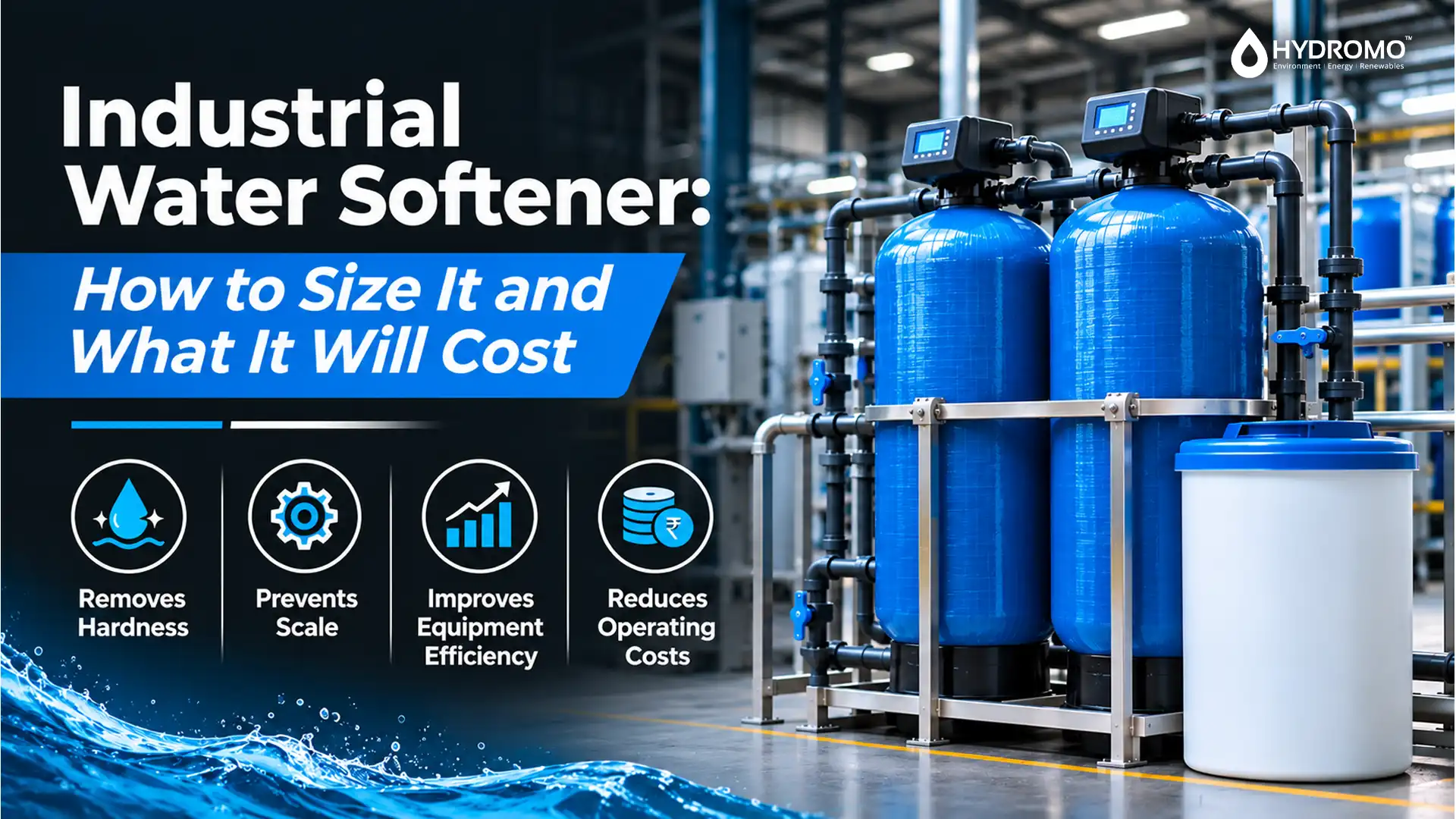
An industrial water softener removes calcium and magnesium from process water using ion exchange resin, so scale doesn’t form in boilers, heat exchangers, cooling circuits, and pipes. The right size depends on three numbers: your hardness, your daily water volume, and how often you can afford to regenerate. Get those wrong and you either overspend on a bigger unit than you need or run a small one that leaks hardness every afternoon.
What an industrial water softener actually does
Hard water carries dissolved calcium and magnesium. When it heats up or evaporates, those minerals come out as scale. A softener passes the water through a bed of resin beads that swap calcium and magnesium for sodium. The water leaves with close to zero hardness. If you want the chemistry in more detail, our guide to ion exchange water softening in industry covers it.
One limit worth knowing: softening does not reduce TDS. It exchanges ions, it doesn’t remove them. If your problem is high dissolved solids rather than scale, you need RO or another process, sometimes after the softener. Here’s a plain comparison of RO and softeners, and a look at how TDS works if you need a refresher.
Where plants use one
- Boiler feed water, where scale directly raises fuel consumption
- Cooling tower makeup, to allow higher cycles of concentration
- Textile and dyeing units, where hardness affects dye uptake and soap use
- Laundries, food processing, and pharma utilities
- Pre-treatment ahead of reverse osmosis membranes to protect them from scaling
Industrial water softener sizing: the calculation
Sizing starts with the hardness load you need to remove each day.
Daily hardness load = daily water volume × hardness
Hardness is often reported in grains per gallon (gpg) or in ppm as CaCO₃. One gpg is roughly 17.1 ppm, so you can convert between them easily. One gpg equals roughly 17.1 mg/L. If you haven’t tested your water recently, start with these simple ways to test water quality, then get a proper lab report for design.
Then divide that load by the capacity of the resin. That capacity depends on the salt dose used during regeneration. Capacity is expressed in grains or gallons, and it matters for sizing, configuring, and troubleshooting. To calculate it, you need raw water hardness in ppm, resin volume in cubic feet, and salt dosage per cubic foot of resin.
A worked example (metric)
Say a plant uses 100 m³ of softened water per day, and the raw water measures 300 ppm total hardness as CaCO₃.
- 300 ppm = 300 g per m³
- 100 m³ × 300 g = 30,000 g = 30 kg of hardness per day
Reference material on softener design puts resin capacity at a medium salt dose at about 0.06 kg of hardness per liter of resin (that’s 26,000 grains per cubic foot). With one regeneration per day:
- 30 kg ÷ 0.06 kg/L = about 500 liters of resin, roughly 17.7 ft³
This is a starting point, not a final design. Real designs add a safety margin and check flow rate separately, because the resin volume that handles the daily load can still be too small for your peak flow.
Three things people forget
Peak flow, not average flow. A plant using 100 m³ a day may draw far more than the average for an hour when several lines run together. The vessel diameter and valve must handle that peak without pushing water through the resin too fast.
Iron. Iron fouls resin and eats capacity. One sizing guide suggests adding 5 grains per 1 ppm of iron to your baseline hardness requirement. If your borewell water has iron, test for it before you finalize anything.
Regeneration schedule. A simplex unit stops delivering soft water while it regenerates. If you run 24 hours, you need a duplex (twin) arrangement so one vessel works while the other regenerates. For 24/7 operations needing large capacity, one vendor guide cites sizes in the range of 500,000 to 1,000,000+ grains. Treat that as a rough benchmark of scale, not a spec for your plant.
Industrial water softener system vs. industrial water softener plant
People use these two terms interchangeably, but they describe different scopes.
An industrial water softener system is the core equipment: resin vessel(s), control valve, brine tank and brine pump or ejector, and basic instrumentation.
An industrial water softener plant is the wider installation around it. That can include a raw water tank, feed pumps, a multimedia or activated carbon filter ahead of the softener (to remove suspended solids and chlorine that damage resin), the softener itself, a soft water storage tank, piping, a hardness test point, and the electrical panel. It usually sits inside a larger industrial water treatment setup, and you can see how the stages fit together in our water treatment process guide.
When you compare quotations, check which of these one vendor includes and another leaves out. A low number often means the pre-filter, tank, or civil work is missing.
What decides the industrial water softener price?
We’re not going to quote a figure here, because a number without your water report would mislead you. What moves the price is predictable, though:
| Factor | Why it matters |
| Flow rate and resin volume | Bigger vessels, more resin, larger valves |
| Simplex vs duplex | Duplex roughly doubles the vessel count but gives a continuous supply |
| Automation level | Manual, semi-automatic, or fully automatic with PLC |
| Vessel material | FRP, mild steel with lining, or stainless steel |
| Pre-treatment | Sand/carbon filters, iron removal if needed |
| Brine system | Size of brine tank, salt handling |
| Civil and installation | Foundation, piping, electrical works |
Look past the purchase price. Salt, water used for backwashing and rinsing, and resin replacement and maintenance make up the running cost. A cheaper unit with poor salt efficiency can cost more over a few years than a better-designed one. Ask each vendor for expected salt consumption per regeneration and the regeneration frequency at your hardness.
If your plant also needs RO after softening, the same logic applies there. Our industrial RO plant guide on cost and capacity explains what drives that budget.
Mistakes that cause trouble later
1. Sizing from a single water test. Borewell and municipal water change with the season. Test more than once.
2. Ignoring the outlet target. Boilers and some processes need near-zero hardness. Decide the limit before choosing the design.
3. Undersizing to save money. An undersized unit regenerates more often, burns more salt, and wears resin faster.
4. Skipping pre-filtration. Suspended solids and chlorine shorten resin life.
5. No hardness monitoring. A simple test kit at the outlet tells you when resin is exhausted before scale does.
Smaller commercial sites such as hotels, hospitals, and apartments have different load patterns. For those, see water softeners for villas, apartments, hotels, and hospitals and the softener vs RO comparison for hotels and hospitals.
Conclusion
Before asking anyone for an industrial water softener price, collect your water analysis (total hardness, iron, TDS, pH), your daily and peak flow, and your operating hours. With those, a vendor can size the system properly, and you can compare quotes on the same basis.
Hydromo can review your water report and recommend a softener sized to your plant. See our water softener solutions or contact the team with your flow rate and hardness values to get a technical proposal.
FAQs
1. How do I size an industrial water softener?
Ans. Start with the daily hardness load: daily water volume × hardness. Divide that by the resin’s capacity at your salt dose. Then check peak flow separately, because a unit that handles the daily load can still be too small for your busiest hour.
2. What information do I need before asking for a quote?
Ans. Have these ready: a lab report for total hardness, iron, TDS, and pH; your daily and peak flow; and your operating hours. With these, vendors can quote on the same basis, and you can compare them fairly.
3. How much resin does 100 m³/day at 300 ppm hardness need?
Ans. That is 30 kg of hardness per day. At about 0.06 kg of hardness per liter of resin (medium salt dose, one regeneration a day), you need roughly 500 liters, or about 17.7 ft³. Treat this as a starting point, since a real design adds a safety margin.
4. What is the difference between ppm and gpg?
Ans. They are two units for hardness. One gpg is about 17.1 ppm as CaCO₃, so you can convert either way.
5. Does a water softener reduce TDS?
Ans. No. A softener swaps calcium and magnesium for sodium, so TDS stays about the same. If your problem is high dissolved solids, you need RO or a similar process, sometimes placed after the softener.
6. Do I need a simplex or duplex softener?
Ans. A simplex unit stops supplying soft water while it regenerates. If your plant runs 24 hours, choose a duplex (twin) unit so one vessel works while the other regenerates.
7. Why does iron in my borewell water matter?
Ans. Iron fouls the resin and cuts its capacity. One sizing guide suggests adding 5 grains for every 1 ppm of iron to your hardness requirement. Test for iron before you finalize the design.
8. What is the difference between an industrial water softener system and a plant?
Ans. The system is the core equipment: resin vessels, control valve, brine tank, and basic instruments. The plant includes everything around it, such as the raw water tank, feed pumps, a sand or carbon pre-filter, soft water storage, piping, and the electrical panel.
9. Why do softener quotes vary so much?
Ans. Vendors often include different things. A low quote may leave out the pre-filter, storage tank, or civil work. Prices also depend on flow rate, resin volume, simplex or duplex, automation level, vessel material, and brine system.
10. What does it cost to run an industrial water softener?
Ans. Running costs come from salt, backwash and rinse water, resin replacement and maintenance. Ask each vendor for salt use per regeneration and how often it regenerates at your hardness. A cheaper unit with poor salt efficiency can cost more over a few years.
11. Why do I need a pre-filter before the softener?
Ans. Suspended solids and chlorine damage the resin and shorten its life. A multimedia or activated carbon filter ahead of the softener protects it.
12. What happens if I undersize the softener?
Ans. It regenerates more often, uses more salt and wears the resin faster. It may also let hardness through at peak demand.
13. How do I know when the resin is exhausted?
Ans. Test the outlet water with a simple hardness kit. It shows exhaustion before scale starts forming in your boiler or pipes.
14. Can one water test be enough for sizing?
Ans. No. Borewell and municipal water change with the season. Test more than once and use a proper lab report for design.
15. Do I need a softener before an RO plant?
Ans. Often yes. It protects the RO membranes from scaling. Your water report will show whether your feed needs it.