
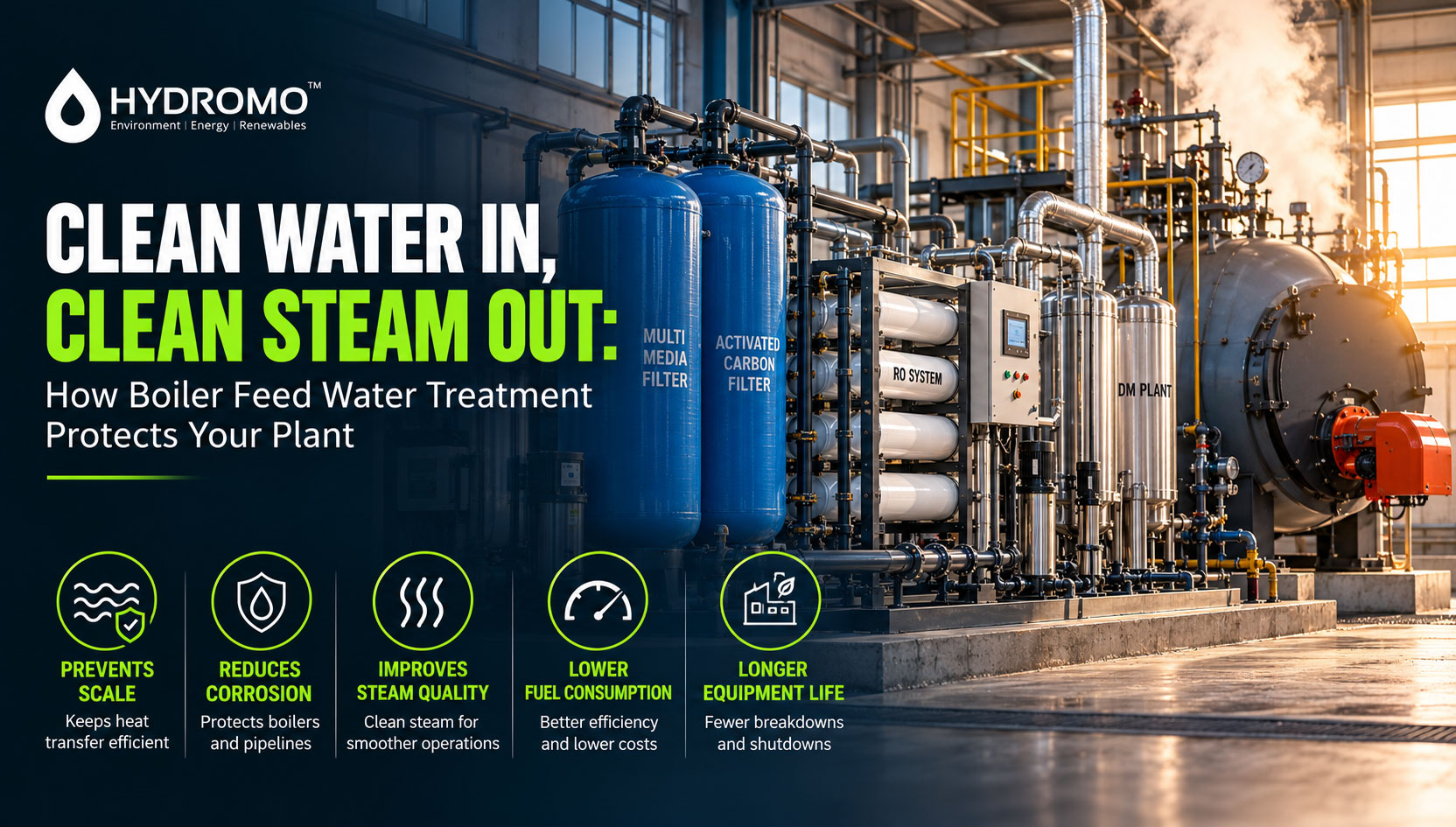
Boiler feed water treatment removes hardness, dissolved oxygen, silica and suspended solids from raw water before it reaches the boiler. Skip it, and scale coats the tubes, metal corrodes, and steam quality drops. A well-planned industrial boiler water treatment program protects the boiler, cuts fuel use and keeps production running between planned shutdowns.
Most boiler failures don’t start in the boiler. They start with the water.
What Raw Water Does Inside a Boiler
Borewell and municipal water carry calcium, magnesium, silica, chlorides and dissolved gases. Once heated, they cause three problems.
Scale forms when hardness salts bake onto tube walls. It conducts heat poorly, so the burner works harder while the metal underneath overheats. Tubes can eventually rupture.
Corrosion comes mainly from dissolved oxygen and low pH. It attacks feed lines, economizers and the shell, often where you can’t easily inspect.
Carryover happens when high dissolved solids cause foaming. Water droplets enter the steam line and damage valves, turbines and process equipment downstream.
A factory in Hyderabad running on 500 ppm hardness borewell water will hit these problems far sooner than one using soft, low-TDS feed. That’s why every design should begin with a proper raw water analysis, and a few simple ways to test water quality on site already tell you a lot about what the boiler will face.
Inside a Boiler Feed Water Treatment Plant
A boiler feed water treatment plant is a sequence of stages, and each one protects the next.
1. Pretreatment. Sand and carbon filters remove turbidity, chlorine and organics that would foul softener resin or membranes. Where suspended solids run high, ultrafiltration gives a much cleaner feed to the stages after it.
2. Softening or demineralization. A softener handles hardness. For higher-pressure boilers, reverse osmosis followed by a DM plant or mixed bed polisher removes dissolved salts and silica.
3. Deaeration. A deaerator heats feed water to drive out oxygen and carbon dioxide. It is the single most effective step against corrosion.
4. Chemical dosing. Oxygen scavengers, pH boosters and scale dispersants handle what mechanical removal misses.
5. Blowdown control. Bottom and surface blowdown remove concentrated solids. Automatic TDS-based control wastes less heat than a fixed manual schedule.
The same logic runs through any water treatment process: remove the biggest problems first, then polish. Boilers just have tighter limits than most other users, which is why water treatment plants built for boiler duty look different from those built for drinking water.
How a Boiler Water Softener Works
A boiler water softener uses cation exchange resin. As water passes through, the resin swaps calcium and magnesium ions for sodium ions. The outlet water is close to zero hardness, so hardness scale can’t form.
When the resin is exhausted, a brine solution regenerates it. Duplex vessels keep one unit in service while the other regenerates, which matters for boilers that can’t stop. Plants that depend on ion exchange water softening usually size the resin bed for at least eight hours between regenerations, and a water softener sized this way keeps salt use predictable.
Softeners have limits. They remove hardness, but not TDS, silica or alkalinity. For medium and high-pressure boilers, a softener alone isn’t enough. That is the core of the difference between RO and softeners: one targets hardness ions, the other removes most dissolved salts.
Typical Water Quality Targets
Exact limits depend on boiler pressure and manufacturer guidance. These ranges are common for low to medium-pressure industrial boilers:
| Parameter | Typical Target |
| Feed water hardness | Near 0 ppm (below 2 ppm) |
| Feed water pH | 8.5 to 9.5 |
| Dissolved oxygen after deaerator | Below 0.007 ppm |
| Boiler water pH | 10.5 to 11.5 |
| Boiler water TDS | Set by boiler pressure and design |
Confirm limits with your boiler maker and test every shift. A weekly lab report can’t catch changes that happen within hours.
Choosing an Industrial Water Treatment System
An industrial water treatment system should be chosen on data, not equipment price. Start with a full raw water analysis covering hardness, TDS, silica, iron, chlorides and alkalinity. Then match the design to three things.
Boiler pressure. A 10 bar fire-tube boiler tolerates far more than a 60 bar water-tube unit.
Condensate return. A plant returning 70 to 80 percent of its condensate needs much less makeup water than one returning 20 percent. Makeup volume sets the plant size.
Steam use. Food, pharma and textile units may need cleaner steam than a general heating application.
Ask vendors for operating cost, not just capital cost. Salt, chemicals, membrane life and power draw decide what the system costs over five years. RO stages in particular vary widely, and the cost and capacity of an industrial RO plant depend on feed TDS and recovery rate. I wouldn’t shortlist any supplier who can’t give you those numbers.
Mistakes That Cost Plants Money
- Running the softener past its rated capacity because the regeneration timer was never adjusted.
- Skipping hardness tests at the softener outlet, so breakthrough goes unnoticed for days.
- Dosing chemicals by habit instead of by test results.
- Ignoring the deaerator until oxygen pitting shows up in an inspection.
- Treating blowdown as a fixed schedule instead of a response to boiler water TDS.
None are expensive to fix. They’re expensive to ignore. A yearly AMC catches most of them early, and plants moving toward smart water management systems get alerts on hardness breakthrough before the boiler sees it.
Before You Compare Quotations
Get your raw water tested and your boiler’s makeup demand calculated first. Those two numbers decide everything else.
Hydromo designs and installs boiler feed water treatment plants, softeners and complete industrial solutions across Hyderabad, Telangana and Andhra Pradesh. Our consulting engineers review water reports and boiler data before recommending any equipment. To start, request a free site assessment through the contact page.
Frequently Asked Questions
1. What is boiler feed water treatment?
Ans. It conditions water before and during boiler operation. It removes hardness, oxygen and dissolved solids and adjusts pH so the boiler resists scale and corrosion.
2. Is a water softener enough for an industrial boiler?
Ans. For low-pressure boilers with moderate TDS, often yes. For higher pressures or high-silica water, add RO or a DM plant, plus a deaerator and chemical dosing.
3. How often should boiler water be tested?
Ans. Check feed water hardness and boiler water pH, TDS and alkalinity at least once per shift. Keep a written log so trends show up before damage does.
4. How much fuel does scale waste?
Ans. Scale insulates the tubes, so more fuel is needed for the same steam. Heavy deposits can add several percent to fuel bills.
5. What is the difference between internal and external treatment?
Ans. External treatment (filtration, softening, RO, deaeration) cleans water before the boiler. Internal treatment (dosing and blowdown) manages conditions inside it. Most plants need both.
6. Can blowdown water be reused?
Ans. Often, yes, after cooling and treatment. Cooling tower makeup is the common choice, and the same chemistry applies to cooling tower water treatment. Plants that recover blowdown and condensate are already practising wastewater recycling, which lowers makeup water bills.
7. How do I size a boiler feed water treatment plant?
Ans. Work out makeup demand from steam output and condensate return, then add margin for regeneration cycles and future expansion.