
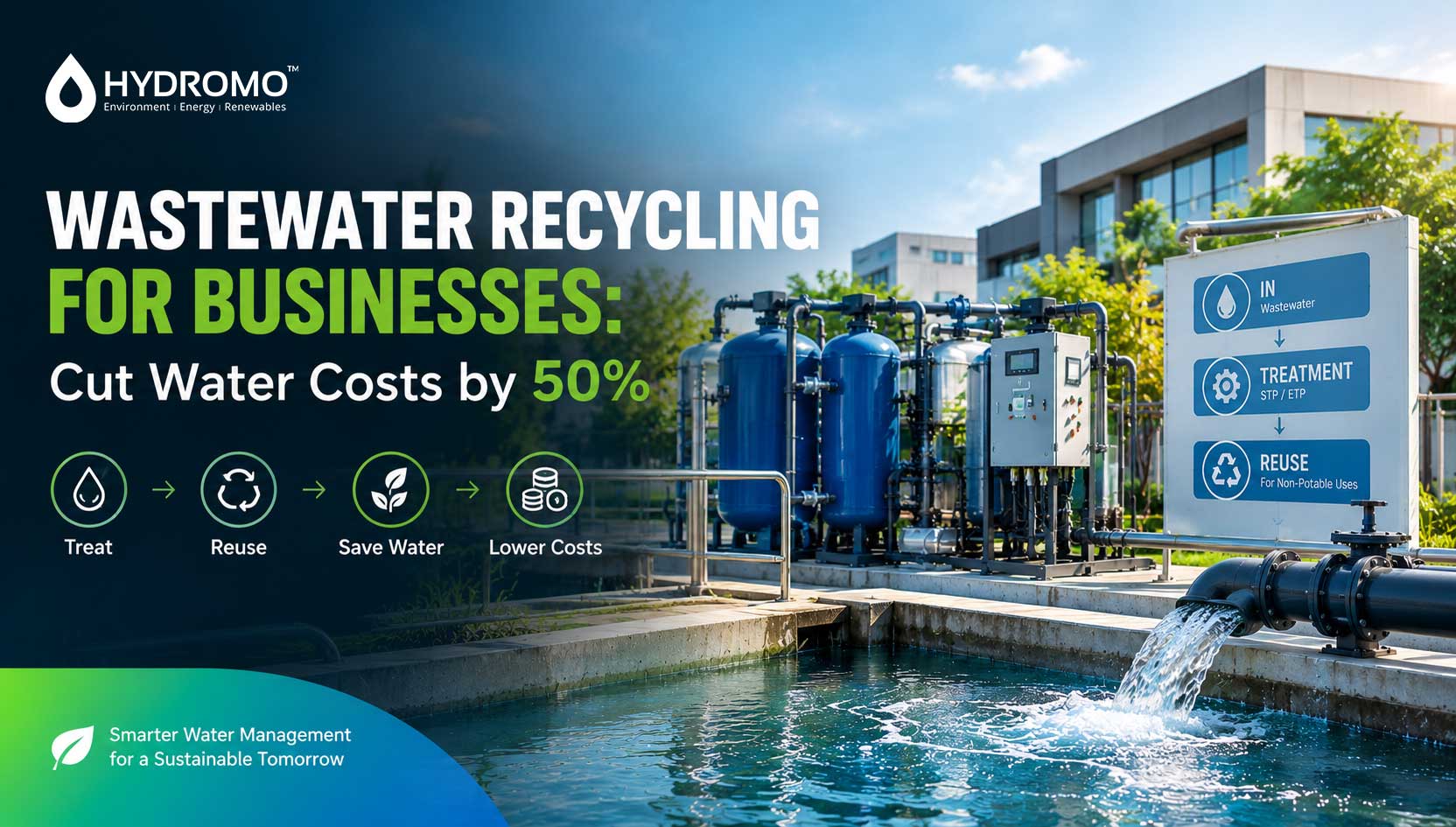
Most businesses pay for the same water twice. Once when it comes in through a tanker or municipal line, and again when it leaves as sewage or discharge. Wastewater recycling for businesses stops the second payment by treating used water on site and sending it back to work. If half of your daily demand does not need drinking-quality water, recycling can cut your freshwater purchase by about half.
That 50% is not a guarantee. It is what the arithmetic produces when the conditions are right. Here is how it works and how to check whether your site qualifies.
Where the 50% Comes From
The saving depends on two numbers: how much of your demand is non-potable and how much wastewater you can collect and treat.
A hotel, hospital, office campus, or factory uses water for flushing, cooling towers, landscaping, floor washing, vehicle washing, and process rinsing. None of these needs fresh water of drinking quality. In many commercial buildings, flushing and cooling together take close to half of the total demand. Treated wastewater covers that share.
A worked example
These figures are assumptions for illustration. Replace them with your own bills.
- Site demand: 100 kilolitres per day (KLD)
- Blended cost of fresh water (tanker plus municipal): ₹60 per kilolitre
- Treated water reused: 60 KLD
- Running cost of treatment (power, chemicals, manpower): ₹10 per kilolitre
Without recycling, the daily bill is ₹6,000. With recycling, you buy 40 KLD (₹2,400) and spend ₹600 treating 60 KLD. The new bill is ₹3,000, a 50% drop. Over a year, that is roughly ₹10.95 lakh.
This ignores the capital cost of the plant, and it also ignores sewer or discharge charges you avoid. Both belong in your payback calculation.
What Treated Water Can Be Used For
The end use decides how much treatment you need. Flushing and gardening need less. Cooling tower make-up and boiler feed need more.
- Toilet flushing and floor washing
- Landscaping and green belt irrigation
- Cooling tower and HVAC make-up water
- Vehicle and equipment washing
- Process rinsing and boiler feed after membrane polishing
Match the treatment level to the use. Treating everything to drinking standard is the most common way to overspend.
Water Recycling Solutions for Commercial Buildings
For apartments, hotels, hospitals, malls, and offices, the core is a sewage treatment plant (STP). Biological treatment such as MBBR or MBR removes organic load. A tertiary stage with filtration and disinfection makes the water safe for flushing and landscaping.
MBR costs more upfront but takes less space and gives a cleaner outlet. In a basement-constrained building, I would pick MBR. Where land is available and the budget is tight, MBBR with a good tertiary stage does the job.
One point decides success more than the technology: separate greywater (showers, basins, laundry) from blackwater where the building design allows it. Greywater is easier and cheaper to treat.
Industrial Water Recycling Solutions
Industrial sites face harder water. Effluent can carry oils, dissolved salts, dyes or high organic load, and each needs a different treatment train.
A typical industrial water reuse system runs an effluent treatment plant (ETP) first, then ultrafiltration, then reverse osmosis (RO) to remove dissolved salts. The RO permeate goes back to cooling or process use. The reject stream can be handled with an evaporator when a site aims for zero liquid discharge (ZLD).
For industries that pay heavily for water, this is where savings show up fastest. Water-intensive units such as food processing, textiles, pharma and poultry often reuse a large part of their effluent.
What Reduces the Savings
A few things shrink the number, and it is better to know them early.
- Poor flow data. Plants sized on guesses are either oversized and wasteful or undersized and bypassed. Measure real flows before design.
- Membrane fouling. RO membranes lose output when pre-treatment is weak. Replacement cost then eats the savings.
- No trained operator. A well-built plant with nobody checking it daily drifts out of spec within months.
- Choosing on capex alone. The cheapest quote often has the highest power and chemical use. Ask every vendor for guaranteed outlet quality and per-kilolitre running cost.
How to Reduce Water Costs for Industries and Buildings: Start With an Audit
1. Pull 12 months of water bills and tanker invoices.
2. Measure daily inflow and outflow at the main points.
3. List every use and mark which ones can accept treated water.
4. Test the wastewater for BOD, COD, TDS and oil content.
5. Compare treatment options on running cost per kilolitre, not only plant price.
Check your State Pollution Control Board requirements as well. Discharge and reuse norms differ by industry and location, and your design should meet them from day one.
Next Step
Before comparing vendors, find out how much of your water bill can be replaced. Hydromo offers a free site water audit for commercial buildings and industries, with a customised proposal that shows running cost per kilolitre. Request a Free Site Assessment and see your own savings number.
Frequently Asked Questions
Can wastewater recycling really save 50% of water costs?
It can when about half of your demand is non-potable and you collect enough wastewater to cover it. Savings are lower for sites with small flushing or cooling demand. A water audit gives the real figure.
How long does payback take?
It depends on your current water price, plant size, and treatment level. Sites that buy water by tanker usually recover the investment faster than those on cheap municipal supply. Ask for a payback calculation based on your own bills.
Is recycled water safe for staff and customers?
Treated water meant for flushing, cooling, and landscaping is not for drinking. When it is disinfected and tested to the applicable standard, it is safe for these uses.
Do small businesses benefit from industrial water reuse systems?
Often yes, if daily water use is high enough. Very small sites may find the plant cost hard to justify, so check the numbers first.