
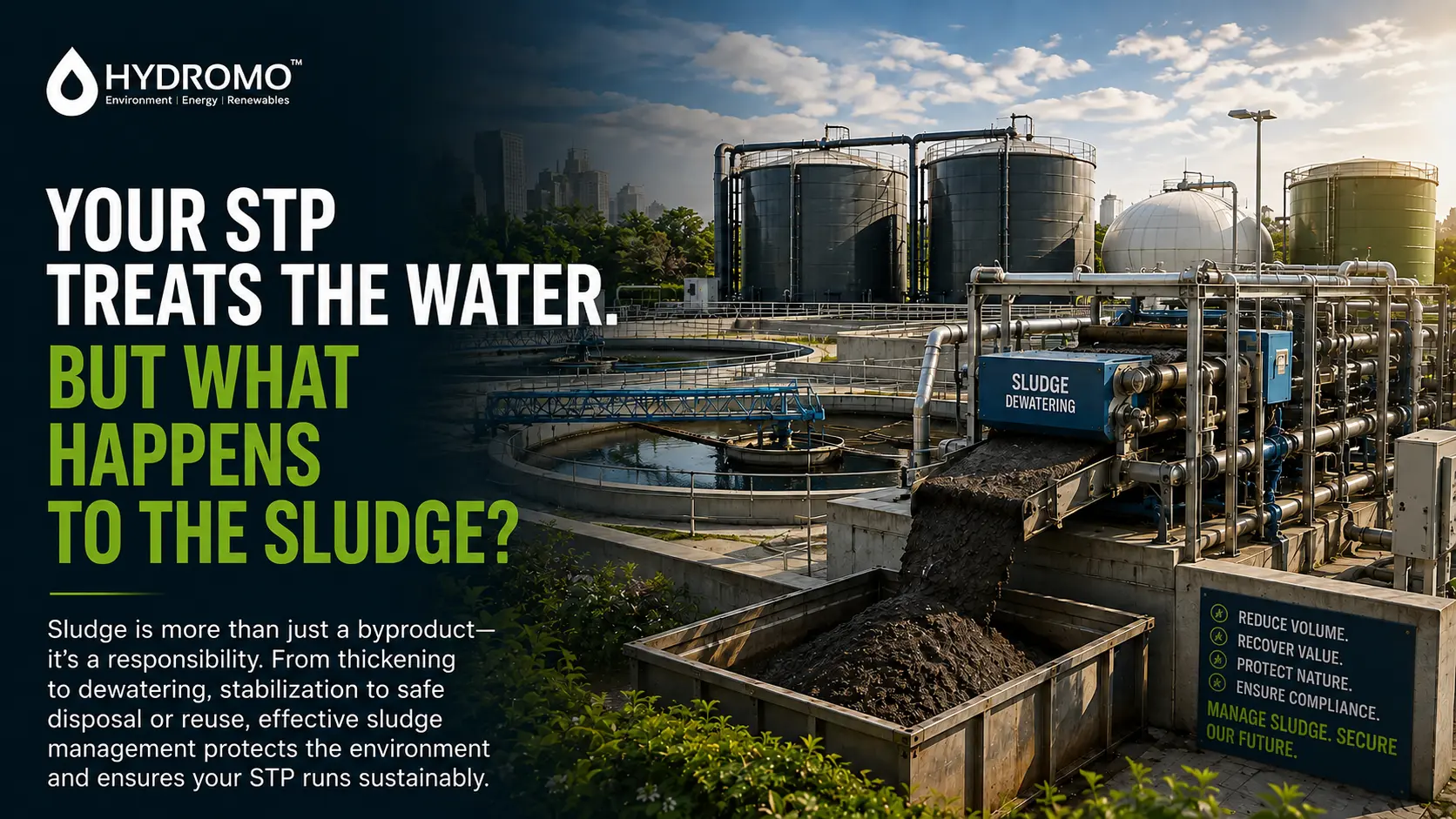
Sludge from wastewater treatment is the solid and semi-solid material left behind once water has been cleaned, organic matter, microorganisms, and settled particles that had to come out before the treated water could be discharged or reused. Every treatment plant produces it. A municipal facility serving a city produces it. So does a small STP sitting in an apartment basement. The volumes differ, but the problem doesn’t go away just because the plant is smaller.
Ignore sludge and it becomes the thing that fails an inspection, blocks a tank, or triples your disposal bill six months after commissioning. Here’s what it actually is, how it gets treated, and what it means if you’re the one responsible for a plant rather than studying one from a distance.
Where Sludge From Wastewater Treatment Actually Comes From
Sludge isn’t a single, uniform substance. What you get depends on which stage of treatment produced it.
Primary sludge settles out early, before any biological treatment starts. It’s mostly the heavy stuff, grit, food particles, organic debris that sinks on its own.
Secondary sludge, often called waste activated sludge or WAS, comes later. It’s the leftover bacterial mass from the biological treatment stage, the microorganisms that did the actual cleaning, now spent and settled out.
Most plants blend the two into a single sludge stream before treatment. Municipal facilities get theirs from domestic sewage. Industrial units, food processing, pharmaceuticals, textiles, and poultry generate sludge with a completely different profile, sometimes heavier in oils, chemicals, or specific nutrients depending on what the factory does upstream. A poultry unit’s sludge and a hospital’s sludge aren’t remotely comparable and shouldn’t be handled as if they were.
Scale changes, but the obligation doesn’t. A 200-flat apartment complex running its own STP still produces sludge every day, and that sludge still needs a disposal route someone can point to when asked.
Why Sludge Needs Treatment Before Disposal
Raw sludge carries pathogens, heavy metals, and nutrient loads that make dumping it untreated a bad idea, not just a rule-breaking one.
Release it into a waterway and you get eutrophication: excess nitrogen and phosphorus feed algal blooms, the blooms die and decompose, the decomposition eats up dissolved oxygen, and fish suffocate. It’s one of the most preventable forms of water pollution there is, and nearly every case traces back to sludge that wasn’t handled properly.
There’s also the cost angle, and this is the part most owners underestimate. Sludge is a small fraction of the total wastewater a plant receives by volume. But treating it well can eat a disproportionate share of the operating budget, which is exactly why it deserves the same planning attention as the water treatment process itself, not a line item added after the tanks are already sized.
How Sludge Treatment Works: The Core Stages
The sequence is broadly the same whether you’re running a city-scale plant or a hotel’s STP. What changes is the scale and the equipment.
1. Thickening
Raw sludge is mostly water. Thickening removes the easiest portion of it, using gravity, flotation, or centrifugal force, without much energy input. It’s a low-cost step, and it noticeably cuts the volume that has to move through everything downstream. Skip it or undersize it, and every later stage costs more to run.
2. Stabilisation (digestion)
This is where organic content breaks down and pathogen counts drop. Two routes:
Anaerobic digestion uses microorganisms in the absence of oxygen and produces biogas, mostly methane, as it goes. Larger plants capture that gas and use it for heat or power, which helps offset running costs. Aerobic digestion does the same job with oxygen present. It’s simpler to operate and suits smaller plants better, though there’s no biogas to show for it.
Digestion can run at moderate (mesophilic) or elevated (thermophilic) temperature. Higher temperature kills pathogens faster but costs more energy to maintain. For most small and mid-size STPs in India, mesophilic aerobic digestion is the more practical choice, the energy saving matters more than shaving a few days off retention time.
Where a digester isn’t practical, plants fall back on lime dosing to raise pH and suppress pathogens, or composting for smaller and rural setups.
3. Dewatering
Stabilised sludge still holds a lot of bound water. Dewatering, belt filter presses, centrifuges, screw presses, forces more of it out, leaving a semi-solid cake that a conveyor or loader can handle instead of a pump. It costs more energy than thickening, but it’s what turns sludge into something you can actually transport off-site without paying to move water.
4. Thermal or advanced treatment
Some facilities go further with thermal drying, incineration, or advanced oxidation, either to destroy remaining contaminants or shrink the volume even more before final disposal. This only makes financial sense at a scale where the drop in transport and landfill cost outweighs the extra energy spent to get there. For a single apartment complex or small factory, it rarely does.
What Happens to Treated Sludge?
Once treated, sludge is usually called biosolids, and there are three real endpoints for it: land application as a soil conditioner or fertiliser, energy recovery through biogas or combustion, or landfilling as the last resort once volume has been cut as far as it can go.
Land application is generally viewed as the best use of the three, but it comes with strict limits on pathogen content and heavy metals, and regulators are not getting more lenient about it. Facilities that treat this as a paperwork exercise rather than a real constraint on their process design tend to find out the hard way.
Sludge Management for STPs and ETPs: What Building Owners Actually Need to Know
Most published material on sludge treatment is written for municipal engineers designing city-scale plants. If you’re running an STP for an apartment complex, a hotel, a hospital, or a factory, your questions look different.
How much sludge will your plant actually produce? It depends on your daily flow and the treatment process installed, an activated sludge-based STP generates noticeably more biological sludge than an MBBR or MBR system treating the same flow, which matters when you’re sizing the dewatering unit.
Is your disposal route documented, or is it just “someone comes and takes it away”? A surprising number of smaller facilities in India still run on the second version, and that gap is exactly what shows up during a pollution control audit.
Undersized thickening and dewatering equipment is one of the most common and avoidable cost leaks we see in STP operations, plants end up paying to transport mostly water off-site because the sludge handling was an afterthought at the design stage rather than sized alongside the rest of the plant. Getting it right upfront is nearly always cheaper than retrofitting it after a tank overflows or a compliance notice lands.
Getting Your Sludge Handling Right From the Start
Sludge from wastewater treatment isn’t a side issue tacked onto the water process. It’s a core part of how well an STP or ETP actually runs, and how much it costs to keep running. Facilities that plan for sludge volume, treatment, and disposal at the design stage avoid most of the compliance and cost problems that surface later, usually at the worst possible time.
If you’re evaluating an STP, ETP, or wastewater recycling system and want sludge handling sized correctly from day one, request a free site assessment from Hydromo’s team.
Frequently Asked Questions
Is sludge from wastewater treatment hazardous?
Untreated, yes, it can carry pathogens, heavy metals, and other contaminants, which is why it’s handled as a potential hazard until it’s stabilised and tested. Once treated to meet regulatory limits, biosolids are considered safe for approved reuse routes like land application.
How much sludge does a typical STP produce?
It depends on your flow rate and the process design, so there’s no single number worth quoting here. Ask your system supplier for a figure specific to your plant rather than relying on a generic estimate.
Can sludge be reused instead of disposed of?
Yes. Treated sludge, as biosolids, can go onto agricultural or non-agricultural land as a soil conditioner, or have its energy content recovered as biogas through anaerobic digestion, provided it meets the applicable regulatory limits.
What’s the difference between sludge thickening and dewatering?
Thickening removes the free water that separates out easily, using low-energy methods like gravity or flotation. Dewatering goes further and forces out water that’s bound more tightly to the solids, producing a drier cake you can actually transport.
Do small STPs need the same sludge treatment as large municipal plants?
The principles are the same; the scale and method aren’t. A small apartment or hotel STP usually doesn’t need a full anaerobic digester, aerobic digestion, correctly sized thickening, and a documented, compliant disposal contract are typically enough, as long as the system was sized properly at the start.