
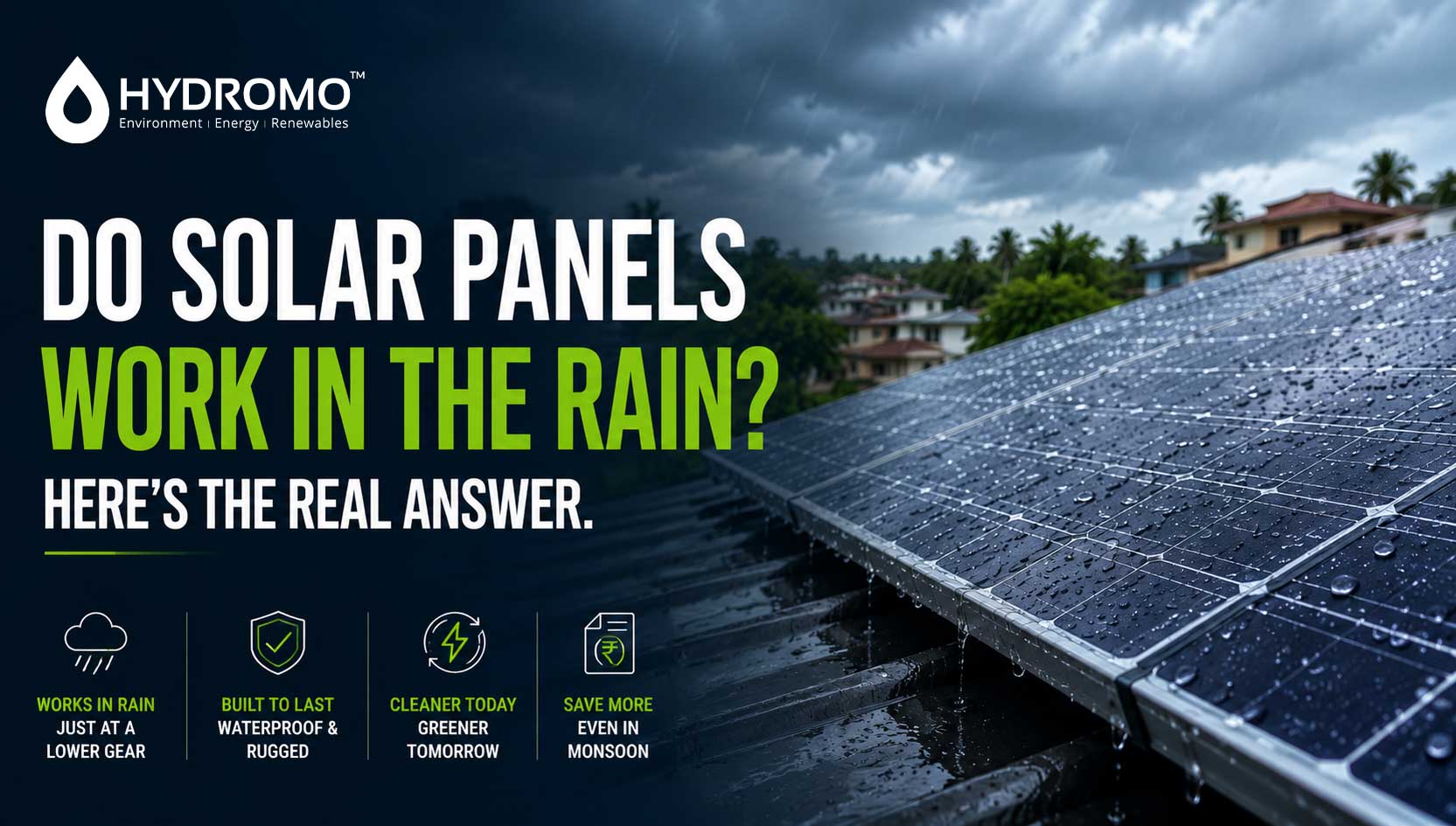
If you’ve ever watched dark clouds roll in and wondered whether your solar investment just became useless for the day, relax; it hasn’t. Solar panels do work in the rain. They just work at a lower gear, the same way your car still runs uphill, just not as fast.
How Solar Panel Efficiency in Rain Actually Works
Solar cells don’t need direct, blazing sunlight to function; they need photons, and photons still reach the ground on a rainy day, just scattered through clouds instead of arriving in a straight beam.
Direct Light vs Diffuse Light Explained
On a clear day, sunlight hits your panel directly; that’s the best-case scenario. On a rainy or overcast day, that same light gets bounced around by clouds and moisture before reaching your roof. This is called diffuse light, and while it’s weaker, it’s not zero. Your panels keep converting it into electricity the whole time.
Solar Panel Output: Rain vs Cloudy Days vs Fog
This is the number everyone actually wants, so here it is straight:
| Weather Condition | Typical Output vs Normal |
| Clear, sunny sky | 100% (baseline) |
| Cloudy/overcast | 30–50% |
| Fog | ~50% |
| Light drizzle | 25–40% |
| Heavy rain | 10–20% |
So no, you won’t wake up to zero power because it’s pouring. You’ll just be leaning on grid power or stored battery power a bit more that day.
Are Solar Panels Waterproof? What the Rating Really Means
Yes, and this is worth understanding properly instead of just taking someone’s word for it. A solar panel isn’t just a flat sheet of silicon sitting exposed. It’s built in layers: tempered glass on top, the photovoltaic cells sealed in the middle, and a weatherproof polymer backsheet underneath, all sealed with an aluminum frame and adhesive. That construction is what earns most panels an IP67 or IP68 rating, meaning they’re designed to handle heavy rain, humidity, and even short-term submersion without letting water near the electrical components.
Solar Panel Warranty in India: What’s Actually Covered
Reputable manufacturers back this up with two separate warranties: a product warranty (typically 10–12 years, covering manufacturing defects) and a performance warranty (often 25 years, guaranteeing the panel won’t degrade faster than promised). If genuine rain damage ever occurs, it almost always points to a manufacturing flaw, and that’s exactly what these warranties exist to catch.
Net Metering in Monsoon: What Happens to Your Bill
Here’s the part most articles skip. If your system is grid-connected (which most rooftop solar setups in India are), you’re on net metering. During sunny months, your panels often generate more than you use, and that surplus gets credited back to you. During monsoon, when generation dips, you simply draw down those banked credits or pull extra units from the grid. Most homeowners don’t feel a dramatic bill spike in July–September; the sunnier months earlier in the year usually cushion it.
Rain and Solar Panel Cleaning: The Hidden Upside
Dust and pollen quietly eat into panel efficiency more than people realize, especially right before monsoon hits. Rain acts as a free rinse, washing off that buildup and often nudging performance back up once the storm passes, assuming your panels are tilted enough for water to run off cleanly rather than pool.
Are Solar Panels Safe During Thunderstorms and Lightning?
Solar panels don’t attract lightning any more than a metal water tank or TV antenna would. What actually matters is whether your installer included proper grounding and surge protection, standard on any professionally installed system, which shields your inverter and wiring from voltage spikes during storms.
Best Solar Panels for Low Light and Rainy Weather
Not all panels handle diffuse, low-intensity light the same way. Here’s a quick comparison:
| Panel Type | Low-Light Performance | Best Suited For |
| Monocrystalline | Strong, precise light absorption | Homes wanting maximum output in limited roof space |
| Bifacial | Very strong—captures reflected light too | Open, ground-mounted, or terrace installations |
| Thin-Film | Good — absorbs a wider light spectrum | Budget setups, less critical roof space |
| Standard Polycrystalline | Moderate — weaker in overcast conditions | Sunny-region installs with minimal cloud cover |
Solar Panel Maintenance Tips for Monsoon Season
Before Monsoon Season Starts
- Get panels inspected and cleaned pre-monsoon
- Check that mounting and grounding are secure
During the Rainy Season
- Monitor daily output through your app; a sudden, unusual drop (beyond normal weather) often signals a loose connection or shading issue
- Keep gutters and drainage clear near the array to avoid water pooling
Quick Note on Panel Angle
A well-angled, well-maintained system will always outperform a neglected one, rain or shine.
Bottom line
Rain doesn’t shut your solar system down; it just asks it to work a little harder with a little less. If you’re building a system with monsoon months in mind, sizing and battery backup make the real difference, and that’s something worth getting right at the planning stage, not after installation.
Ready to go solar without worrying about the weather?
Get a free site assessment from Hydromo’s solar experts—we size your system (and battery backup, if needed) around your actual local rainfall patterns, not generic assumptions. 👉 Request a Free Site Assessment | Talk to Hydromo Experts
FAQ Section
1. Do solar panels stop working completely when it rains?
No. They keep generating electricity through rain, just at 10–20% of their sunny-day output, since diffuse light still reaches the cells.
2. Can heavy rain damage my solar panels?
Rarely, if ever. Panels are sealed and rated (typically IP67/IP68) to handle heavy rain, humidity, and splashing without letting moisture reach the internal wiring.
3. Will I lose power completely during monsoon season?
Only if you’re on an off-grid system with no battery backup. Grid-connected systems draw extra power from the utility, and net metering credits from sunnier months usually offset monsoon dips.
4. Does rain clean solar panels?
Yes, moderate rain washes off dust and pollen, often improving performance slightly once skies clear, provided panels are angled for proper water runoff.
5. Is it safe to have solar panels during thunderstorms?
Yes, when installed correctly. Grounding and surge protection, standard in professional installations, protect your system from lightning-related voltage spikes.
6. What solar panel type performs best in low light or rain?
Monocrystalline and bifacial panels generally handle low-light and diffuse-light conditions better than standard polycrystalline panels.