
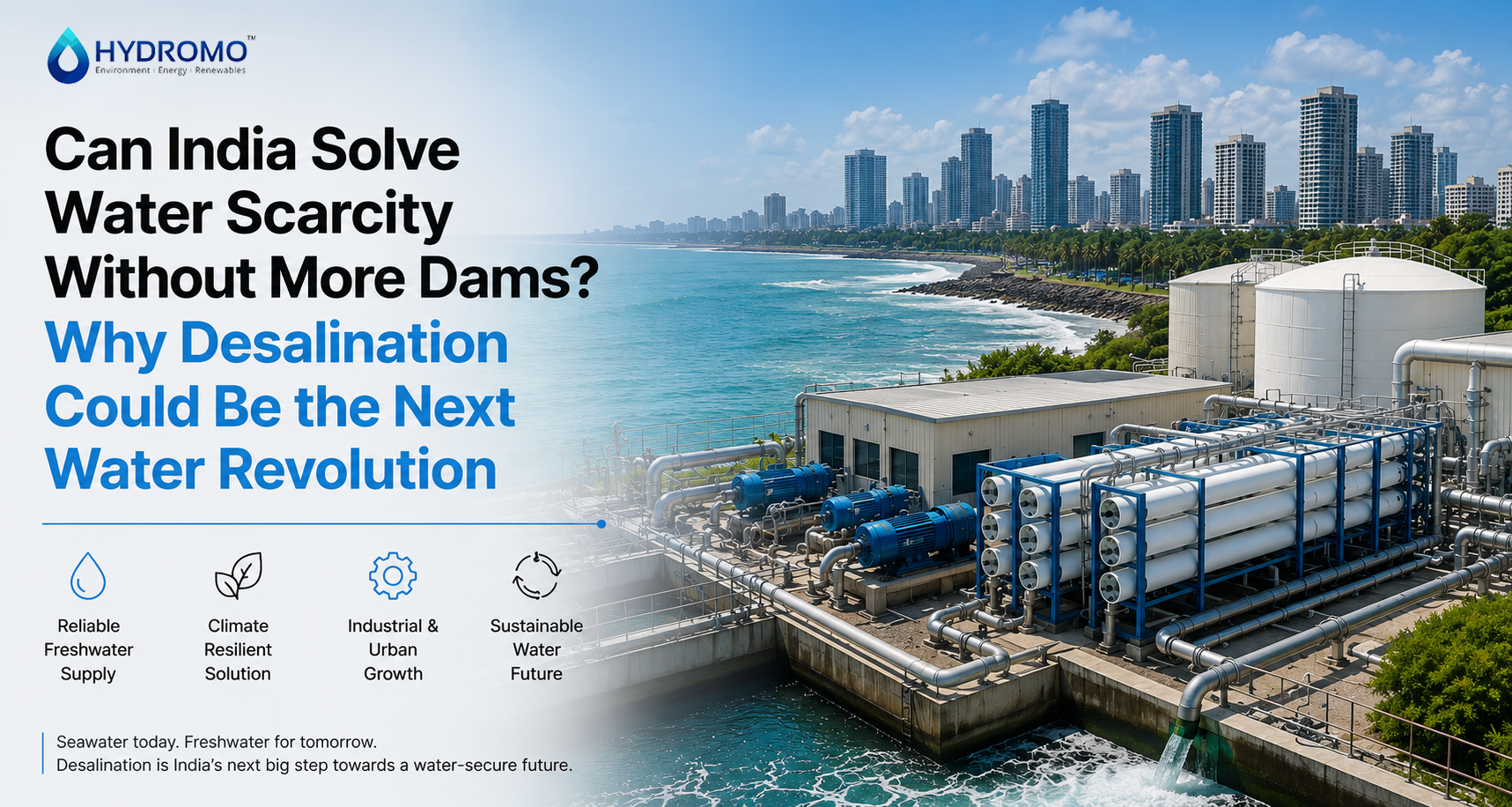
No rain for months. A reservoir reduced to mud-cracked banks. Borewells are pulling up less water every single week, and tankers still can’t keep up no matter how many trips they make. This isn’t a worst-case scenario; it’s already happening in more than one Indian city. Yet the go-to response is still the same tired one: build another dam. That answer is running out of road.
Population growth, faster urbanization, a climate that no longer follows the old rulebook, and industries that need water around the clock are all pulling on the same limited supply at once. Dams have carried India’s water needs for generations, and they’re not going anywhere. But treating them as the default fix for every shortage is starting to look outdated.
Engineers and policy folks are now piecing together a wider toolkit: wastewater recycling, rainwater harvesting, groundwater recharge, and one option with a supply that’s basically endless if you live near the coast: desalination.
India’s Water Crisis Is Outpacing Its Old Infrastructure
Why Dams Alone Won’t Get the Job Done
Dams have done a lot of heavy lifting: drinking water, irrigation, hydropower, and industrial supply—all of it. Nobody’s arguing they should be scrapped. But the problems they’re being asked to solve today are a different shape than the ones they were built for.
Rainfall isn’t behaving the way it used to. When one state gets flooded, the neighboring one is bone dry, and reservoirs that depend on a predictable monsoon are left guessing. On top of that, there simply aren’t many good spots left to build new dams. The ones that made sense are mostly built. What remains usually means uprooting entire communities, years of environmental clearance, and a construction timeline that stretches well past a decade, none of which helps a city that needs more water now, not in 2038.
Meanwhile, factories, pharma units, and power plants keep expanding, and they can’t run on “whenever the reservoir fills up.” They need water that shows up reliably, every single day.
India’s water problem was never really about storage capacity alone. It’s about having too few sources doing too much work. The fix isn’t one bigger source; it’s several smaller, dependable ones working side by side. That’s where desalination starts to matter.
What If the Ocean Became India’s Biggest Freshwater Source?
Desalination, Explained Without the Jargon
India sits next to one of the largest water resources on the planet, and up until recently, we’ve mostly ignored it, for obvious reasons. You can’t drink seawater. But the technology to change that has quietly matured to the point where it’s no longer experimental. It’s just engineering that works.
Here’s roughly how it happens:
- Seawater intake: Water is pulled in through intake systems designed to disturb marine life as little as possible.
- Pretreatment: Before it touches the actual filtration membranes, the water gets stripped of sand, algae, and floating debris. Skip this step and you’ll wreck the membranes fast.
- Membrane filtration: High-pressure pumps push the water through membranes fine enough to let water molecules through while blocking salt and other dissolved impurities.
- Mineral balancing: Membranes strip out the good minerals too, so they’re added back in to make the water taste and behave like normal drinking water.
- Storage and distribution: From there, it’s sent out to whoever needs it, a municipal grid, a factory, or a hotel.
In short: Sea → Intake → Pretreatment → Membranes → Mineral Balancing → Storage → Distribution.
None of this is new science. What’s changed is how efficient and affordable it’s become over the last twenty years. Plants today produce far more water per unit of energy than they did a decade ago, and they’re being built with a lot more environmental care than the early versions.
The Coastal Cities That Stand to Gain the Most
India’s coastline runs over 7,500 kilometers, which is a genuinely underused advantage. A handful of cities are already leaning into desalination, or seriously weighing it, because their circumstances leave few other good options.
Chennai has been through drought scares severe enough to make national headlines, and desalination has become a real part of how the city is trying to stop that from happening again.
Visakhapatnam, with its ports, refineries, and fast-growing industrial base, needs a water supply that doesn’t fluctuate with the weather, and desalination fits that need directly.
Mumbai’s population and commercial footprint keep expanding, and an added, rain-independent water source gives the city more breathing room during dry spells.
Kochi’s tourism industry and urban growth are both quietly water-hungry, and desalination offers a way to support both without draining local sources dry.
Mangaluru, home to petrochemical plants and port operations, needs large, steady volumes of process water, something groundwater alone struggles to guarantee.
Tuticorin’s industrial base faces a similar squeeze, making desalination a practical long-term answer rather than a backup plan.
Why These Cities Can’t Just Wait It Out
A few things are converging at once. Populations keep growing, which means more mouths and more taps. Industries need water on tap, literally, or production stalls and costs climb. Rainfall has become less predictable, so relying on it as a primary source is riskier than it was thirty years ago. And groundwater, the fallback most cities lean on when surface water runs short, is being pumped faster than it can recharge, which in coastal areas also invites seawater to creep into the aquifer and ruin it for good.
Desalination Isn’t Just a Technology; It’s a Mindset Shift
The real story here isn’t about machinery, membranes, or filtration steps. It’s about India moving away from betting everything on rainfall and river flow and instead building a water strategy with more than one leg to stand on. Tapping into a source that’s essentially inexhaustible takes pressure off rivers, reservoirs, and groundwater, resources that, once damaged, don’t bounce back easily. It also gives industries the confidence to keep growing without wondering if next year’s monsoon will decide their fate.
As the technology keeps getting cheaper and more efficient, it’s hard to see desalination staying a “coastal nice-to-have.” It’s shaping up to be one of the more dependable pillars in how India manages water going forward, not instead of dams, rainwater harvesting, or recycling, but alongside them.
Exploring desalination or a broader water strategy for your city, industry, or facility? Talk to Hydromo’s water experts for a site assessment.
Frequently Asked Questions
1. What is desalination, and how does it help with water scarcity?
Basically, it’s the process of taking seawater and stripping the salt out through membranes until what’s left is clean, usable water. For coastal areas, that means a supply that doesn’t rise and fall with the monsoon or depend on a river showing up on time.
2. Can desalination replace dams in India?
Not really, and that was never the point. Dams still do the heavy lifting for freshwater storage. Desalination just gives cities another leg to stand on, one that keeps working even when the rains don’t.
3. Which industries benefit most from desalination plants?
Quite a few, actually. Power plants, food processing units, pharma companies, hotels, petrochemical facilities, ports, and manufacturing setups all need water that’s consistent in both quality and quantity, something desalination is built to deliver.
4. Is desalinated water actually safe to drink or use industrially?
Yes. Once it’s been through reverse osmosis and had minerals added back in, it meets the same standards expected of regular drinking water and industrial process water.
5. How much energy do modern desalination plants actually use?
A lot less than they used to. Energy recovery devices, better membranes, and renewable power integration have brought operating costs down noticeably compared to older-generation plants.
6. What should be checked before setting up a desalination plant?
A few things matter here, the raw water quality, TDS levels, how much water is needed daily, what energy sources are available, and a realistic maintenance plan. Skip any of these and the plant design usually suffers later.
7. Can desalination work alongside rainwater harvesting and wastewater recycling?
Absolutely, and honestly, that’s how it works best. Most well-thought-out water strategies don’t lean on one source; they combine desalination with recycling, rainwater harvesting, and groundwater recharge.
8. How does Hydromo help with desalination projects, start to finish?
Hydromo stays involved through the whole journey, from the initial site assessment and water testing, right through technology selection, custom plant design, installation, commissioning, operator training, and the AMC support that keeps things running long after.