
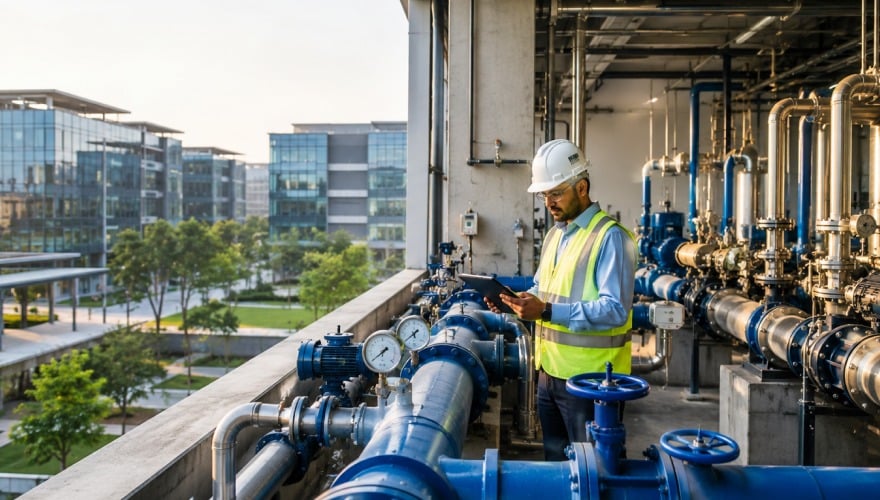
Expensive Uptime Losses
When a pipe bursts on the fifth floor of a tech park at 2 a.m., the first casualty is not always the flooring. It is the server room. And after that, the business continuity plan, the SLA
commitments, and someone’s job. Water-related downtime in commercial and IT infrastructure is one of those risks that rarely appears in boardroom conversations until it is far too late.
That is changing, and fast.
The Real Cost of Ignoring Water Infrastructure
The management in facility operations has always considered the water system to be a passive service. However, buildings and information technology parks use water on an
industrial level; they require a constant flow of water supply, such as cooling towers, HVAC units, firefighting systems, sanitation systems, and data centers.
An undetected leak in a pipe can cost a lot in terms of utility bills and compromise the structure of the building. A pressure failure in a cooling loop can spike server temperatures within minutes. The consequences range from a spike in water bills to full operational shutdown and the financial exposure is significant.
Understanding What Is Meant By ‘Smart’ Water Infrastructure
Smart water infrastructure technology uses Internet of Things (IoT)-based sensors, flow monitoring, cloud computing, and automated shutoff systems to provide full visibility into water systems.
This is done before something happens, such as abnormal flows at 3 a.m., leaks in the riser pipes, or loss of critical cooling fluid pressure.
Key technologies being deployed today include:
- Acoustic leak detection sensors that identify leaks behind walls and under floors
- Smart flow meters with NB-IoT connectivity for continuous remote monitoring
- Digital twin models of building water networks that simulate failure scenarios
- Automated zone isolation valves that contain leaks without manual intervention
Market Forecast: A Growth Rate of 13% CAGR
The market for global smart water networks had a valuation of $17.71 billion in 2025 but is projected to grow to reach $41.93 billion by 2034, having achieved a CAGR growth rate of
10.2% due to various reasons including water scarcity, infrastructural degradation, the digital revolution, and rigorous regulatory guidelines (Dataintelo, Dataintelo, Smart Water Network Market Report, 2025-2034).
Commercial & Industrial are some of the top segments growing at a fast pace due to increasing investment from IT parks and large office campuses into intelligent water management systems. In India, there has been a rapid growth in the adoption of smart monitoring systems in SEZs, tech corridors, and green-rated business spaces.
Growth Factors Specific to IT Parks and Commercial Buildings
- Regulatory pressure — Green building certifications (IGBC, LEED, GRIHA) now require measurable water efficiency Buildings without them face valuation risk and tenant attrition.
- ESG reporting — Large corporates occupying Grade A spaces must now account for water use in sustainability disclosures. Smart metering provides the auditable data they need.
- Insurance and risk management — Insurers are beginning to price water damage risk into commercial property Proactive monitoring is becoming a financial hedge, not just a best practice.
- Energy-water relationship — Water cooling systems affect the amount of energy used. Improved water management in data centres would lead to lower energy costs by improving chiller efficiency.
Reactive Management vs Predictive Management
The most forward-thinking facility teams are no longer asking “how do we fix leaks?” they are asking “how do we prevent them from ever forming?” Predictive water infrastructure uses historical usage patterns and real-time sensor data to flag degrading pipes, thermal stress points, and consumption outliers before a failure event occurs.
This is not futuristic. The technology is being implemented right now in hospitals, IT parks, and commercial buildings in India and elsewhere around the world.
Conclusion
Water is no longer a background utility for commercial buildings and IT parks. This is critical infrastructure. Companies which adopt smart water monitoring systems in their facility management system would not just save money; they would preserve system uptime, minimise their carbon footprint, and create an operational resiliency that the future requires.