
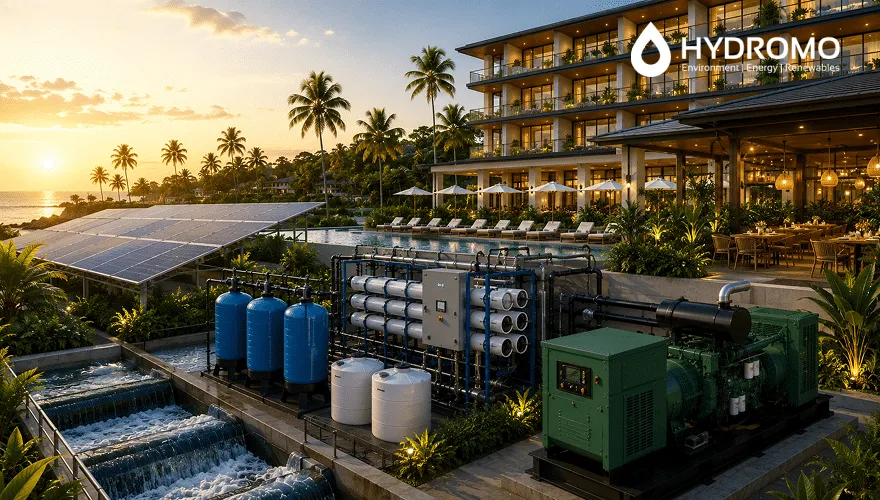
Upon arrival, guests can expect to find seamless comfort. They want water to be pumped at a steady pressure, expect warm water to run when they want to shower, the air conditioning to be working at all times and the lighting to be bright and on. What they don’t see and what most hotel owners think about all the time is the complex infrastructure which makes all of this possible.
All well-run hotels, resorts and restaurants have a very carefully controlled water treatment system, energy generation system, back-up power and pressure control system, etc., behind the scenes. Right now, that infrastructure is more strained than ever.
Utilities are increasing. The supply of municipal water is getting more and more unstable. Both visitors and corporate customers are posing more demanding inquiries regarding sustainability. And regulators are now starting to push for ESG requirements that were once optional. The need to have the right infrastructure has become a competitive imperative for hospitality operators in India and elsewhere.
Why Hospitality Businesses Face Growing Infrastructure Challenges
Hotels and resorts are one of the most resource intensive businesses in an economy. Hozelton’s mid-sized hotel (100 rooms) uses a range of 150-400 litres per day per room. Throw in a restaurant, banquet hall, swimming pool or a landscaped garden and that number continues to rise.
On the energy side, HVAC, water heaters, commercial kitchens, elevators and lighting, can cost lakhs of rupees per month! The annual energy cost is crores for the large resorts/hotel chains.
The problems compound:
- The unreliable water supply from the municipality leads to properties relying on borewells, however, not all borewell water is suitable for guests.
- Outages, particularly during busy periods, have the potential to cause service disruptions, compromise food safety, and tarnish the guest experience.
- Increasing electricity costs are putting an additional strain on thin profit margins in an already thin-margin industry.
- The promise of sustainability now plays a major role in the buying decision, especially from companies from our corporate customers and travel companies such as Booking.com.
A city hotel which is connected with the municipal water and has to tackle TDS is in need of a different solution, as is a beach resort getting water from a private borewell, or a banquet hall hosting 300+ events annually all of them have the same core issue: inadequate infrastructure to meet the needs of contemporary hospitality.
The Water Challenge: Why Water Treatment for Hotels Has Become Essential
Go into any hotel kitchen, laundry or guest bathroom and you will see how critical water quality is to a facility. It is not only about the quality of the quantity.
Limescale occurs in boilers, geysers and pipes due to hard water, leading to greater maintenance costs and lowered lifespan of the equipment. Water with high TDS (Total Dissolved Solids) contents can cause an immediate impression of white residue on glassware, linen and surfaces. Diseased water from borewells or old pipes may cause people to voice health issues, with far-reaching consequences on reputation for your hospitality business.
The solutions to these problems are right at your fingertips when it comes to water treatment for hotels.
A good water treatment system will incorporate the following:
- Pre-filtration, sediment, rust and suspended particle removal
- Water treatment systems to soften hard water and prevent damage to equipment.
- Treatment systems to reduce the presence of pathogens (UV or chemical)
- Filters for finished potable water production
- Results include rapid reduction of maintenance calls, extended equipment life, reduced guest complaints due to water quality, and cleaner laundry product. The savings gained from descaling and replacement of equipment can justify investment in one year for large properties.
Water management is no longer a “back of house” issue for hospitalities. It significantly affects customer satisfaction ratings, process productivity and long-term costs.
How RO Plants Help Hotels Deliver Safe and Consistent Water Quality
Access to drinking water in guest rooms, restaurant areas and staff areas is a must. The price of bulk mineral water is high, can result in plastic waste, and poses logistical challenges.
This issue can be addressed at scale by an RO plant in hotels.
A reverse osmosis system forces water through the semi-permeable membranes which will eliminate the dissolved salts, heavy metals, bacteria and other contamination. The product is a clean, safe, potable water to be bottled at the site, fed into a restaurant or delivered directly to a guest room dispenser.
RO plant is also required at a hotel which has a restaurant/banquet facility as it guarantees that the cooking water is never compromised, directly impacting on food taste, equipment performance and food safety compliance.
Practically speaking:
- If the RO plant capacity is required in a 100 room hotel, the capacity required will depend on the activity of the restaurant and kitchen; typically 2000-5000 litres per day (L/D) is required.
- If the resort is larger or the property has a number of F&B outlets, modular systems of greater output may be necessary.
- RO treated water may also be reused in cooling towers and laundering pre-rinse water and for garden irrigation, remineralised or blended to required levels.
This can be a significant saving in bulk mineral water procurement and is a great sustainable story to tell guests and corporate buyers who seek to reduce single use plastics.
Why Hotels and Resorts Need High Pressure Water Pumps for Reliable Operations
For multi-storey hotels and gravity. One tenant on the 8th floor is running the shower in the early morning, who knows what PRM system might be in place?
For commercial applications, a high pressure water pump guarantees available water pressure from the restaurant kitchen on the ground floor, to the top floor suites. If properties are not properly managed for pressure:
The upper floor rooms have low air pressure showers.
When you have multiple buildings in a resort that are unequally distributed across the resort.
The commercial dishwashers and laundry equipment are not getting enough pressure.
Inadequate performance of fire suppression systems
For the following, pressure boosting systems are especially important:
- Multi-storey city hotels and business hotels
- Resort properties that are scattered over a wide land area
- “Landscaping requirements” property is defined as a property that requires irrigation and extensive landscaping.
- Commercial kitchen that is popular with hotels with multiple services per day
The right pumping solution sized and configured will eliminate pressure complaints, alleviate plumbing stress as well as help ensure all the outlets on the property will perform exactly as they should.
Rising Energy Costs: Why Solar Panels for Hotels Are Becoming a Smart Investment
There is one kind of infrastructure investment that’s gaining momentum amongst hospitality businesses: solar energy.
The amount of electricity used by a 100-room hotel running HVAC, lighting, water heating, and kitchen systems can be as high as 50,000 to 80,000 units per month. That works out to very high monthly expenses and it’s only going to get larger.
One obvious way to cut down that exposure is to install solar panels in hotels. For a 50-200KW rooftop solar installation (depending on available roof area and consumption pattern), around 30% to 70% of the grid electricity can be saved during peak sunlight hours.
The financial case is pretty solid:
- Lowered electric costs due to the first month of operation
- Net metering is a positive for states with “export” restrictions.
- Government support such as accelerated depreciation available under the Income Tax Act and capital subsidies available in the states.
- A typical return of investment is approximately 4 to 7 years, and system life expectancies are 25+ years.
- With properties working towards LEED, IGBC or equivalent green ratings, Green certification support is provided.
Solar power provides a true sustainability story for the hotels together with the financials. Today, corporate travel managers, wedding planners arranging wedding venues or eco-conscious travelers are turning to properties that are visibly committed to sustainability – through specific actions, and measurable ones at that.
Solar Panel Systems for Commercial Buildings: The Future of Hospitality Infrastructure
The fact that there is a transition from Rooftop Solar to a complete Solar Panel System for commercial buildings is a step-up in the Hotel/Resort’s energy management.
Present day commercial solar systems consist of:
- Rooftop installations connected to the grid that do not rely on electricity obtained from the grid for daytime use
- Solar water heating systems that reduce the energy cost of generating hot water, one of the main consumers in a hotel.
- Equipping outdoor lighting at a resort, pathways, parking areas and landscaping with solar lights.Installing solar lights outside the resort pathway, parking lots and “landscaping”.
- Real-time monitoring and analytics tools for generation, consumption and savings.
- Ground-mounted solar can boost the offset percentage as well as rooftop solar for a large hotel once the hotel has considerable land area. Some properties are now taking aim at 80% and beyond in renewable energy coverage of their base load.
The economics of commercial solar energy solutions are continually improving as the price of solar panels continues to decline and battery storage technology moves towards being viable. Implementing solar energy into the next major capital expenditure of a hotel can no longer be considered an option, but a wise choice.
Why DG Sets Remain Critical for Hospitality Businesses
During the day it is solar. The rest is left to the grid. So what if the power goes out at 2 AM, while visitors are sleeping, the elevator is operating, the kitchen is setting up the breakfast service, and the data centre is running reservation systems online?
This has been the reason why a DG set for hotels is still a pivotal piece of the hotel infrastructure despite the prominence of renewable energy.
Hospitality businesses were hardest hit by power outages, caused by weather, electricity faults or load shedding:
- Walk-in coolers and freezers can be a problem within hours.
- The elevators stop, causing an instant safety hazard.
- Central Air Conditioner breakdowns no way in the summer of peak heat.
- Security goes out of action, access goes offline and CCTV goes dark.
- If not secured, point-of-sale and reservation systems are vulnerable to data loss.
- Seamless failover is achieved with a properly sized diesel generator using automatic transfer switches. The switch is usually imperceptible to visitors. Operations are uninterrupted.
- If a home has already installed solar, a DG set can be used during the night, monsoon showers and during days when the sun is not visible long enough to provide the required battery storage. Many highly managed hospitality properties are combining a solar system for a base-load application with a DG system for emergency power needs.
- The most intelligent way of managing energy in a hotel combining solar energy with grid or DG backup which enables automatic cost and energy-saving optimisation, is the most resilient and cost-efficient solution currently on the market.
The Smart Approach: Integrating Water, Energy and Power Infrastructure
This is where a number of hospitality businesses make the expensive blunder.
They buy from four different vendors: first a water treatment system, second solar panels, third a DG set, and fourth pressure pumps. Every vendor optimises his/her scope. No one considers the system as a whole.
The result is equipment that is not able to communicate with one another, maintenance contracts from numerous suppliers, and recurring operational headaches caused by design differences between the equipment.
An integrated solution to sustainable infrastructure in hospitality, where water, energy and power systems are planned as an integrated whole offers measurable benefits:
Reduce overall investment by planning for size coordination and shared infrastructure facilities
More efficient energy use during pump systems and water treatment load sizing for solar applications
Easier to maintain (one in charge)
Documentation and audit on sustainability compliance are more manageable and transparent for certifications and ESG reporting.
More rapid troubleshooting, if one team understands the interdependence of all of the systems.
That’s the trend this industry is going, and the properties that reach there first will have their functional and reputation advantage hard to come by, if at all possible.
Building the Hospitality Infrastructure of the Future
If the customer doesn’t find the right room to sleep in, your hotel won’t exist. There’s no room left for hotel management to be reactive in the modern day and age. Downtime, equipment failure, water quality issues, and unsustainable energy use are far too costly, not only in terms of cost, but in lowering guest satisfaction and harming brand reputation.
The properties which will be successful in the coming decade will be the ones which will invest in integrated, sustainable infrastructure today such as water treatment systems providing protection for guests and equipment, RO plants that provide consistent drinking water quality, high-pressure pumping systems that ensure water distribution, solar energy systems that reduce electricity bills and carbon footprints, and DG backup systems that ensure operations do not stop.
Hydromo offers hotels, resorts, restaurants and hospitality companies one-stop solutions for water treatment, solar power solutions, pumping solutions and power backup solutions for easier infrastructure planning. Hospitality operators don’t have to work with multiple vendors in many systems, they have one vendor that knows how the two systems work together and plans accordingly.
Sustainability in hospitality doesn’t have to be a ‘green’ new addition to a press release. It’s all about creating infrastructure that’s more efficient, less expensive to operate, and robust enough to meet the needs of an ever-open house. This future is here today, and is open to every property willing to plan for it.
FAQ’s
1. Why is water treatment important in hotels?
A. Hotels are using water from multiple sources including municipal, borewell and tankers with widely different quality. Damage to equipment, food quality loss, health risks, and guest complaints are all the results of untreated water. Designing a water treatment system correctly helps protect the infrastructure, the safety of the guests and costs in maintenance.
2. What is the saving of the hotels using solar panels?
A. The savings will vary based on the size of the property, electricity cost and solar system size. Most hotels can expect a solar system to save them 30% to 60% on their grid electricity bill. Net metering and incentives typically result in a 4- to 7-year payback on a system that will run for 25+ years.
3. The size of a RO plant needed for a hotel is?
A. For a 100 room hotel which does not have a restaurant, an RO plant of 2,000 to 3,000 litres per day is required. For properties that have active F&B operations, Banquet Hall or Staff accommodation, a minimum of 5,000 litres per day should be planned for. The most accurate sizing is obtained by a site-specific assessment that uses real consumption data.
4. Why do resorts need pressure boosting systems?
A. Resorts are frequently built with a lot of land area and very large height ranges between the water sources and the different locations where the water is consumed. Multi-point pressure is seldom available from a municipal system for a large property. High pressure pumps provide equal and adequate pressure at all points of use starting from kitchen to guest villa.
5. Do DG sets fit into a hotel’s solar energy application?
A. Yes. Solar systems only work during the day, while battery storage systems are improving, but are yet to become cost competitive for large-scale applications. DG supplies are critical during nights when solar is not available, when it’s cloudy for a long period, or during peak usage times. The two systems do not compete with each other, but complement.
6. Which is the best possible water treatment program for hotels?
A. It depends on the source water quality, consumption level and end use requirements and there is no single universal solution. Most hotels use a combination of pre-filtration, softening and disinfection systems for their general use as well as an RO system for their drinking and cooking water. The first step is to have a water quality test performed and then have a professional make an assessment.
7. How Solar panel systems offer significant benefits to commercial buildings?
A. Commercial solar systems lower electricity costs, shield against electricity tariff hikes, enable energy independence, and aid sustainability certifications. Acceleration of depreciation benefits and capital subsidies further strengthen the financial picture in the case of commercial buildings in India. Solar is one of the longest-life capital investments that a commercial property can make, with long lifespan.
8. Can treated wastewater be reused in hotels and resorts?
A. 100% yes and this is becoming more prevalent in hotels that have water conservation targets. Greywater (which includes water from sinks, showers and the washing machines) can be treated and reused for flushing toilets, irrigation, and cooling tower make-up water. The rejected water from a RO system can be used for non-potable use instead of discharged. For any hotel, water recycling is a valuable economic and environmental practice, especially in water scarce areas.
9. Hospitality water management is defined as what?
A. Hospitality water management is the water treatment system in place to source, treat, distribute, use and recover water throughout a hotel or resort. It includes water quality maintenance, pressure control, monitoring usage, the implementation of water recycling programs and adherence to regulations to cut costs, safeguard the health of guests and enhance sustainability.
10. How to select the appropriate DG set size for my hotel?
A. DG sizing is based on the property’s Critical load equipment that cannot be stopped during a power outage. Usually, covers HVAC of common areas, elevators, kitchen equipment, lighting and IT systems. In a load audit the total critical load (in kW) is determined, and the DG set is chosen to be 70% to 80% of this load, to allow for efficient operation. Fuel is consumed when an oversized house is oversized and when an undersized house is undersized.