
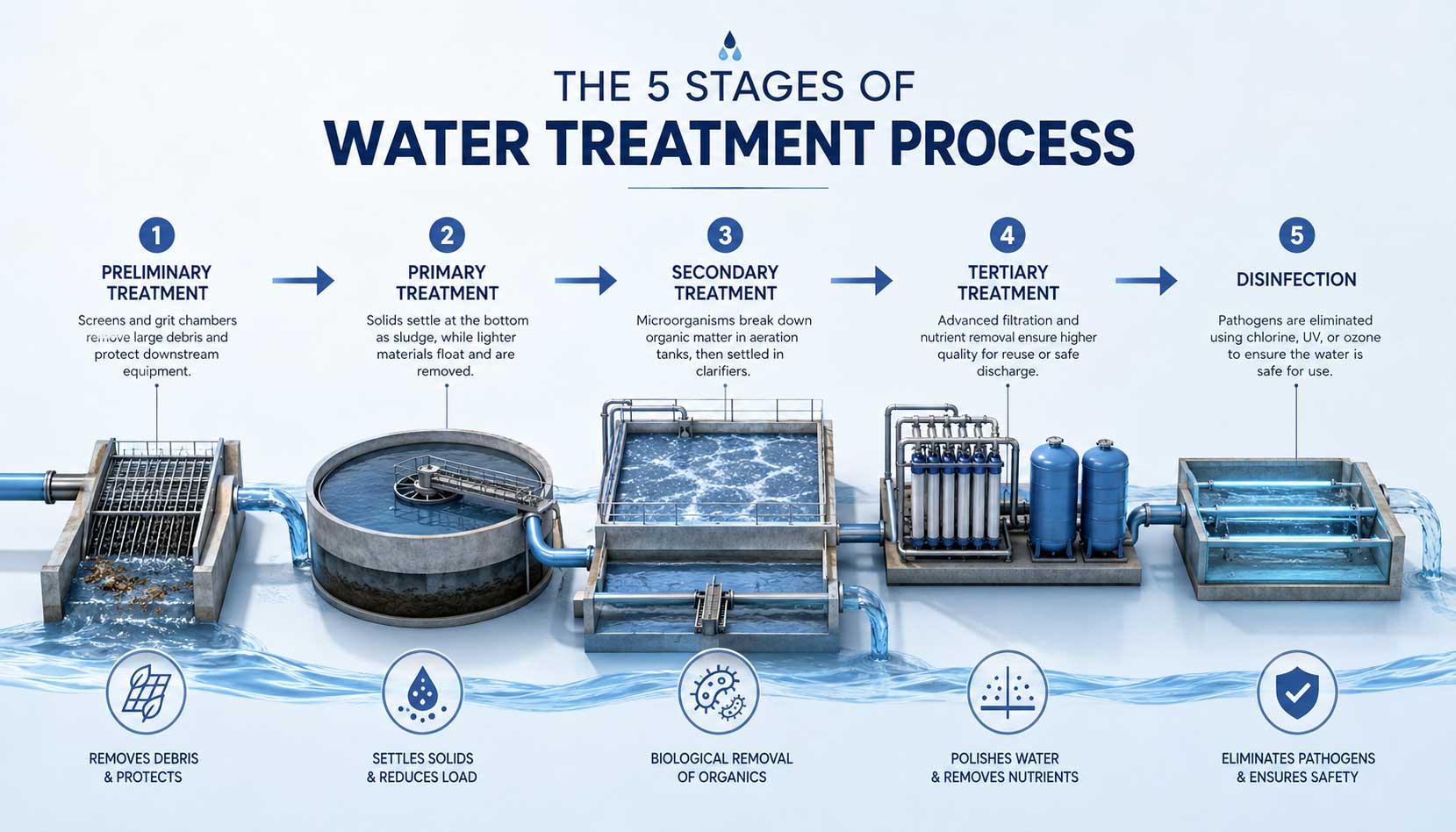
Turn on a tap, and clean water shows up like it’s nothing. Behind that simple moment sits a water treatment process with several carefully engineered stages, each doing a specific job to turn raw or used water into something safe again.
Whether you’re a facility manager evaluating a plant for your building, a student researching the topic, or just curious how it all works, this guide walks through the full water treatment plant process, from the first screen to the final drop.
Drinking Water vs. Wastewater Treatment: What’s the Difference?
Both follow a similar logic, remove solids, break down contaminants, disinfect, but they start from different places. Drinking water treatment takes raw water from a river, lake, or borewell and makes it safe to consume. Wastewater treatment takes used water from homes, hotels, hospitals, or factories and cleans it before it’s discharged or reused. Many of the steps below apply to both, just tuned differently depending on the source.
The Water Treatment Process, Stage by Stage
Preliminary Treatment: Screening Out the Big Stuff
Every treatment plant starts here. Screens and grit chambers pull out sticks, plastic, rags, and sand before they can damage pumps or clog downstream equipment. It’s unglamorous, but skip it and everything after gets harder.
Primary Treatment: Settling Out Solids
Next, water sits in a tank long enough for gravity to do its work. Heavier solids sink as sludge, lighter material floats and gets skimmed off, and coagulant chemicals help fine particles clump together so they settle faster. This step alone typically removes over half the suspended solids.
Secondary Treatment: Where Biology Does the Heavy Lifting
This is where microorganisms take over. In an aeration tank, bacteria consume the organic matter and nutrients still dissolved in the water, the same process, called activated sludge treatment, used in nearly every modern sewage treatment plant. A follow-up clarifier separates the now-settled biological sludge from the clearer water above it.
Tertiary Treatment: Polishing the Water
For water that needs to meet stricter reuse or discharge standards, tertiary treatment goes a step further, removing leftover nitrogen and phosphorus, and filtering out anything secondary treatment missed. This stage is what makes treated wastewater safe enough for irrigation or industrial reuse.
Disinfection: The Final Safety Check
The last step kills whatever pathogens remain. Chlorine is the most common method, prized because a small residual dose keeps protecting water as it travels through pipes. UV light and ozone are increasingly popular alternatives, fast and chemical-free, though they don’t offer that same lingering protection.
Modern Water Treatment Technologies Worth Knowing
Conventional treatment has been joined by newer tools that push water quality further. Membrane bioreactors (MBR) combine biological treatment with membrane filtration in one compact step, popular where space is tight, like apartment complexes. Reverse osmosis (RO) forces water through an ultra-fine membrane to remove dissolved salts and contaminants, essential for desalination and high-purity industrial use. Advanced oxidation processes (AOPs) use ozone or hydrogen peroxide to break down pollutants that resist standard treatment, increasingly used for industrial effluent with complex chemistry.
Sludge Treatment: Turning Waste Into a Resource
Every treatment process generates sludge, and what happens to it matters. It’s thickened to cut down its water content, then stabilized through digestion, sometimes anaerobic digestion, which produces biogas that can offset a plant’s own energy use. Dewatered, treated sludge often ends up as agricultural fertilizer or soil conditioner rather than landfill waste, turning a disposal problem into a resource.
Sustainability and Energy Efficiency in Water Treatment
Aeration, pumping oxygen into biological treatment tanks, is typically the single biggest energy cost at a treatment plant. Efficient blower systems, smart aeration controls, and biogas recovery from sludge digestion can meaningfully cut both energy bills and carbon footprint, without compromising treatment quality.
Water Treatment Challenges in India, and Where It’s Headed
India’s growing cities are pushing STPs and ETPs to handle more volume with tighter discharge norms, especially around apartment complexes, hotels, and industrial parks where water reuse is now expected rather than optional. Zero Liquid Discharge (ZLD) systems, which recover nearly all usable water from effluent, are becoming standard for water-stressed industries. As regulations tighten and water stress grows, expect compact, energy-efficient, high-recovery systems to become the norm rather than the exception.
Planning an STP, ETP, or RO plant for your building or facility? Request a free site assessment from Hydromo’s water treatment experts.
Frequently Asked Questions
What are the 4 main steps in water treatment?
Preliminary, primary, secondary, and tertiary treatment, typically followed by disinfection as a final step.
How does a water treatment plant work?
It removes solids, breaks down organic matter biologically, and disinfects the water in sequence, tailoring each stage to the water’s starting quality.
Is treated wastewater safe to reuse?
Yes, once it passes through tertiary treatment and disinfection, treated wastewater is commonly reused for irrigation, industrial processes, and even non-potable municipal use.
What’s the difference between STP and ETP?
An STP (sewage treatment plant) treats domestic wastewater; an ETP (effluent treatment plant) treats industrial wastewater, which often needs specialized processes for its specific contaminants.
Do all plants use tertiary treatment?
No, many discharge after secondary treatment if that meets local requirements. Tertiary treatment is added when water needs to be reused or meet stricter standards.