
Every community has a story. The best ones begin with action, not paperwork.
That’s really what corporate social responsibility projects should be about. Not a line item in an annual report. Not a photo opportunity. A real, working solution that changes how people live, every single day.
Yet somewhere between good intentions and ground reality, a lot of corporate social responsibility CSR spending misses the mark. Money gets released. A plaque gets installed. And six months later, nobody remembers the project even happened.
Corporate Social Responsibility Applicability in India
Under the Companies Act, 2013, corporate social responsibility applicability is triggered for companies that cross certain financial thresholds, specifically net worth, turnover, or net profit limits set by the government.
Qualifying companies must spend at least 2% of their average net profit from the preceding three years on CSR activities. A CSR committee is expected to plan and monitor how this budget is used.
How an End-to-End Implementation Partner Improves Success
This is where an experienced execution partner changes the outcome entirely.
Instead of managing multiple vendors, contractors, and consultants separately, companies work with one team that handles the entire project, from the first site visit to years of after-service support.
Hydromo works as a CSR infrastructure execution partner in exactly this way, managing water, renewable energy, and sustainable community infrastructure projects end-to-end. The value isn’t just technical expertise, it’s accountability across the entire lifecycle of the project, so nothing gets lost between planning and delivery.
Examples of High-Impact CSR Projects
Some of the most effective corporate social responsibility projects focus on infrastructure that communities use every single day:
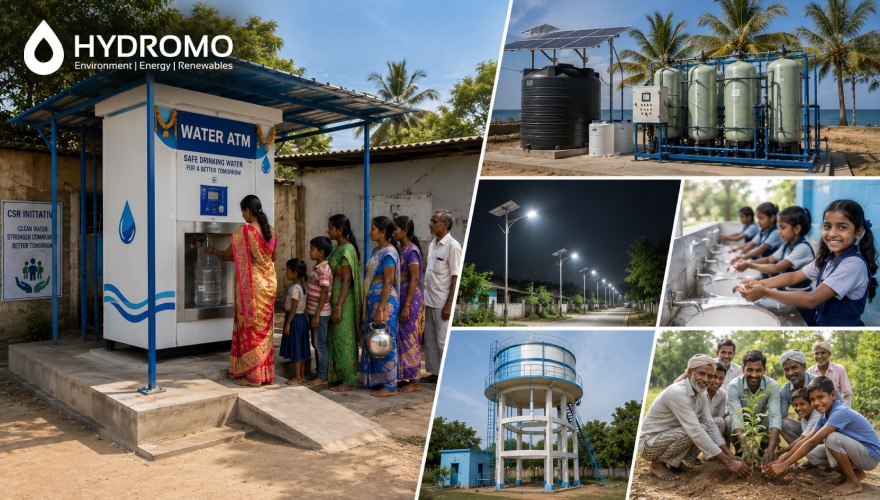
Community RO Plants: Villages with high fluoride, salinity, or contaminated groundwater get access to safe drinking water, often for hundreds of families at once.
Desalination Systems: In coastal areas with limited freshwater access, small-scale desalination units turn seawater into a reliable, everyday water source.
Solar Street Lighting: Solar-powered lights improve safety on rural roads and reduce dependence on unreliable grid electricity, especially in remote areas.
Water Infrastructure: Pipelines, storage tanks, and distribution systems that connect a treated water source to actual households, not just a plant sitting unused.
Sustainable Rural Infrastructure: Combined projects, water, sanitation, and energy designed to work together instead of as disconnected, isolated efforts.
Infrastructure only matters when it improves everyday life. These are the projects that do exactly that.
Real-World CSR Projects Delivered by Hydromo
It’s one thing to talk about impact. It’s one thing to show it. Here are two examples of corporate social responsibility projects that moved from paper to practice.
Mallampudi Village, Andhra Pradesh, Partner: Tata Trusts
The groundwater in Mallampudi was unfit to drink, and families depended on unsafe sources every single day, with real health consequences to show for it.
The solution was a desalination-based water ATM, engineered and commissioned end-to-end. The result: TDS levels dropped from a dangerous 13,000 mg/L to a safe 30 mg/L, with clean water available 24 hours a day at roughly ₹7 for 20 liters, down from a ₹400 market price for the same amount.
That’s not a plaque on a wall. That’s a village that no longer worries about its water.
JK Fenner, Swasthya, Patancheru, Telangana
Families around Patancheru had no dependable source of safe drinking water. A 500 LPH community RO plant was engineered, installed, and commissioned under the JK Fenner Swasthya CSR program.
Today, that plant delivers consistent, tested, safe drinking water to local families every day—a straightforward outcome, but one that took proper site assessment, engineering, and follow-through to achieve.
These two examples show what’s possible when a CSR budget is matched with disciplined, end-to-end execution rather than a one-off handover.
What Does a CSR Project Actually Cost?
CSR budgets fund outcomes, not just equipment, but it still helps to know roughly what different types of corporate social responsibility projects require. Final costing always depends on a proper site assessment and community need analysis, but here’s an indicative range:
- Solar Street Lighting: approximately ₹2,049 – ₹5,173 per unit (+GST), depending on wattage, from single-street coverage to high-footfall public spaces.
- Community RO Plants: approximately ₹2.5 lakhs – ₹5.5 lakhs, depending on daily capacity, from a single locality to a multi-community scale.
- Desalination RO Systems: approximately ₹12 lakhs – ₹18 lakhs for coastal and high-TDS regions, sized to the population served.
These numbers exist to help CSR heads and ESG managers plan realistically, not to reduce a project to a price tag. When the planning is right, the investment tends to follow with confidence.
Ready to build a CSR project that actually lasts?
Talk to Hydromo’s CSR infrastructure experts and request a free site assessment for your next water, solar, or community infrastructure project
FAQ Section
Q1: What is corporate social responsibility (CSR)?
CSR is a company’s commitment to contribute positively to society through initiatives in areas like education, healthcare, water, energy, and environment, beyond its core business operations.
Q2: Which companies are covered under corporate social responsibility applicability in India?
Companies that cross specific net worth, turnover, or net profit thresholds under the Companies Act, 2013 are required to spend at least 2% of their average net profit on CSR activities.
Q3: What are some examples of high-impact CSR projects?
Community RO plants, desalination systems, solar street lighting, water infrastructure, and sustainable rural infrastructure are among the most effective long-term CSR investments.
Q4: Why do many CSR projects fail after completion?
Most failures come down to poor execution, weak engineering, low-quality procurement, or the absence of long-term maintenance and support after commissioning.
Q5: How does an implementation partner help with CSR projects?
An end-to-end partner manages the full project lifecycle, from need assessment to long-term support, ensuring the project actually functions and delivers outcomes, not just gets completed.
Q6: How much does a typical CSR infrastructure project cost?
Costs vary by scale and technology, solar street lighting units typically range from around ₹2,000 to ₹5,000 each, community RO plants from roughly ₹2.5 lakhs to ₹5.5 lakhs, and desalination systems from about ₹12 lakhs to ₹18 lakhs. Final costs depend on site assessment and community need.