
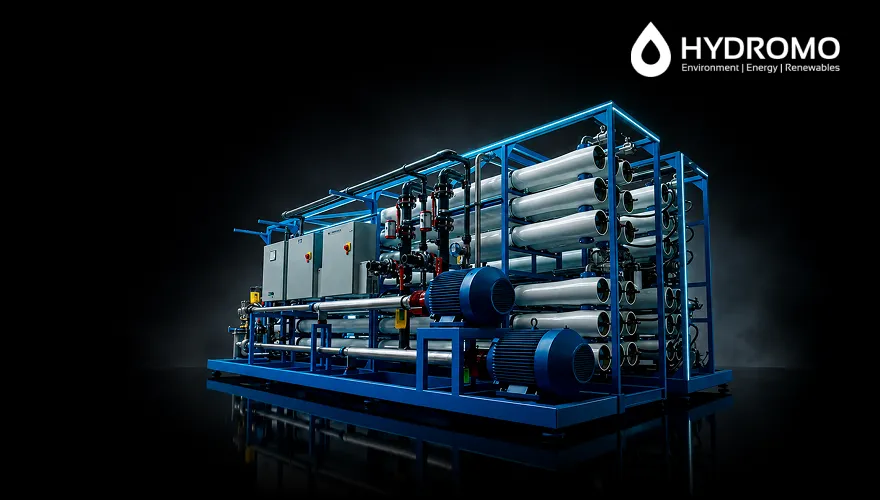
Hyderabad runs on water. And for any business that depends on consistent, high-quality water — a hospital, a pharma unit, a food processing plant, a hotel — the municipal supply rarely cuts it on its own.
A commercial RO water system solves that. But the market in Hyderabad is cluttered with vendors selling nearly identical spec sheets at wildly different prices, and the difference between a well-designed plant and a poorly spec’d one shows up about 8 months into operation — in membrane replacements, breakdowns, and TDS that keeps creeping up.
This guide covers what actually matters when you’re selecting or upgrading a reverse osmosis water treatment plant in Hyderabad.
What TDS Level Should a Commercial RO System Produce?
RO water TDS level is the first number most buyers ask about — and the most misunderstood.
For most industrial and commercial applications, the target output TDS is between 10 and 50 ppm. Borewell water in Hyderabad typically comes in at 800–1800 ppm. A well-designed RO system should bring that down by 90–95%.
That said, the right TDS depends on what the water is for. Dialysis units need below 5 ppm. Food processing plants typically need below 50 ppm. A hotel or office can comfortably run at 50–100 ppm output. If your vendor is quoting you a single TDS target without asking about end use — that’s a red flag.
1000 LPH RO Plant Price in Hyderabad
For a standard 1000 LPH (litres per hour) commercial RO plant in Hyderabad, installed price ranges from ₹2.5 lakh to ₹5.5 lakh depending on:
- Feed water TDS and source (borewell vs. municipal)
- Membrane brand (DuPont Filmtec, LG Chem, Toray vs. generic)
- Pre-treatment requirements (softener, antiscalant dosing, sediment filters)
- Automation level (manual flush vs. automatic CIP)
- Enclosure type (SS panel vs. FRP vs. open skid)
A ₹1.8 lakh quote and a ₹4.5 lakh quote can both be for a “1000 LPH RO plant” — the difference is in what the cheaper one will cost you at month 9. Get the membrane brand in writing, and ask for a guaranteed rejection rate.
RO Plant AMC: Why It Matters More Than the Purchase Price
An RO system without a maintenance contract is a liability. Membrane fouling, antiscalant depletion, and pressure drop issues build slowly and invisibly — until output TDS jumps or flow rate drops.
A proper RO plant AMC covers:
- Quarterly membrane flush and CIP checks
- Antiscalant and chemical dosing calibration
- Pressure gauge and pump health checks
- Filter cartridge replacement schedule
- Water quality testing logs
Hydromo’s AMC contracts include scheduled site visits, performance monitoring, and emergency response — for systems we install and, in many cases, systems installed by other vendors.
If you’re evaluating vendors, ask what the AMC costs before you sign the purchase order. Some vendors price the system low and recover margin through consumables and service callouts.
Choosing the Right System for Your Sector
Pharmaceutical factories need validated systems with documented rejection rates, GMP-compliant materials, and water quality logs. The RO membrane spec matters here — pharmaceutical-grade installations in Hyderabad use DuPont Filmtec or equivalent, with online TDS monitoring.
Restaurants and commercial kitchens generally need 500–2000 LPH systems with automatic flushing. RO water TDS output below 50 ppm is standard for cooking and drinking water.
Factories and industrial units with high-hardness borewell water need a softener upstream of the RO — otherwise membrane life drops from 3–5 years to under 12 months. Hydromo sizes pre-treatment based on actual feed water testing, not assumptions.
Hydromo designs, installs, and maintains commercial RO systems and reverse osmosis water treatment plants across Hyderabad, AP & Telangana. Technical partners include DuPont Filmtec, LG Chem, Veolia, and Toray.
Contact: hydromo.in | +91 7995201717
FAQs
1. What is a commercial RO plant and how does it benefit my business?
A commercial RO plant uses semipermeable membranes to remove dissolved solids, heavy metals, bacteria, and other contaminants from your water supply. For businesses in Hyderabad, where borewell TDS can exceed 1500 ppm, it’s the most reliable way to get consistent water quality without depending on tankers or municipal supply variations.
2. What is the average price range for a 500 LPH commercial RO system in India?
A 500 LPH commercial RO system in Hyderabad typically costs between ₹1.2 lakh and ₹2.8 lakh installed, depending on membrane brand, pre-treatment requirements, and automation. Budget separately for AMC — approximately ₹15,000–₹30,000 per year depending on system complexity.
3. How do I select the right RO membrane for hard water areas?
For high-TDS hard water (above 1000 ppm), use high-rejection membranes from DuPont Filmtec, LG Chem, or Toray with a softener in the pre-treatment stage. Running RO membranes directly on hard water without softening causes rapid scaling and cuts membrane life significantly.
4. What are the operational costs of running a commercial RO plant?
Main operating costs are electricity (0.25–0.5 units per 1000 litres), membrane replacement every 3–5 years, filter cartridge replacement every 3–6 months, antiscalant chemicals, and AMC charges. A 1000 LPH system in Hyderabad typically costs ₹3–6 per 1000 litres to operate, excluding AMC.
5. What are the advantages of an AMC for an industrial RO system?
A maintained system holds output TDS steady, extends membrane life by 40–60%, reduces emergency breakdowns, and keeps you compliant if you’re in a regulated sector like pharma or food processing. It also gives you documented water quality logs — useful for audits.
6. Do commercial RO systems come with automatic cleaning features?
Yes. Better-spec’d systems include CIP (Clean-in-Place) automated membrane flush cycles that run on a timer or when differential pressure crosses a threshold. For high-use applications — continuous 24-hour operation — automatic CIP is worth specifying at the time of purchase rather than retrofitting.
7. What capacity RO plant does a factory need?
Capacity depends on shift hours, number of users, and process water requirements. A general rule: 1 litre per person per hour for drinking water, plus your process load. Hydromo sizes systems based on actual site assessment — not a formula — because feed water quality and usage patterns vary significantly across Hyderabad’s industrial corridors.
8. How do I choose a suitable RO system for a pharmaceutical factory in Hyderabad? Pharmaceutical RO systems need validated rejection rates (typically >99%), GMP-compliant wetted materials (SS316L), online TDS monitoring, and documented water quality logs. In Hyderabad, pharma clusters in Patancheru, IDA Uppal, and Jeedimetla have specific TSPCB compliance requirements that the system design should account for.