
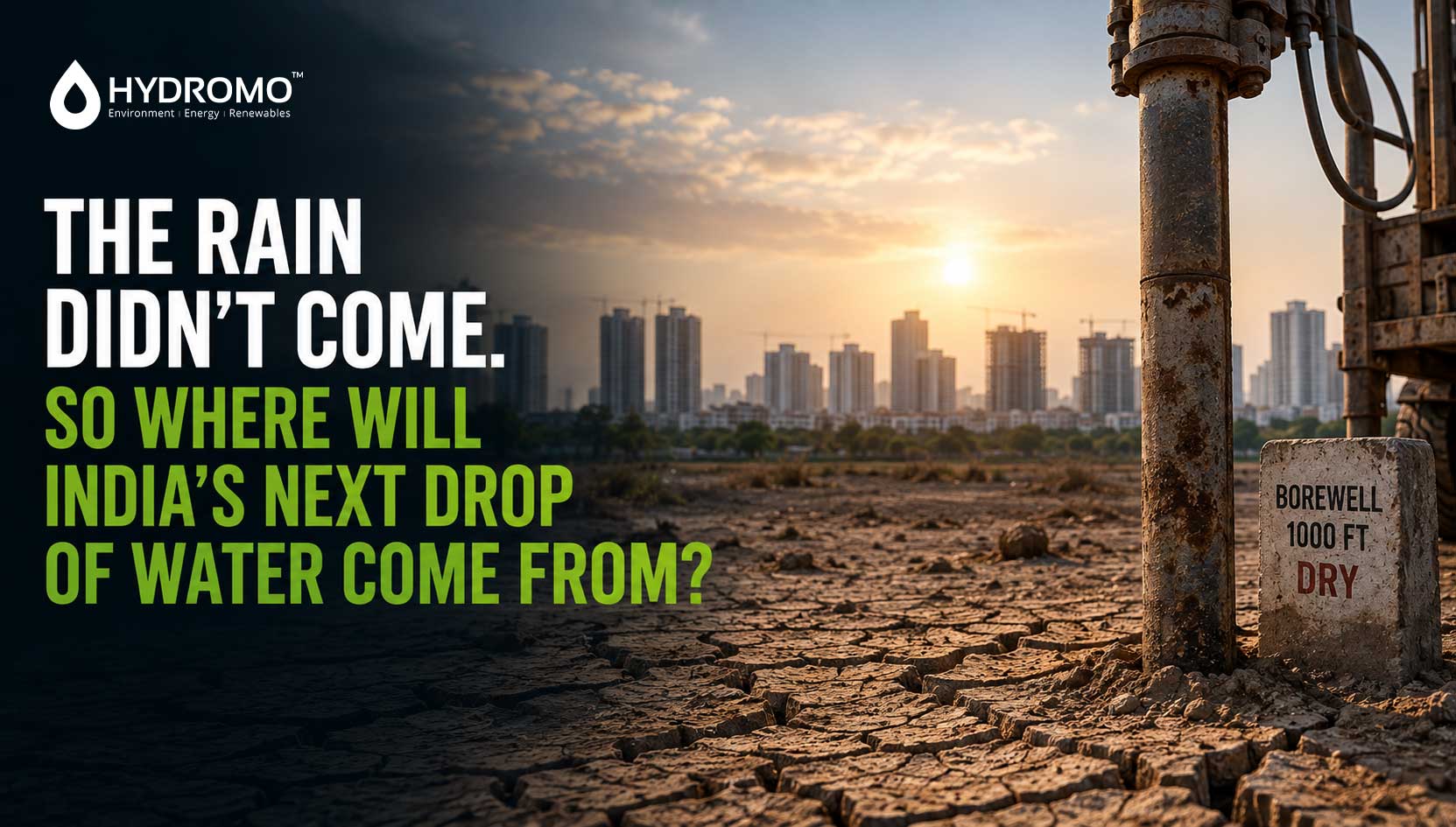
A borewell in Quthbullapur used to hit water at 300 feet. This year, drilling rigs went past 1,000 feet and came up dry. That single fact tells you more about India’s water problem than any rainfall statistic can.
For years, the conversation around water in India has circled back to one question: will the monsoon be good this year? This season, the answer arrived early, and it wasn’t reassuring. By mid-June, rainfall across the country was running 42 to 43 percent below normal, the weakest start to the season in over a decade. The India Meteorological Department trimmed its full-season forecast to around 90 percent of the long-period average, placing the season in the “below-normal” category. By the end of July, the national deficit still stood near 16 percent, with more than half of India’s districts recorded as rainfall-deficient even as a few pockets flooded from short, intense downpours.
That contradiction, floods in one district, drought in the next, is the real story. India isn’t simply short on rain. It’s short on rain that falls where and when it’s needed, in a form the ground can actually absorb.
Groundwater was never a savings account.
Most Indian households and businesses don’t wait for the monsoon to fail before reacting. They already have a backup plan: drill deeper. That backup plan is what’s collapsing.
The Central Ground Water Board’s own assessment found that of the roughly 712 districts it monitors, 102 are extracting groundwater faster than it can recharge, and 32 of those have effectively zero water left for future use. Groundwater still supplies about 70 percent of everything India draws for irrigation, industry, and drinking combined, which means when a district runs out, there isn’t a quick substitute waiting in the wings.
Hyderabad is a case study in real time, not a future projection. Telangana’s Groundwater Department has confirmed that 70 percent of the city is now over-exploiting its aquifer, and in 11 of its 16 mandals, extraction runs between 100 and 177 percent of what’s actually available. In Kondapur, Madhapur, Gachibowli, Kukatpally, and Serilingampally, borewells that once drew water from 300–500 feet now come up empty past 1,000 feet, and some households are drilling to 2,000 feet just to keep a supply running. Around 12,000 apartment borewells across the city failed this year, roughly three times the number that failed last year. On a single day in May, the city logged more than 15,000 tanker bookings.
Even a stronger monsoon can’t undo that in one season. Officials tracking northeastern Hyderabad this year found the weak rains added barely 0.35 to 3 meters to the water table, a fraction of what’s been pumped out. Groundwater doesn’t behave like a tank that refills every June. It behaves like a bank account that’s been overdrawn for two decades, and one good deposit doesn’t clear the debt.
The question worth asking isn’t “When will it rain?”
It’s “Where is the water actually coming from right now, and is that source going to last?” For most cities, the honest answer is whatever’s left underground, plus tankers, plus whatever gets wasted the moment it does rain.
That third point matters more than it gets credit for. When Hyderabad does get a downpour, most of it runs straight into stormwater drains within hours. High-rise construction across the city has paved over exactly the surfaces that used to let water soak back into the aquifer. So the city ends up in the strange position of flooding one week and running dry the next, the same pattern showing up nationally in this year’s monsoon data.
This is where the fix stops being about praying for better rain and starts being about designing better systems around whatever rain does arrive and reusing the water that’s already inside a building instead of sending it down a drain after a single use.
What actually replaces a failing monsoon?
There’s no single technology that solves this. It’s a combination of capturing what falls, cleaning what’s already used, and cutting the amount pulled from the ground in the first place.
Rainwater harvesting is connected to recharge, not just storage. A rooftop harvesting tank that fills up and overflows during a storm isn’t solving anything; it’s just delaying the runoff by a few hours. The systems that actually help are designed to route surplus water into recharge pits and structures that put it back into the aquifer nearby, so the next borewell down the street benefits too. For apartment complexes and industrial campuses in Hyderabad, this is often the single highest-impact retrofit available, and it’s far cheaper than drilling a new 1,000-foot borewell that may run dry in two years anyway.
Sewage treatment plants that produce water good enough to reuse. Every apartment complex, hospital, and hotel generates wastewater every single day, rain or no rain. A well-run STP can turn that into water fit for gardens, flushing, and cooling towers, cutting fresh groundwater demand by 30 to 50 percent in many residential and commercial buildings, depending on how the recycled water is routed back into daily use. Unlike rainfall, this source is available 365 days a year.
RO and water treatment matched what’s actually coming out of the ground. As borewells go deeper, the water pulled up often carries more dissolved salts, fluoride, or hardness than shallower sources used to. A commercial RO plant sized for today’s feed-water quality, not the quality from five years ago, prevents a second failure: equipment scaling, pipe corrosion, and water that’s technically available but not safe or usable.
Zero Liquid Discharge for Industry. Factories and processing units that treat, recycle, and reuse their process water internally aren’t dependent on the same shrinking groundwater pool as the residential blocks around them. In water-stressed industrial belts, this isn’t an environmental nice-to-have anymore; it’s what keeps a production line running when the local water table drops below the intake point.
A water audit before any of the above. Most buildings don’t actually know where their water goes. A proper audit, checking borewell yield, tanker dependency, per-person consumption, and recycling potential, usually finds 15 to 25 percent of water use that can be cut or substituted with recycled water before a single new pipe gets laid.
None of these are exotic. What’s missing in most buildings isn’t the technology; it’s the decision to install it before the borewell runs dry, not after.
What this means for the months ahead
If this year’s monsoon pattern repeats, and IMD’s own outlook suggests below-normal rainfall is now a recurring category rather than an exception, the cities and buildings that treated water recycling and rainwater recharge as optional will be the ones queuing for tankers again next summer. The ones that built a closed loop between rainfall, wastewater, and reuse will feel the deficit less each time.
If you’re responsible for a building, a plant, or a campus in Hyderabad or anywhere in Telangana right now, the practical next step isn’t to wait for a better forecast. It’s to get a water audit done before peak summer demand hits so you know exactly how much of your current groundwater use could be replaced by recycled or harvested water and how much a failed borewell is actually going to cost you if you wait.
Book a free water audit and find out exactly how much of your building’s groundwater use can be replaced with recycled or harvested water before summer demand peaks.
FAQ Section
Q1. Why is India’s groundwater running out even in years with normal rainfall?
Groundwater depletion builds up over decades of extraction outpacing recharge. Even a normal monsoon adds back only a fraction of what’s pumped out annually, especially in cities where concrete surfaces block natural recharge. A single good rainy season doesn’t reverse years of overdraft.
Q2. Is rainwater harvesting still worth it if the monsoon is weak?
Yes, a weak monsoon makes every drop that does fall more valuable, not less. Harvesting systems connected to recharge pits capture short, intense downpours (which is exactly the pattern this year’s monsoon has shown) before they run off into drains.
Q3. How much water can a sewage treatment plant actually save for an apartment or hotel?
Depending on how recycled water is routed back into flushing, gardening, and cooling use, buildings typically cut fresh groundwater demand by 30 to 50 percent. It’s also a source that doesn’t depend on rainfall at all.
Q4. My borewell water quality has changed; is that linked to the water crisis?
Yes. As water tables drop, borewells often draw from deeper, harder, or more mineral-laden layers. This is a common sign of aquifer stress and usually means the RO or treatment system in place needs to be re-evaluated for the new feed-water quality.
Q5. What’s the first step for a building or industry facing a water shortage?
A water audit. It identifies exactly how much water is used, where it’s wasted, and how much could be replaced through recycling or harvesting before committing to a new borewell or a larger tanker contract.