
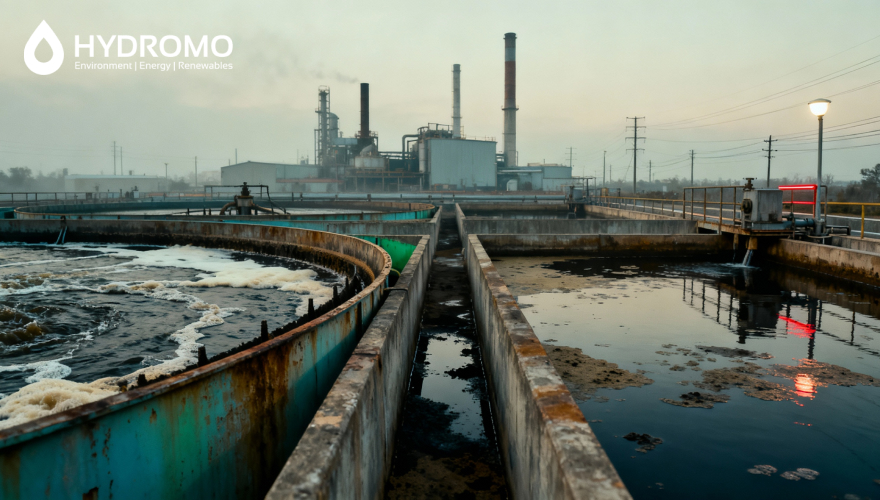
The treatment systems of about 83% of industrial wastewater in India use outdated infrastructure, power interruptions, poor maintenance and the failure to treat complex effluents, which can lead to poor performance.
This translates to low treatment efficiency, non-compliance with regulations and expensive operation costs.
India produces 15,000+ MLD of industrial wastewater, and only a fraction (some 30 percent) of this is actually treated, and this amounts to system inefficiency as a country environmental and business risk.
What Are the Major Causes of the Industrial Wastewater System Failure?
Infrastructure of outdated Treatment.
The majority of ETPs have been configured to handle simpler effluents and are incapable of handling:
- Large BOD/COD loads (of up to 150,000 ppm in food and beverage industries)
- Toxic heavy metals, oils and organic toxins.
- Highly variable flow rates
Power Supply Instability
Power interruptions are experienced in 70% industries.
Industrial belt treatment uptime is reduced by 30-40% such as Telangana.
There are unending biological processes that cannot work with a high frequency of shutdowns.
- Maintenance deficiencies and Skills deficiencies.
- Poor training of operators.
- Irregular sludge removal
- The systems operate at only 20-30% design capacity.
Why Conventional Treatment Systems Fail in India
- 60% of activated sludge plants fail under variable hydraulic and organic loads
- Toxic effluents inhibit biological treatment in over 50% of chemical industries
- High energy demand (0.5–1 kWh/m³) increases operating costs
- Sludge disposal adds a significant financial burden
What Is the Impact of Underperforming Wastewater Systems?
- Daily losses of ₹10,000–₹50,000 due to fines, shutdowns, and production delays
- Increased environmental damage and groundwater contamination
- Inability to reuse treated water in water-scarce regions
- Rising non-compliance with CPCB and SPCB norms
What Can Be Done?
Best Practice Solutions to Enhance Performance.
– Deals with changes in loading and enhances resilience without complete replacement of plants.
High-tech hybrid technologies (anaerobic + membranes).
– Decrease sludge, save 30-50% of energy, increase the quality of effluent.
Automated and real-time observation.
– Improves the use of plants to 90%+.
– Reduces the possibility of human error and compliance.
Training of the operators and optimization of processes.
– 75 percent better regulatory compliance.
What does Hydromo do to improve the performance of industrial wastewater?
Hydromo offers tailored and high-efficiency industrial wastewater treatment that is optimised to meet the Indian operating conditions.
Hydromo systems deliver:
- 95%+ treatment efficiency
- Low energy consumption
- Minimal sludge generation
- Reuse-ready treated water
- Full CPCB compliance
The modular designs of Hydromo also have a high degree of automation to guarantee long-term in much of the high-load and unpredictable power conditions, such as those found within the industrial clusters of Hyderabad.
FAQ
1. How many wastewater systems in industries perform poorly in India?
About 83% of industrial wastewater treatment systems of wastewater are not in optimal capacity.
2. Why are the majority of ETPs poor performers?
This is because of the outdated designs, interruptions in power, poor maintenance, and the complicated nature of effluents.
3. Is it possible to upgrade the old wastewater treatment plants?
Yes. Retrofits can be done in a modular way, be automated, and technologically enhanced to recover efficiency without necessarily replacing them.
4. What is the amount of energy used in the treatment of industrial wastewater?
The regular systems use 0.5-1 kWh/m3 which can be lowered as a result of the modern technologies by 30-50% of the previous consumption.
5. Is industrial wastewater that can be reused?
Yes. Using sophisticated treatment, wastewater can be re-used to cool, flush, landscape and also process requirements.