
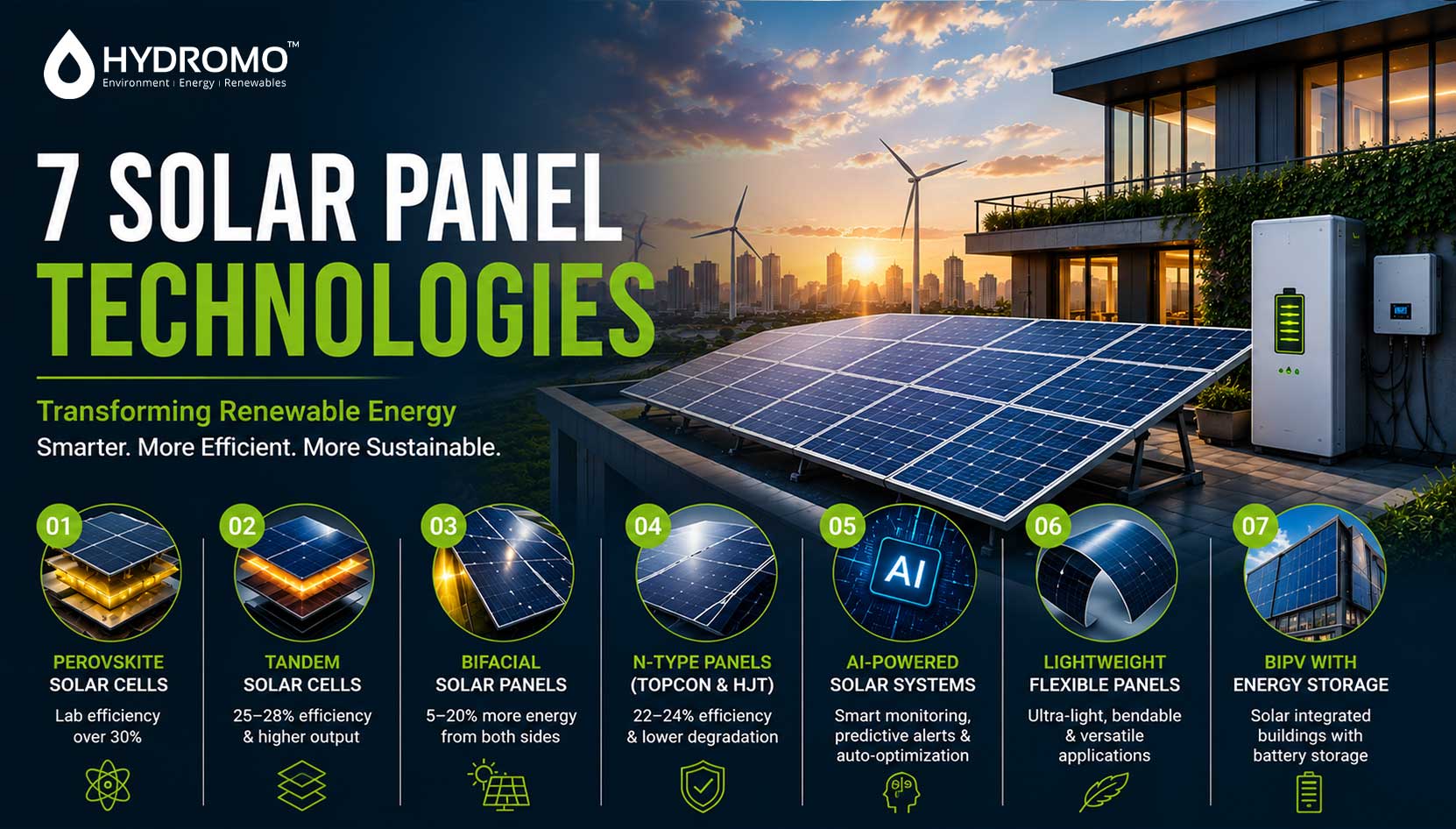
Most “top solar technologies” lists mix lab records with what you can actually install this year. That gap matters if you’re planning a commercial rooftop system or a ground-mount project—so here’s the version with the lab-vs-real split, the pricing, and the installation conditions that decide whether a technology pays off.
1. Perovskite Solar Cells: Impressive, But Not Installable Yet
Perovskite gets called the future of solar for good reason. LONGi’s perovskite-silicon tandem cell hit an NREL-certified 34.85% efficiency in lab testing, and Oxford PV has shipped commercial modules at 24.5% to early customers. That’s real progress, not hype.
What most articles skip: you cannot buy a perovskite panel for your home right now. The barrier isn’t manufacturing—it’s heat. Above roughly 85°C, which a rooftop panel in Rajasthan or Telangana reaches easily in summer, the perovskite layer degrades. Full IEC certification and bankable field data for commercial modules are expected between 2026 and 2028. If someone quotes you a “perovskite panel” for residential installation today, ask which certification it’s passed.
2. Tandem Cells: The Realistic Near-Term Winner
Tandem cells pair perovskite with silicon so the silicon layer carries the proven reliability while perovskite adds efficiency on top. This combination—not standalone perovskite—is what manufacturers like Trinasolar, JinkoSolar, and LONGi are racing to scale for utility projects. For India’s PLI-driven manufacturing base, the real decision point over the next five years is whether domestic plants add tandem capacity or keep importing it after 2030.
3. Bifacial Panels: Gains Depend Entirely on Where You Put Them
Bifacial modules capture light on both faces, but the “10–30% more energy” number thrown around online only applies under specific conditions. Here’s what actually drives the gain:
- Dark rooftop tiles: 3–6% gain—often not worth the price premium
- White or reflective rooftop membrane: 8–12%
- Ground-mount on light sand or gravel: 12–18%
- Elevated ground-mount over snow or high-albedo surfaces: 20–30%
Mounting height matters as much as the surface. Panels need at least 0.5–1 meter of clearance for the rear cells to catch meaningful reflected light. Field data from ground-mount projects in Rajasthan, Gujarat, and Tamil Nadu consistently lands in the 10–20% range once that clearance is done right—skip it, and you’re paying a premium for a gain you won’t see. For a sense of what this looks like at scale, our breakdown of 1 MW solar power plant cost and ROI walks through the numbers for a ground-mount project sized for factories and large commercial sites.
4. N-Type TOPCon and HJT: The Current Workhorse
TOPCon and HJT panels are what most serious commercial installers are actually specifying in 2026, not perovskite. TOPCon’s lower temperature coefficient (around -0.30%/°C) means it loses less output as rooftop temperatures climb through an Indian summer, and HJT pushes degradation down to roughly 0.25% a year—the lowest of any commercially available technology. For a 25-year system, that difference compounds into a meaningful gap in lifetime energy versus older P-type panels. This is the technology mix behind most of our commercial solar installations in Hyderabad and Andhra Pradesh, where summer roof temperatures make the coefficient difference measurable on the electricity bill.
5. AI-Managed Solar Systems
AI layered onto an existing solar array handles fault detection, predictive maintenance alerts, and automated tilt or tracker adjustment. For commercial and industrial sites running multiple arrays, this shows up as fewer unplanned outages and 10–15% better operational efficiency—not from a smarter panel, but from catching a failing string or a soiling issue before it costs a month of output.
6. Flexible Thin-Film Panels: Right Tool, Narrow Job
CIGS thin-film panels reach 15–20% efficiency at a fraction of the weight of rigid monocrystalline modules—a real advantage for EV integration, curved rooftops, and portable kits where structural load is the constraint, not efficiency. The trade-off worth knowing before you buy: flexible CIGS panels typically carry 5–10 year warranties, compared to 25 years on a standard rigid module. They’re built for mobile and temporary use, not as a rooftop replacement. If EV charging infrastructure is the actual project, it’s worth reading alongside our EV charging station cost breakdown for India and our DC fast charger lineup, since the charger spec matters more than the panel type here.
7. BIPV with Integrated Storage
Solar glass, façade panels, and window integration let a building generate power without a visible panel array—increasingly relevant for architects targeting net-zero certification. Paired with battery storage, this turns the building envelope itself into generation and storage infrastructure, though system design is highly project-specific and priced individually rather than per-watt.
Where This Leaves You in 2026
If you’re buying today, TOPCon or HJT for rooftops and bifacial for ground-mount are the technologies with proven field data and available financing. Perovskite and tandem cells are worth watching for 2027 onward, not for this year’s installation. Not sure which fits your site? Request a free solar site assessment from Hydromo and we’ll match the panel technology to your roof, load, and budget instead of the other way around.
FAQs
Can I actually buy a perovskite solar panel in India right now?
No. As of 2026, perovskite panels aren’t sold through standard residential or commercial channels in India. Oxford PV has shipped limited commercial tandem modules to select overseas customers, but full certification and bankable field data for mass deployment are expected between 2026 and 2028.
Is a bifacial worth the extra cost on a normal home rooftop?
Usually not, unless your roof has a light-colored or reflective surface with real mounting clearance. On dark rooftop tiles, gains run 3–6%, which rarely covers the price premium. Ground-mount projects on gravel or sand see 12–18% and pay back faster.
Which panel handles Indian summer heat best—TOPCon or HJT?
Both outperform older P-type panels, but HJT has the lower degradation rate over time (~0.25% a year vs. TOPCon’s ~0.4%). TOPCon is currently cheaper and more widely available from ALMM-listed Indian manufacturers.
Do flexible solar panels work as a rooftop replacement?
No—they’re built for weight-constrained or curved surfaces like EVs, boats, and portable kits. Warranties reflect that 5–10 years on flexible CIGS versus 25 years on a standard rigid module.
Will perovskite panels make my current TOPCon or bifacial system obsolete?
Not for years. Tandem perovskite-silicon cells are the more likely near-term commercial product, and even those are only just reaching early commercial shipment. A system installed today will likely finish its usable life before perovskite becomes a mainstream rooftop option.
What actually determines bifacial gain—the panel or the installation?
The installation. Mounting height and ground albedo (reflectivity) matter more than the panel spec sheet. The same bifacial module can produce a 5% gain or a 20% gain depending purely on what’s underneath it and how high it sits.